"Kamala Says": The Most Memorable, Mocked, and Viral Quotes from Kamala Harris
Few American politicians have generated such a dedicated cottage industry of meme-makers, late-night comedians, and political opposition researchers as Kamala Harris. As U.S. Senator from California, then as Vice President, and now as a continuing force in Democratic politics heading toward a potential 2028 presidential run, Harris has delivered a series of statements that — regardless of their intended meaning — struck audiences as uniquely confusing, circular, or simply strange. Some quotes became genuine viral phenomena, inspiring their own Wikipedia pages. Others were seized upon by political opponents to paint a portrait of rhetorical incoherence. Still others were simply misquoted, fabricated entirely, or ripped from context so thoroughly that the original meaning was lost.
This article examines the real record — the verbatim, verified, and documented statements that earned Harris her reputation as the reigning queen of what critics call the "word salad." It also examines the cultural response these quotes generated, and what they reveal about how American politics consumes political speech in the age of social media.
The Coconut Tree: Anatomy of a Viral Moment
No single utterance has done more for Kamala Harris's internet footprint — both critically and, later, affectionately — than what is now known simply as "the coconut tree quote."
On May 10, 2023, Harris delivered remarks at the swearing-in ceremony for the White House Initiative on Advancing Educational Equity, Excellence, and Economic Opportunity for Hispanics, held in the Indian Treaty Room of the Eisenhower Executive Office Building. The topic was educational equity. Near the end of her speech, Harris pivoted to a personal anecdote about her mother:
"My mother used to — she would give us a hard time sometimes, and she would say to us, 'I don't know what's wrong with you young people. You think you just fell out of a coconut tree?' You exist in the context of all in which you live and what came before you."
The intended message was clear enough in context: students succeed or struggle within the broader ecosystems of family, community, and historical circumstance — they do not arrive in a vacuum. The coconut tree metaphor (a child who thinks they fell from one, rather than grew within a world that shaped them) was her mother's way of demanding humility and contextual awareness.
But the clip, isolated from its context, hit the internet like a coconut falling from a very tall tree. The abrupt tonal shift from policy speech to informal maternal anecdote, combined with the phrase's inherent absurdity when excerpted, made it instantly shareable. It sat dormant for over a year.
Then, in July 2024, when President Joe Biden announced he would not seek re-election and endorsed Harris, the clip went nuclear. Within days, "coconut tree" became the shorthand for the entire Harris campaign aesthetic — half-serious policy ambition wrapped in an oddly endearing tendency toward strange rhetorical detours. Coconut and tree emojis flooded social media timelines. Supporters embraced it as a rallying symbol; critics cited it as evidence of incoherence. The quote earned its own Wikipedia article, one of very few quotes from any American politician to receive that distinction.
Harris herself eventually acknowledged the phenomenon. At a December 2024 event, she nodded to the coconut tree meme, cementing its place in the cultural record.
The Significance of the Significance of the Passage of Time
If the coconut tree quote became a meme because of its charm, the "significance of the passage of time" quote became infamous for an entirely different reason: it appeared to say absolutely nothing at all, repeatedly.
In March 2022, Harris traveled to Louisiana to promote the Biden administration's rural broadband initiative. During her remarks, she managed to use the phrase "significance of the passage of time" four times in a very short stretch of speech:
"The Governor and I and we were all doing a tour of the library here and talking about the significance of the passage of time, right?... So when you think about it, there is great significance to the passage of time in terms of what we need to do to lay these wires, what we need to do to create these jobs. And there is such great significance to the passage of time when we think about a day in the life of our children..."
Former House Speaker Newt Gingrich went on Fox News and described the speech as a "total humiliation." Critics across the political spectrum raised their eyebrows. The repetition of the phrase without meaningfully developing what "the significance" actually was — what insight about broadband or education was specifically tied to the passage of time — left audiences genuinely puzzled.
Defenders argued that Harris was making a legitimate (if clumsily expressed) point: that infrastructure investment, broadband access, and educational opportunity compound over time, and that delay has real costs for children. The passage of time is significant in that frame. But the manner in which the thought was articulated — cycling the phrase without resolution — became a template for what critics and satirists began calling her "word salads."
Unburdened by What Has Been (And When It Was Said)
Perhaps Harris's most philosophically ambitious recurring phrase is her mantra: "what can be, unburdened by what has been."
The phrase first appeared publicly on January 21, 2019, when Harris announced her presidential campaign at Frank Ogawa Plaza in Oakland, California:
"We are unburdened by what has been — and inspired by what can be."
She returned to it repeatedly. In 2020, during the Biden-Harris campaign, she tweeted: "When young children see someone who looks like them running for office, they see themselves and what they can be, unburdened by what has been." It became a staple of her stump speeches and, eventually, her 2024 presidential campaign.
Philosophically, the phrase draws on a recognizable tradition in progressive politics: the idea that structural change requires the imagination to envision futures not constrained by present or historical arrangements. Think of it as a political version of beginner's mind.
But the phrase also generated backlash precisely because of how often it was deployed — often without concrete policy specifics attached to it. Critics noted that the formulation could be used to justify almost anything or nothing at all. The satirical site The Federalist ran a piece presenting Harris quotes formatted as motivational posters, with "Unburdened by what has been" occupying the same aesthetic space as a sunset stock photo. Mediaite documented how Harris simply refused to stop using it even as it became widely mocked.
Still, it is one of her genuinely authored philosophical anchors — not a verbal stumble, but a deliberate rhetorical choice that divided audiences between those who found it aspirational and those who found it empty.
Who Doesn't Love a Yellow School Bus?
In 2022, Harris promoted the Biden administration's investment in electric school buses. The policy context was entirely reasonable — the Environmental Protection Agency had allocated billions to replace diesel school buses with electric ones, reducing children's exposure to harmful exhaust fumes. What became memorable was not the policy, but the delivery.
During appearances in Seattle and elsewhere, Harris asked audiences a rhetorical question that somehow became more famous than the underlying policy:
"Who doesn't love a yellow school bus? Can you raise your hand if you love a yellow school bus? Many of us went to school on the yellow school bus, right? And it's part of our experience growing up. It's part of a nostalgia and a member of the excitement and joy of going to school to be with your favorite teacher, to be with your best friends, and to learn. The school bus takes us there."
The quote was genuine and documented, captured on C-SPAN and widely reported. Critics on social media reacted with a mix of bewilderment and delight. Fox News ran segments asking whether Harris could be allowed to speak in public. Supporters argued — reasonably — that there was nothing wrong with building public enthusiasm for a policy by appealing to shared childhood memories.
What made it odd was not that she mentioned yellow school buses — it was the extended meditation on their nostalgic significance, delivered with apparent earnestness, that left audiences uncertain whether they were watching policy communication or something else entirely. The moment also became notable as one of Harris's recurring rhetorical tics: beginning with an extremely simple observation and then describing it with more words than seemed necessary.
This pattern — circling the obvious — became the defining critique of her communication style.
The COVID Tautology: Time for What We've Been Doing
In January 2022, NBC News anchor Craig Melvin asked Vice President Harris a direct question: should the Biden administration change its COVID-19 strategy?
Her response became one of the most frequently cited examples of circular reasoning in modern political speech:
"It is time for us to do what we have been doing. And that time is every day. Every day it is time for us to agree that there are things and tools that are available to us to slow this thing down."
It is worth reading that twice. The statement essentially defined the present moment as the time to continue doing the present thing. Critics, including many who were not partisan opponents, noted that this did not actually address the question of whether any adjustment to strategy was warranted.
The quote was verified and undisputed. It became a touchstone for arguments that Harris struggled to think on her feet in unscripted settings, or alternatively, that she was deliberately non-committal on a politically sensitive question about the administration's pandemic management.
The Venn Diagram Enthusiasm
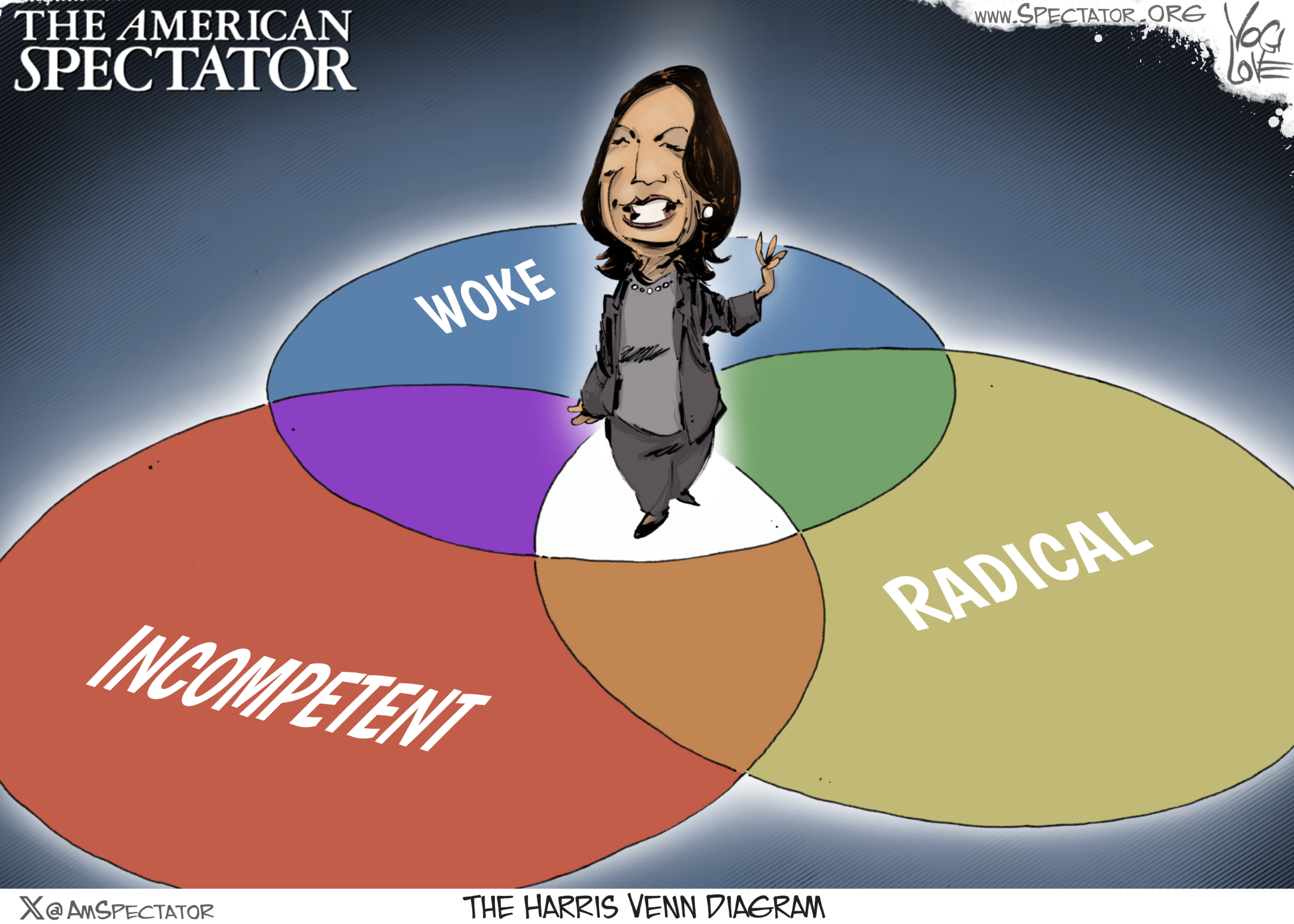
Less famous than some of her other verbal detours but equally beloved by connoisseurs of political oddity is Harris's documented affection for Venn diagrams.
On multiple occasions, Harris has expressed what can only be described as genuine enthusiasm for this basic statistical visualization tool. Critics catalogued her fondness for invoking Venn diagrams as metaphors for intersecting policy areas or social issues, often in contexts where other politicians might simply say "these issues overlap." The invocations were treated by detractors as evidence of a speaking style that reached for academic-sounding language without the underlying analytical rigor to back it up.
Whether or not that critique is fair, the Venn diagram became part of the informal Kamala Harris vocabulary — a shorthand in political commentary for her rhetorical habit of gesture toward intellectual framework while delivering content-thin results.
The Fake Quotes Problem: What She Did NOT Say
Any honest account of Kamala Harris's verbal legacy must grapple seriously with a parallel phenomenon: the large volume of quotes attributed to her that she never actually said.
Snopes has fact-checked and debunked at least 19 separate Harris quotes that were either entirely fabricated or heavily distorted from their original form. These have circulated widely on social media, sometimes garnering millions of impressions before corrections could reach a comparable audience.
The mechanism behind the fakes is instructive. Because Harris's actual verbal style — circular, often repetitive, sometimes apparently tautological — sounds unusual, fabricated quotes written in that same style are highly plausible to audiences primed to believe them. A fake Kamala Harris quote can be constructed simply by extending the "word salad" aesthetic in a new direction, and many readers have no way to distinguish it from the real thing.
This creates a politically significant problem. Critics can point to genuine, documented, fully verbatim quotes that are legitimately strange. But those genuine quotes exist in an information environment flooded with fakes. The authentic becomes indistinguishable from the manufactured, and vice versa.
For the purposes of this article, every quote cited above is verified and sourced. The coconut tree quote has its own Wikipedia page and was documented by NPR, CBS News, and The Washington Post. The passage of time remarks were broadcast on C-SPAN. The yellow school bus quotes were transcribed by E&E News and captured on multiple cameras. The COVID response quote was from a televised NBC interview.
2026: The Accent Controversy and the Return
Even in 2026, with the 2024 presidential election long decided, Harris remains a politically active figure and continues to attract rhetorical scrutiny.
In September 2026, Harris appeared at a Detroit NAACP rally to campaign for Democratic U.S. Senate candidate Abdul El-Sayed ahead of the midterms. The event generated renewed attention — not primarily for policy content, but because critics alleged she had adopted a noticeably different accent while addressing the predominantly Black audience, a charge that had also been leveled during her 2024 campaign.
At the same event, Harris made remarks linking attacks on DEI (diversity, equity, and inclusion) to attacks on maternal care, saying "an attack on DEI is an attack on maternal care." She also offered what became a characteristically quotable line:
"Shirley Chisholm talked about it. If you're not at the table, bring a folding chair. Otherwise, you might be on the menu."
Separately, she was quoted as saying: "It's OK to not be in love with a candidate. It's OK to vote and ask everybody else to vote, because this choice is better than that one."
The accent criticism revived a long-running debate about code-switching — the practice, common across many communities, of modulating speech patterns depending on one's audience. Harris has navigated this controversy before, and her defenders argue that code-switching is a normal and culturally common practice, not a form of inauthenticity. Critics contend that in a politician of Harris's national profile, it reads as performative.
Whether or not a potential 2028 presidential campaign materializes, the Detroit appearance confirmed that Harris remains a lighting-rod figure whose every public utterance is subject to microscopic analysis.
Why Do These Quotes Matter? The Communication Style Debate
It is worth stepping back from the individual quotes to consider what, if anything, they collectively reveal.
Defenders of Harris frequently point out that many of the criticized passages, when read in full context, were not actually as meaningless as they appeared in isolation. The coconut tree had a clear context. The passage of time had a point. The yellow school bus was a populist rhetorical bridge from policy to personal memory. Even "unburdened by what has been," dismissed as vacuous by critics, has a traceable philosophical lineage and a coherent meaning.
The critique, however, is less about whether individual passages have meanings that can be reverse-engineered with enough context, and more about whether they communicate those meanings efficiently and compellingly. A politician's job is to move audiences — to explain, persuade, inspire. When a significant portion of the audience consistently walks away confused, that is a functional communication failure regardless of whether a determined analyst can reconstruct the intended message.
The Independent's coverage framed the debate precisely this way: are these soundbites taken out of context, or evidence of genuine ineptitude as a public communicator? The answer appears to be: sometimes one, sometimes the other, and the distinction matters.
There is also a documented tendency in Harris's speaking style — observed across multiple years and contexts — toward repetition and circularity. The passages of time speech was not a one-off. The word-salad criticism was not manufactured by a single political attack ad. It was repeated often enough, across enough different venues and topics, that it became a recognizable pattern.
The Meme Economy and Political Communication
One of the most interesting aspects of the Kamala Harris quote phenomenon is how it was absorbed by internet culture — and how that absorption shifted depending on the political moment.
Prior to July 2024, the viral clips existed primarily as material for critics. After Biden withdrew and Harris became the presumptive Democratic nominee, many of the same clips underwent a remarkable reinterpretation. As The Washington Post reported, clips previously used to mock her were being repurposed as signs of her relatability. Young voters on TikTok and Instagram embraced the coconut tree not as evidence of verbal chaos but as proof of a politician willing to be genuinely themselves — strange, funny, human.
The "brat summer" phenomenon of 2024 — the music-driven cultural moment associated with pop star Charli XCX — briefly overlapped with the Harris campaign, with the candidate's team embracing online culture in ways that felt generationally specific. The word salads, in this frame, became endearing quirks rather than disqualifying gaffes.
The election result in November 2024 suggests that this cultural reinterpretation — however genuine — was insufficient to overcome other political headwinds. But the dual reading of Harris's most famous quotes (absurd failure of communication vs. relatable, unfiltered humanity) reflects a genuine ambiguity in how Americans process political language in the social media era.
The Record, Plainly Stated
For the sake of clarity and accountability, here is a concise compilation of verified Harris quotes that generated significant public attention, with dates and contexts:
January 21, 2019 — Oakland presidential campaign announcement: > "We are unburdened by what has been — and inspired by what can be."
January 2022 — NBC interview on COVID strategy: > "It is time for us to do what we have been doing. And that time is every day."
March 2022 — Louisiana broadband event: > "There is great significance to the passage of time in terms of what we need to do to lay these wires..." (phrase repeated four times)
2022 — Seattle school bus event: > "Who doesn't love a yellow school bus? Can you raise your hand if you love a yellow school bus?"
May 10, 2023 — White House education equity ceremony: > "You think you just fell out of a coconut tree? You exist in the context of all in which you live and what came before you."
2024 presidential campaign (multiple occasions): > "What can be, unburdened by what has been."
September 2026 — Detroit NAACP event: > "An attack on DEI is an attack on maternal care."
Conclusion
Kamala Harris occupies a genuinely unusual place in the annals of American political rhetoric. She is a figure whose real, documented, verbatim statements have become viral cultural artifacts — some beloved, some ridiculed, many both simultaneously. The coconut tree quote has a Wikipedia page. The passage of time speech is a fixture of conservative attack ad compilations. The yellow school bus has become a kind of Rorschach test: ask someone what they think of it, and their answer tells you something about their priors more than about the quote itself.
What the record shows clearly is that Harris's communication style — circular at times, repetitive at others, and occasionally reaching for profundity in ways that land as platitude — has been a consistent element of her public profile across years and contexts. It is equally clear that a significant number of quotes attributed to her online are fabrications, and that the genuine and the invented exist in a polluted information environment that serves no one well.
As she continues to campaign in 2026 and potentially positions herself for 2028, the question of whether her communication style evolves — or whether she doubles down on the unburdened-by-what-has-been brand — will be watched closely. Whatever happens, the coconut tree is not going anywhere.
Sources:
- Kamala Harris' awkward quotes turned into internet memes — The Washington Post
- You think you just fell out of a coconut tree? — Wikipedia
- The Kamala Harris coconut tree meme, explained — NPR
- Kamala Harris' viral 'Coconut Tree' quote, explained — Forbes
- What to know about Kamala Harris' viral coconut tree meme — CBS News
- Harris Roasted for Rambling About the 'Significance of the Passage of Time' — IJR
- Kamala Harris mocked for gushing over a 'yellow school bus' — Fox News
- VP Harris: 'Who doesn't love a yellow school bus?' — E&E News / Politico
- 19 Kamala Harris quotes we've examined that were made-up or misrepresented — Snopes
- Kamala Harris — Wikiquote
- Public image of Kamala Harris — Wikipedia
- More Kamala Harris Remarks at NAACP Event Have Everyone Talking — RedState
- Kamala Harris' Public Speaking Gaffes — The Independent
- Kamala Harris 'word salads' defended on 'The View' — Fox News
- 'Unburdened by what has been': Harris's go-to phrase — YouTube/Mediaite