The Guitar That May Be Cursed: Joe Bonamassa and the 1960 Gibson Les Paul Standard "Bolin 'Burst"
Few objects in the world of rock guitar carry the weight of a story as layered, strange, and genuinely haunting as a sunburst Les Paul that spent nearly six decades quietly accruing history. It was photographed in black and white, spotted under stage lights in small Colorado clubs, wielded across two coasts by one of the most gifted guitarists of the 1970s, and ultimately tracked down in a desert Utah town by one of the most obsessive guitar collectors alive. Along the way, it passed through the hands of a man who never really owned it, was owned for decades by a man almost nobody knew about, and was finally purchased in a cash deal that ended in tragedy two months after the ink dried.
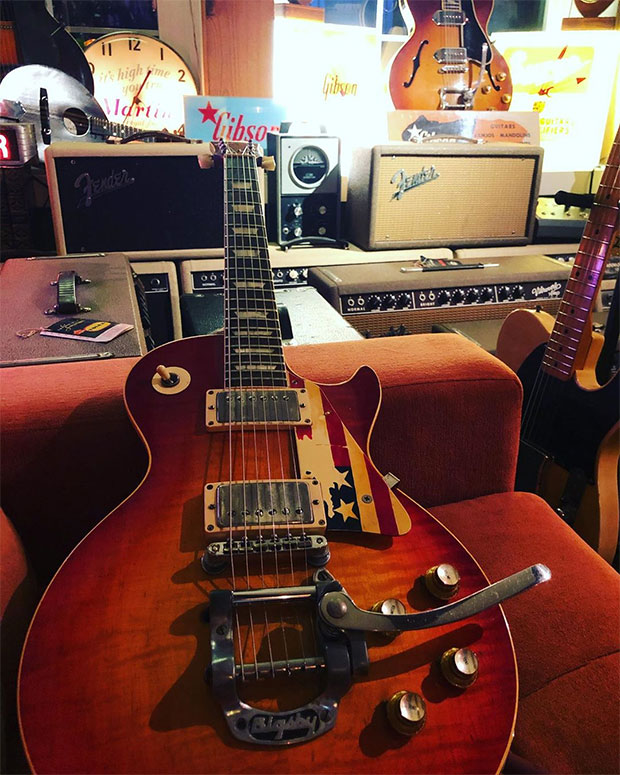
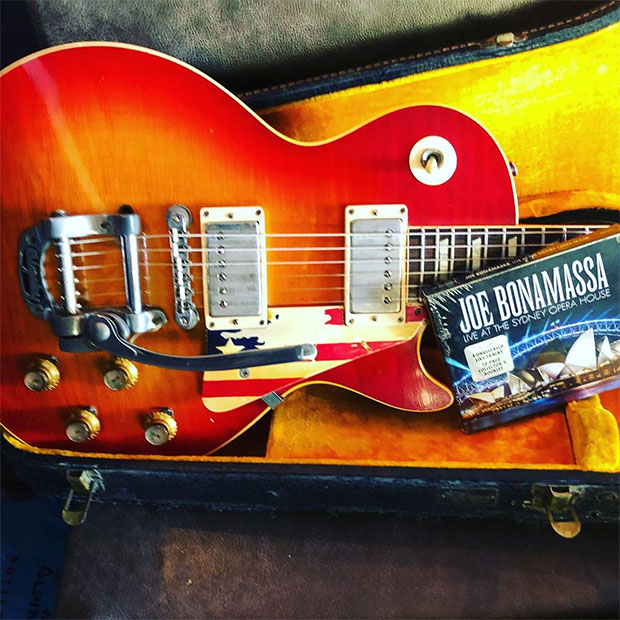
The guitar is the 1960 Gibson Les Paul Standard now known as the Bolin 'Burst. It belongs to Joe Bonamassa. It lives in Nerdville, his Los Angeles home-turned-museum, alongside approximately 400 other instruments. And the story of how it got there is one of the most extraordinary provenance tales in the history of the vintage guitar market — a market that, itself, is already rich with extraordinary stories.
The Instrument: Understanding What a 1960 'Burst Actually Is
To understand why this guitar matters — why it was worth a decade of research, cross-country tracking, and a cash deal arranged in Moab, Utah — you first have to understand what a 1960 Gibson Les Paul Standard is, and why collectors treat these instruments with something closer to reverence than commerce.
Between 1958 and 1960, Gibson produced its Les Paul Standard in a sunburst finish: a warm amber center bleeding outward into cherry red or dark brown at the edges, applied over a hand-carved maple top that sat atop a mahogany body. The pickups were PAF humbuckers — "Patent Applied For" humbuckers, designed by Seth Lover — which produced a warm, thick, harmonically rich tone that players and engineers have spent the ensuing decades trying to replicate. No one has fully succeeded.
Production numbers were strikingly low. In 1958, Gibson shipped approximately 434 Les Paul Standards. In 1959, that number climbed to roughly 643. In 1960, production reached approximately 635 units before Gibson discontinued the model entirely, replacing it with a sleeker double-cutaway body that would eventually become the SG. The Les Paul Standard would not return until 1968, when Eric Clapton's use of a vintage example with Cream ignited a firestorm of demand that has never cooled.
The guitars produced in those three years — universally called "Bursts" — are now considered among the most collectible and valuable production electric guitars ever made. A clean, original 1959 example regularly commands seven figures at auction. Even the 1960 models, which feature a somewhat thinner neck profile than the chunky 1959s (a characteristic some players actually prefer), trade at stratospheric prices. A 1960 Les Paul with documented provenance, significant history, and original hardware is not merely a guitar — it is a piece of cultural artifact as much as it is a musical instrument.
The Bolin 'Burst is all of that and more.
Tommy Bolin: The Prodigy Nobody Could Keep Up With
To fully appreciate what the guitar meant in Bonamassa's hands, and why he spent nearly a decade hunting it down, requires understanding the man most closely associated with it — and the tragic arc his life described.
Tommy Richard Bolin was born on August 1, 1951, in Sioux City, Iowa. He moved to Denver, Colorado, as a child and fell hard into music as a teenager, first as a drummer for a band called the Miserable Excuse before picking up the guitar and discovering his true instrument. He dropped out of high school and moved to Boulder to pursue music full time — a gamble that, by any measure, paid off.
Bolin's career was brief and, in retrospect, almost violently compressed. He seemed to absorb influences faster than most guitarists could process a single one: Jimi Hendrix, Eric Clapton, B.B. King, Wes Montgomery. He fused blues vocabulary with jazz harmony, hard rock energy with R&B feel, and a signature wah-wah technique that made his playing immediately identifiable. Critics and fellow musicians were struck by the range. He wasn't imitating anyone. He was synthesizing everything.
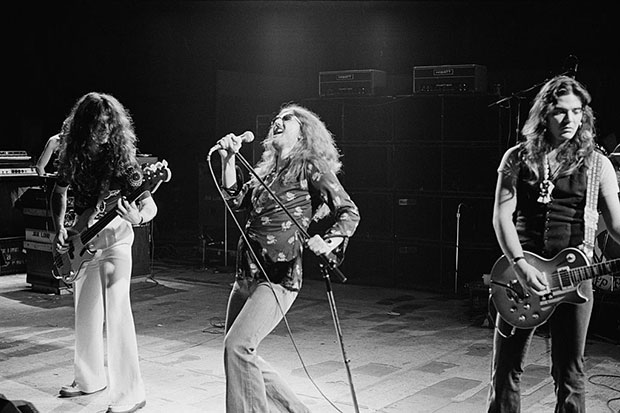
His first significant band was Zephyr, formed in Boulder in 1969. The group — featuring the powerhouse vocals of Candy Givens, her husband David Givens on bass, Bobby Berge on drums, and John Faris on keyboards — played a potent mix of psychedelic rock and blues rock, touring the western United States and building a passionate following in Colorado and California. Their 1969 self-titled album, produced by the Turtles' Howard Kaylan, captured a band still finding its footing, but Bolin's guitar work was already startling in its confidence.
After Zephyr dissolved in 1972, Bolin cycled through a band called Energy before his national breakthrough came at the 1970 Denver Pop Festival, where his performance announced him to a wider audience. The real career-defining moment came in 1973 when he replaced Joe Walsh in the James Gang — stepping into the shoes of a guitarist who had gone on to form the Eagles, no small act to follow. Bolin played with the James Gang for roughly two years, recording Bang and Miami with the band and firmly establishing himself as one of the era's premier rock guitarists.
In 1973, he also appeared on Spectrum, the landmark jazz fusion album by drummer Billy Cobham, where his solos on tracks like "Stratus" and "Quadrant 4" drew comparisons to the finest jazz-rock guitar work of the period. Bolin could do anything with a guitar, and the Cobham album proved it to audiences who might never have found him through a rock radio station.
His solo debut, Teaser (1975), was widely acclaimed — a genre-defying collection featuring contributions from keyboardist Jan Hammer, saxophonist David Sanborn, and drummer Narada Michael Walden. Then came perhaps his most daunting assignment: in September 1975, he replaced Ritchie Blackmore in Deep Purple, joining the band mid-tour and appearing on Come Taste the Band. Blackmore was considered irreplaceable. Bolin somehow held his own.
His second solo album, Private Eyes, was released in 1976.
On December 4, 1976, one day after a concert performance with his band in Miami, Florida, Tommy Bolin was found dead in a hotel room. He was 25 years old. The death was ruled an accidental drug overdose. His city of birth, Sioux City, Iowa, would later honor him with a bronze statue and memorial park. In 2002, he was inducted into the Iowa Rock 'n' Roll Music Association Hall of Fame.
He left behind a body of work astonishing in both its quality and its brevity. And running through nearly all of it — through the early Zephyr shows, through the James Gang recordings, through the solo work — was a single 1960 Gibson Les Paul Standard sunburst that he had never technically owned.
The Guitar's True Owner: David Brown and the $125 Purchase
Here is where the story takes its first turn.
The guitar that would become known as the Bolin 'Burst was not purchased by Tommy Bolin. It was purchased in 1966 in Denver, Colorado, by a man named David Brown, who paid $125 for it. This was not an unusual price for a mid-1960s vintage guitar market that had not yet begun to grasp what these sunburst Les Pauls actually were. The 1960s were, in that sense, a window of opportunity: the guitars were out of production, not especially fashionable, and frequently changed hands for sums that now seem almost comically small.
Brown bought the guitar, and he kept it. The 1960 Les Paul Standard became his instrument, residing with him through the late 1960s and into the 1970s.
At some point in the early 1970s, while Tommy Bolin was touring with Zephyr, his own guitar was stolen. The precise circumstances of the theft have not been publicly detailed, but the result was immediate and practical: Bolin needed an instrument. David Brown, who moved in the same musical circles in Colorado, loaned Bolin his Les Paul.
What followed was one of the more unusual lending arrangements in rock history. Bolin used the guitar — Brown's guitar — extensively throughout his subsequent career. It appeared in photographs and on film. It was there for the Zephyr work. It was there for the James Gang era. It was there for solo recordings and touring. For anyone watching Bolin play, this sunburst Les Paul was Tommy Bolin's guitar, the visual and sonic signature of one of rock's most gifted practitioners.
But it was not his. He never owned it. After each stint, the guitar returned to David Brown. Brown's name did not appear in liner notes or press materials. The Les Paul was simply there, borrowed, played magnificently, and returned — a quiet constant in a turbulent career.
"The guitar is not really a Tommy Bolin guitar, per se," Bonamassa would later say in a video produced for his website. "It's a guitar that was owned by a fella named David Brown, who purchased it in Denver in 1966 for $125."
When Bolin died in December 1976, the guitar remained with Brown. It had always been with Brown.
The Decade-Long Hunt: Bonamassa and the Search for the Bolin 'Burst
Joe Bonamassa was born on May 8, 1977, in Utica, New York — roughly five months after Tommy Bolin's death. He began playing guitar at age four and opened for B.B. King at age twelve, a story so extraordinary it tends to overshadow the decades of serious music-making and collecting that followed. By the time he became seriously interested in acquiring historically significant vintage instruments, Bonamassa had developed a method that combined rigorous research, archival digging, and the patient pursuit of private sellers who didn't always know what they had.
His collection at Nerdville — a word he coined for his Los Angeles home, where the guitars live in climate-controlled storage and organized displays — numbers more than 400 instruments. The guitars span decades and makers, from pre-war acoustics to vintage amplifiers, but the beating heart of the collection is vintage Gibson Les Pauls, and among those, the Bursts occupy a place of particular significance.
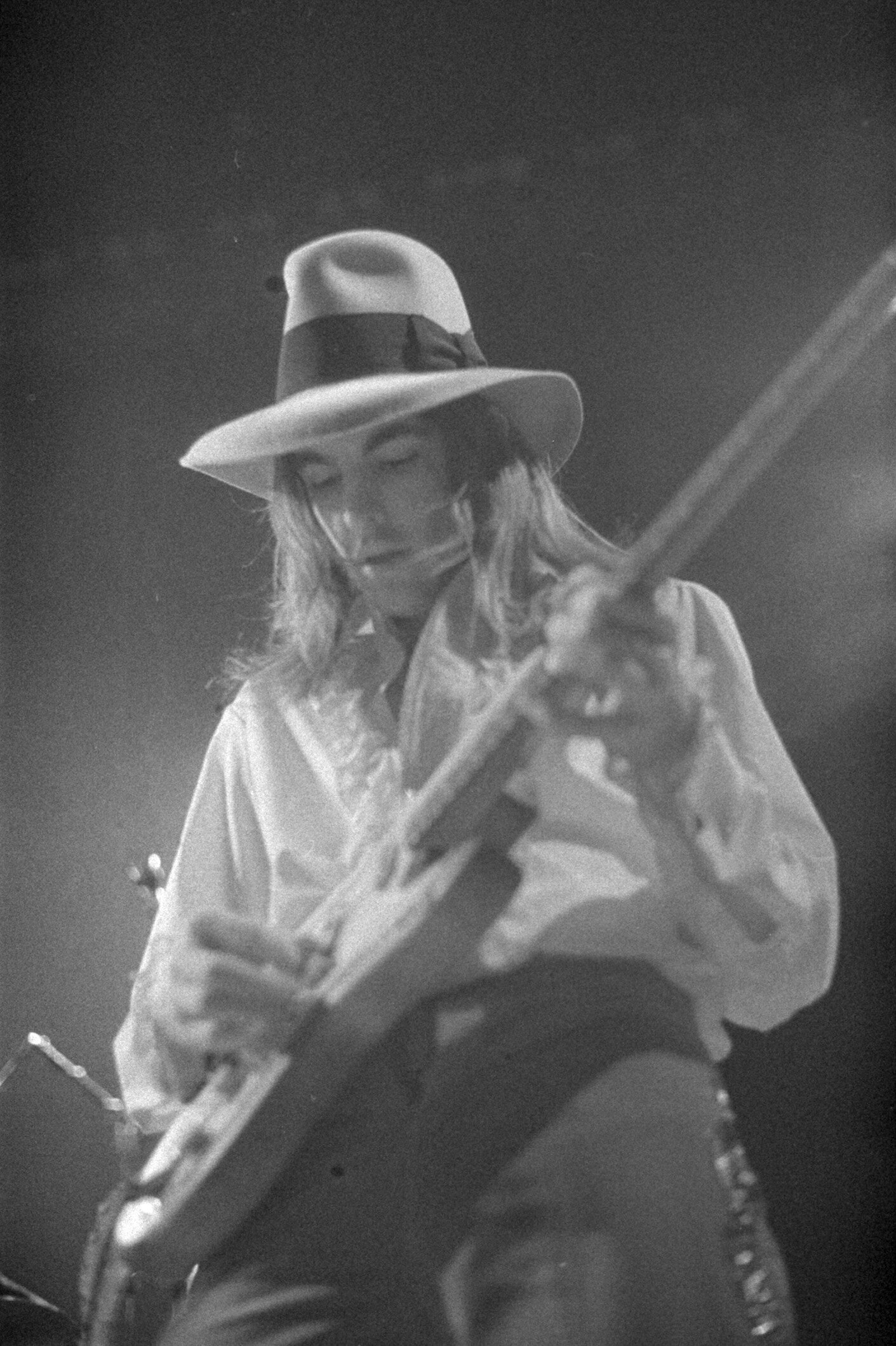
Bonamassa's introduction to the Bolin 'Burst came, as it does for so many guitar obsessives, through a photograph. It was a black-and-white image of Bolin playing with Zephyr — a stage shot that captured the young guitarist in full flight, the sunburst Les Paul visible at the center of the frame. Something about the image lodged itself in Bonamassa's imagination. He knew Bolin's music. He recognized the guitar. He began to dig.
"I have been looking for this guitar for approximately 10 years," Bonamassa said. "Researching who had it, who has it."
This kind of long-form, patient research is characteristic of how Bonamassa approaches the most significant acquisitions in his collection. For particularly rare or historically loaded instruments, he has described spending years building a paper trail — tracking ownership chains, reaching out to people who knew the original player, following leads that often went cold before occasionally, unexpectedly, opening doors.
The False Lead: Jimmy Wischer and the Other 1960 Les Paul
The search for the Bolin 'Burst was complicated by a near-miss that Bonamassa has spoken about publicly. At some point in his research, he encountered Jimmy Wischer — a guitarist and bassist who had played alongside Bolin — and purchased from him a 1960 Gibson Les Paul Standard that he believed was the guitar associated with Bolin's career.
He was wrong. Or rather, he was partially right in the most frustrating possible way.
The guitar Bonamassa purchased from Wischer was, in fact, a 1960 Les Paul that Bolin had played. Bolin had also used this guitar. But it was not the primary instrument — not the guitar that appeared in the famous photographs, not the one that ran through Bolin's career like a spine. It was a related instrument, associated with Bolin, but not the central artifact.
Bonamassa eventually worked this out through continued research and conversations with people who had known and worked with Bolin. The "main" guitar — the one Brown had purchased in 1966, the one loaned to Bolin after the theft, the one photographed and filmed across a decade of remarkable music — was still out there.
The search continued.
Finding David Brown: Moab, Utah
The breakthrough came when Bonamassa's research led him to David Brown, the guitar's actual owner since 1966. Brown was living in Moab, Utah — a small, spectacularly positioned desert city in the canyon country of southeastern Utah, better known today as a gateway to Arches National Park than as a node on the vintage guitar market.
The details of exactly how Bonamassa located Brown have not been fully detailed publicly, but the outcome was a meeting and a negotiation. The two men reached what Bonamassa described as a "cash deal" — a private sale, off the books of auction houses or dealers, the kind of transaction that defines the quiet end of the high-end vintage market, where instruments of significant historical weight often change hands between individuals who share a passion for what the object represents.
Brown, by Bonamassa's account, was "very kind and very generous." He understood what he was selling and to whom. The guitar — his guitar, the one he had bought in 1966 for $125 and loaned to one of rock's great guitarists for a decade — was going to a collector who would appreciate it, study it, and preserve it.
The deal was done. The 1960 Gibson Les Paul Standard left Moab and traveled to Los Angeles. It came home to Nerdville.
Approximately two months later, Joe Bonamassa received a phone call. David Brown had died in a car accident.
"The Guitar That May Be Cursed"
Bonamassa has spoken about this development with evident and genuine discomfort. The acquisition had been a hard-won conclusion to years of research — the satisfying end of a collector's quest. And then the person on the other side of that deal was suddenly and violently gone.
"It was a very bittersweet deal," Bonamassa said. "The guy was very kind and very generous. And then two months later, I get a phone call that he passed away in a car accident. That's strange. And that's why I call it the guitar that may be cursed."
He has also described the entire episode as "the strangest guitar deal I've ever been a part of" — a striking statement from someone who has completed hundreds of vintage guitar transactions, many of them involving instruments with complicated histories and significant monetary value.
The designation "cursed" sits uneasily with the object itself. This was, after all, a guitar associated with a musician who died at 25 of a drug overdose. Its owner for nearly fifty years died two months after selling it. The guitar has been present at, or immediately adjacent to, loss and premature death at multiple points in its story. Whether one lends credence to the idea of cursed objects or not, the pattern of tragedy that surrounds this particular instrument is difficult to overlook.
It is worth noting that Bonamassa has not shied away from the guitar's history. He has discussed it publicly, released a detailed feature about it on his website in 2019, and positioned it as one of the signature pieces in his collection — not despite its dark associations but, in some sense, because of them. A guitar's provenance is inseparable from its meaning, and the meaning of the Bolin 'Burst is threaded through with loss, borrowed time, and strange coincidence.
The Peculiar Ownership Question: What It Means for It to Be "Tommy Bolin's Guitar"
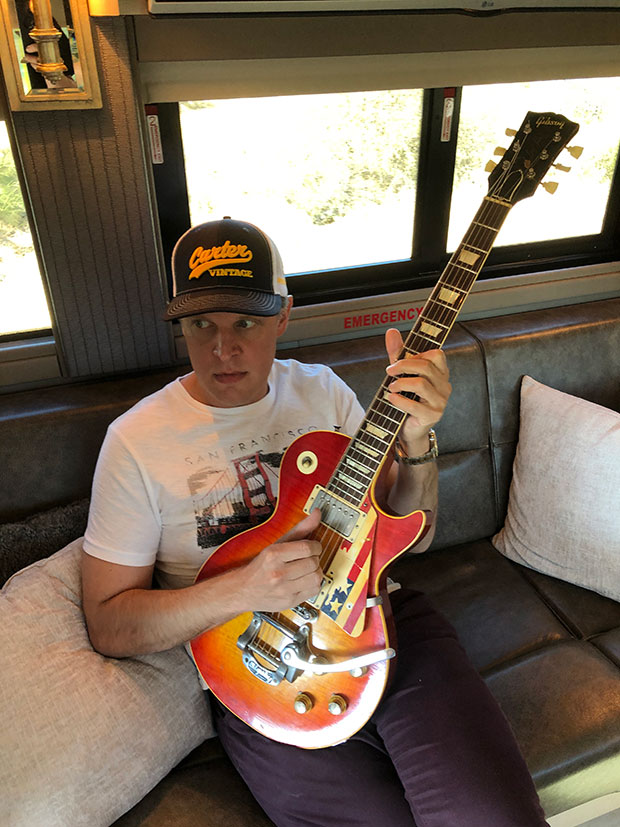
One of the most intellectually interesting aspects of the Bolin 'Burst story is the question of ownership — not in the legal sense, but in the deeper, more culturally resonant sense in which we talk about instruments "belonging" to the musicians who defined them.
Consider the most famous examples: the black Fender Stratocaster Hendrix used at Woodstock. Stevie Ray Vaughan's battered Number One. Peter Green's 1959 Les Paul, which eventually made its way to Gary Moore and then Kirk Hammett. In each case, the connection between player and instrument is so total that the instrument seems permanently marked by the music made on it — the guitarist's imprint left in the wood, the pickups, the wear patterns.
The Bolin 'Burst complicates this. Tommy Bolin is photographed with it. He recorded with it. He toured with it. His sound, in a significant portion of his recorded output, came through this guitar. It is, by any reasonable definition, his guitar in the historical and cultural sense.
And yet he never owned it. Not for a day. The legal title ran from Gibson to some unknown first owner to David Brown, whose name nobody outside Colorado's music scene had heard. Bolin used it on loan, continuously, for years — and then it stayed with Brown when Bolin moved on or when Bolin died.
Bonamassa has been precise about this distinction in his public comments. He does not refer to it as "Tommy Bolin's guitar" in the proprietary sense. He refers to it as "the guitar Tommy Bolin is most commonly associated with" — an accurate, careful phrasing that honors the truth of the situation while acknowledging what the object represents in the historical record.
The question of what constitutes ownership of a guitar's identity, as opposed to its title, is genuinely unresolved by this story. David Brown owned the guitar for fifty-odd years and remained essentially unknown to the guitar-collecting world. Tommy Bolin played it for a fraction of that time and gave it his name. History made its choice.
Nerdville: Where the Bolin 'Burst Lives Now
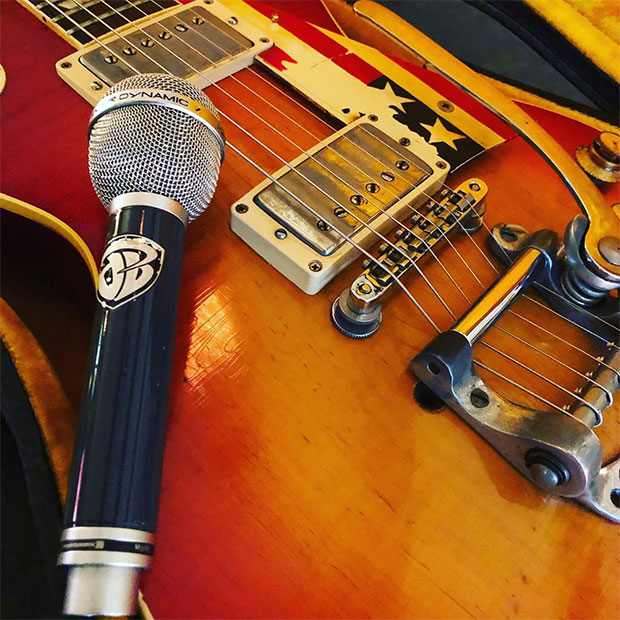
The guitar currently resides at Nerdville, Bonamassa's Los Angeles home and the physical headquarters of one of the most significant private guitar collections in the world. The collection, estimated at over 400 guitars, spans makers, eras, and configurations — vintage Gibson Les Pauls, Fender Stratocasters and Telecasters, acoustic instruments, rare amplifiers, and other period equipment. It is not a museum in the institutional sense, but it functions as one: a working archive of guitar history, organized and maintained by someone who understands each object's place in the larger story of the instrument and the music it shaped.
Within that collection, the Bolin 'Burst occupies a specific kind of significance. It is not merely rare — though a 1960 Gibson Les Paul Standard with this level of documented provenance is extraordinarily rare. It is historically anchored in a way that pure rarity cannot replicate. It connects directly to one of rock's most discussed short careers, a career that was cut off in a Miami hotel room before it reached anything like its natural conclusion.
Bonamassa, who has spoken extensively about his relationship with the instruments in his collection, treats them as repositories of history rather than purely financial assets. The Bolin 'Burst fits that framework with unusual precision: it is a guitar that holds, in its wood and its hardware, the record of places it has been and sounds it has made, in the hands of someone who left far too soon.
Tommy Bolin's Enduring Legacy
It is worth pausing to consider what Tommy Bolin represented, and what his relatively obscure status in popular rock history says about how we remember guitarists.
In the early 1970s, Bolin was being spoken of — alongside Rory Gallagher — as among the most talented guitarists of his generation, a potential successor to the throne that Clapton, Page, and Beck had established. He had the technique. He had the feel. He had the range. He had replaced Joe Walsh in the James Gang and Ritchie Blackmore in Deep Purple and held his own against the expectations that came with both replacements.
His solo work on Teaser and Private Eyes showed a musician operating at the intersection of rock, jazz, funk, and blues in ways that few of his contemporaries managed. The Billy Cobham Spectrum sessions in 1973 put him in front of a jazz audience and earned him critical acclaim that crossed genre lines. His wah-wah technique was idiosyncratic, expressive, and genuinely his own.
And then he was gone. At 25. Leaving behind two solo albums, a handful of band recordings, session work of the highest caliber, and a legacy that has always struggled to find the mainstream recognition it arguably deserves.
His memorial in Sioux City stands as a reminder of where he came from. The Tommy Bolin International nonprofit maintains his archives and hosts an annual Tommy Bolin Rock Fest. Guitar magazines periodically revisit his catalog and come away shaking their heads at what was lost. He is a figure in the tradition of musicians taken too early, whose absence is as significant as their presence — though his name remains less well known than it should be, even within the communities that celebrate the music he helped define.
The Bolin 'Burst does not resolve that obscurity, but it carries it forward in a physical form. Every time Bonamassa shows the guitar, tells its story, or includes it in the narrative of his collection, the name Tommy Bolin enters a conversation it might otherwise have missed.
The Collector as Curator: What Bonamassa's Hunt Represents
The story of the Bolin 'Burst is, among other things, a story about what serious collecting requires — and what it means to pursue an object whose value is inseparable from its history.
Bonamassa spent approximately a decade on this search. He followed the photograph. He traced the ownership chain. He encountered a false lead — the Wischer guitar — that would have satisfied a less meticulous researcher. He persisted, tracked Brown to Moab, and closed a cash deal. By any measure, this is the behavior of someone for whom the guitar's meaning outweighs its monetary value, even when the monetary value itself is significant.
Vintage Les Paul Standards of this era and provenance trade at prices that would have seemed fantastical to the players who originally used them. David Brown paid $125 in 1966. The market for comparable instruments today — before any provenance consideration — begins in the hundreds of thousands of dollars and extends well beyond. A 1960 'Burst with Tommy Bolin's documented association represents a premium on top of that base price that would be difficult to calculate precisely, because there is no exact comparable.
None of this is the point Bonamassa tends to make when he talks about the guitar. He talks about the photograph that started the search. He talks about David Brown's kindness. He talks about the phone call two months later. He calls it the strangest deal he's ever been part of, and the guitar that may be cursed.
For a man with 400 guitars, the Bolin 'Burst is defined not by its scarcity or its market value but by the story attached to it — a story that is, in its own way, as strange and compressed and ultimately sad as the career of the musician who gave it its name without ever holding the title.
Conclusion

The 1960 Gibson Les Paul Standard known as the Bolin 'Burst is, at its core, a story about borrowed time. Tommy Bolin borrowed the guitar and made it his own without ever owning it. David Brown owned the guitar for decades without ever being part of its public story. Joe Bonamassa spent a decade reclaiming the guitar for history, and the man who sold it to him died two months later on a Utah road.
These are not the usual coordinates of a gear acquisition story. They are something stranger: a provenance tale that doubles as a meditation on legacy, ownership, and what it means for an object to carry the weight of a life. The guitar that may be cursed sits now among 400 others at Nerdville, its sunburst top marking the transition from amber to cherry to dark at the edges, its PAF pickups holding sixty-plus years of physics and history in two small rectangular frames. It was played by one of rock's most gifted and overlooked guitarists. It was kept by a quiet man in Denver and then Moab who mostly stayed out of the story. It was found by a collector who knew exactly what it was and spent a decade proving it.
Whatever else it is, the Bolin 'Burst is proof that guitars accumulate meaning the way wood accumulates wear — slowly, invisibly, until you hold it up to the light and suddenly see everything it has been through.
Sources: jbonamassa.com (2019), Guitar World, Guitar.com, Vintage Guitar Magazine (Ward Meeker, November 2010), Wikipedia (Tommy Bolin, Zephyr, Spectrum), AllMusic, Keeping the Blues Alive Foundation.