Dify
Dify (styled dify.ai; legal entity LangGenius, Inc.) is an open-source platform for building, deploying, and operating production-grade AI applications and agentic workflows. Founded in March 2023 and headquartered in the San Francisco Bay Area, the company operates additional offices in Tokyo, Shanghai, and Suzhou. As of mid-2026, its GitHub repository ranks among the most-starred open-source AI projects globally, with over 142,000 stars, and more than one million applications have been deployed through the platform.
What They Do and What Problem They Solve
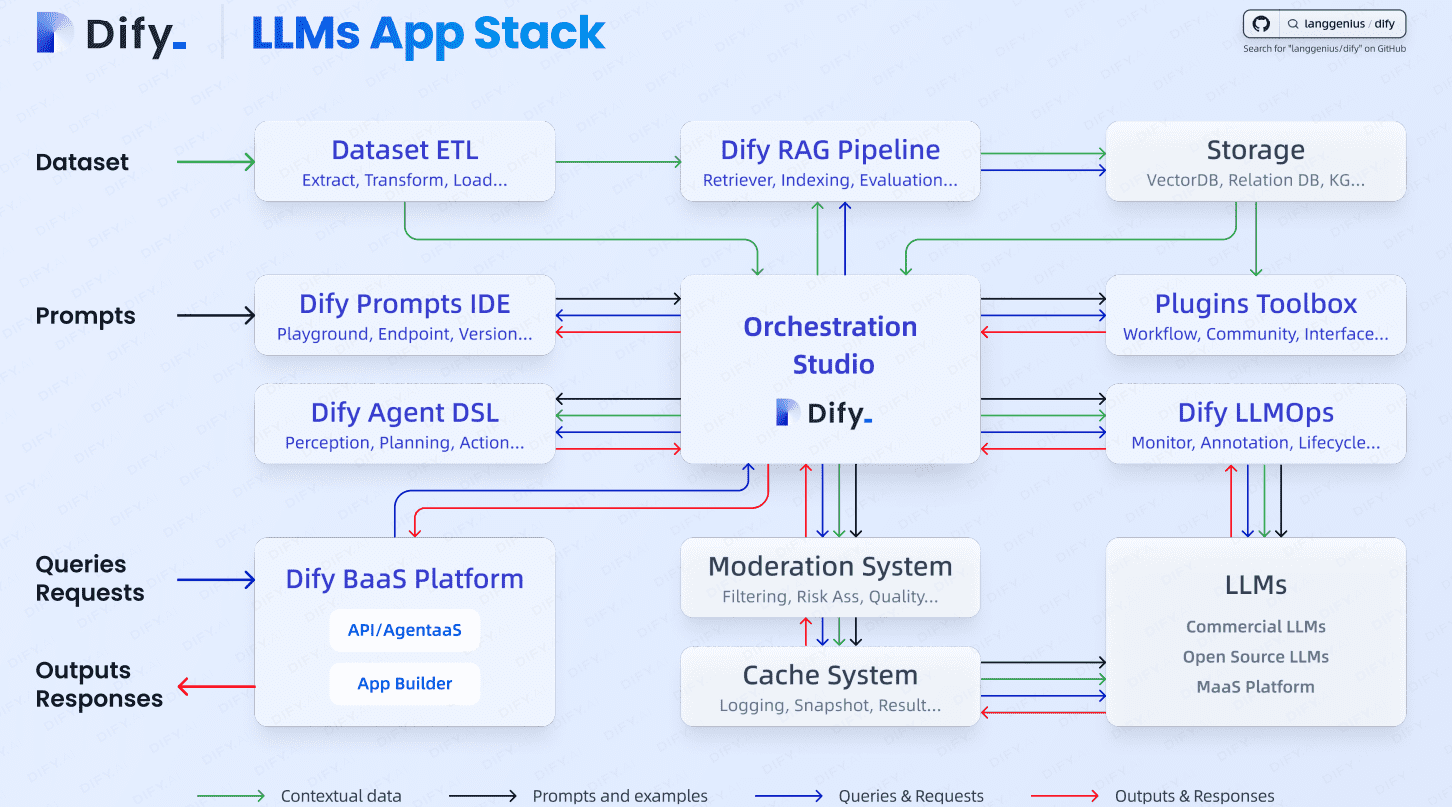
Building AI-powered applications with large language models (LLMs) has historically required deep software engineering expertise: teams had to write custom orchestration logic, manage prompt versioning, wire together retrieval pipelines, and integrate disparate model APIs—work that could take weeks before a prototype was functional. Dify addresses this gap by providing a unified, visual, no-code/low-code workspace that collapses those steps into a single collaborative environment.
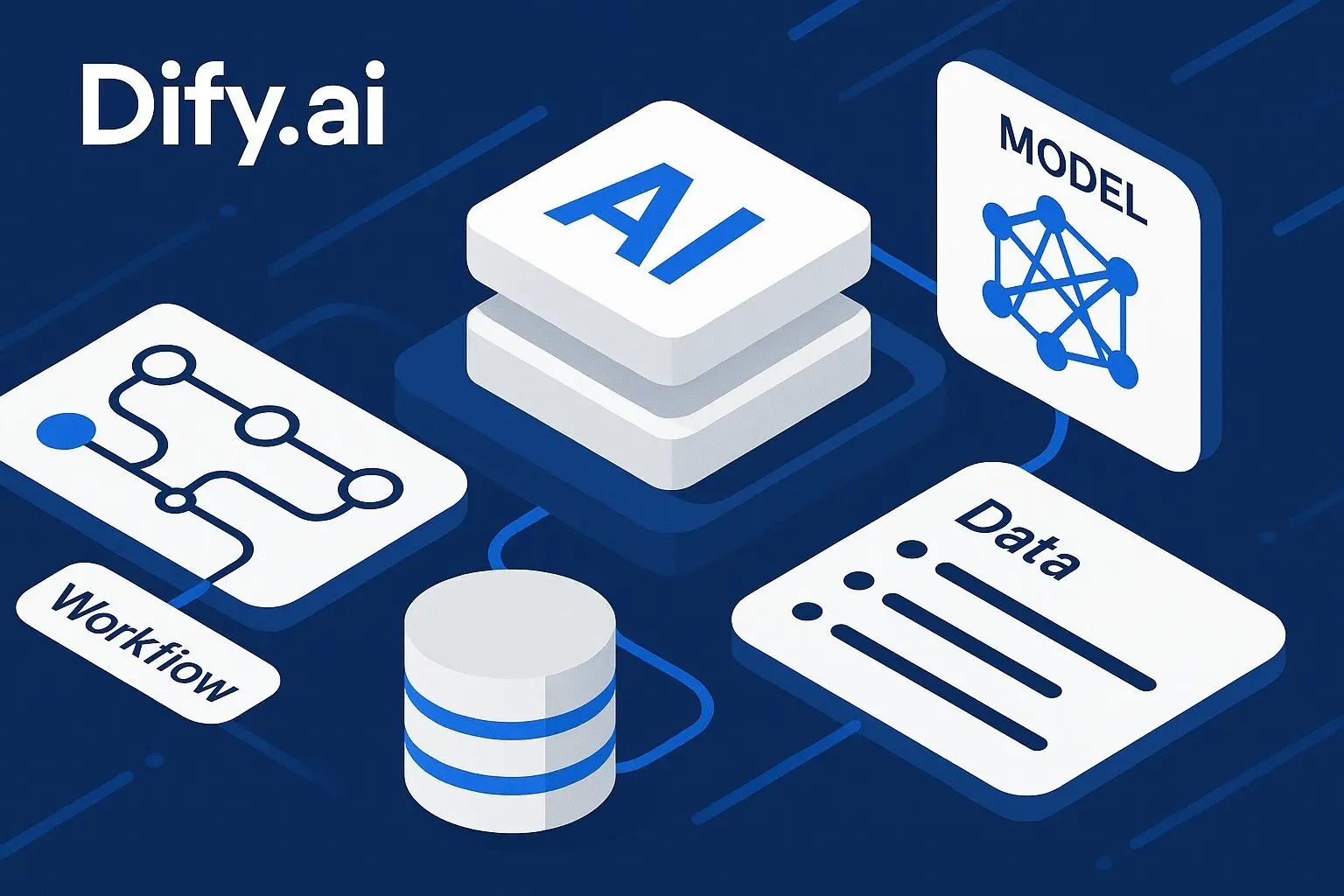
The platform's core thesis is that AI infrastructure should be accessible to a broad range of builders—not just machine-learning engineers—while remaining production-ready for enterprise teams. It combines a visual workflow builder, retrieval-augmented generation (RAG) pipeline management, a multi-agent orchestration framework, model management across dozens of providers, and built-in observability into a single system that can be deployed on a public cloud, a private VPC, or self-hosted infrastructure with no rebuilding of the stack required when moving from prototype to production. [Dify official site]
Products and Services
Dify organizes its offering into two functional layers: Build tools and Deploy options.
Build
Workflow Studio is the central product: a visual canvas for designing agentic workflows by connecting nodes representing LLM calls, data retrieval steps, conditional logic, tool invocations, and human-review gates. A Human Input node introduced in recent releases allows workflows to pause for human review or approval before resuming. [Dify Blog]
Knowledge Pipeline handles the data preparation side of RAG applications. Teams can ingest PDFs, PowerPoint files, and other common document formats, which are chunked, embedded, and indexed into searchable knowledge bases. The pipeline supports hybrid search (vector plus keyword) and is designed to feed grounded, factually-anchored responses into AI applications.
Marketplace provides a catalog of pre-built tools, model connectors, and integrations that can be dropped into workflows without custom code. Supported model providers include OpenAI, Anthropic, Azure OpenAI, Google, Meta, Mistral, and numerous self-hosted inference endpoints.
Model Context Protocol (MCP) support, introduced in version 1.6.0, is bidirectional: Dify can call any external MCP server as a tool within a workflow, and it can expose its own agents and workflows as MCP servers for consumption by external clients. [Dify Blog]
Deploy
| Tier | Description |
|---|---|
| Dify Cloud | Fully managed SaaS; handles infrastructure, scaling, and model routing |
| Dify Enterprise | Private deployment for enterprise teams with SSO, RBAC, audit logging, and dedicated support |
| Community Edition | Open-source, self-hosted with Docker under the Dify Open Source License (Apache 2.0 with conditions) |
The self-hosted Community Edition carries no usage fees beyond infrastructure and LLM API costs and is the primary driver of Dify's open-source community. [GitHub – langgenius/dify]
Pricing and Business Model
Dify operates a freemium SaaS model with a parallel open-source distribution channel.
| Cloud Plan | Monthly Price (per workspace) | Annual Price |
|---|---|---|
| Sandbox | Free (trial credits, limited apps) | — |
| Professional | $59 | $590 (≈17% savings) |
| Team | $159 | $1,590 (≈17% savings) |
| Enterprise | Custom (from ~$150,000/year on AWS Marketplace) | Custom |
Model consumption costs are billed separately by the underlying model vendor when teams supply their own API keys. Enterprise customers receive on-premises deployment, SSO, custom SLAs, and dedicated support channels. [Dify Pricing – CompareEdge] [Dify Pricing – Dupple]
Revenue from the cloud and enterprise tiers is complemented by a community-led growth motion: the free Community Edition generates widespread adoption and familiarity, which converts enterprise teams and developers with production requirements into paying customers. As of 2025, Dify reported approximately $3.1 million in annual revenue with a team of roughly 28 people, signaling high revenue-per-employee efficiency at that stage. [GetLatka]
Marketing and Positioning
Dify's official tagline is "The Platform for Production-Ready Agentic Workflows." Its positioning rests on three pillars:
- Democratization of AI development — by replacing backend code with a visual interface, Dify extends AI application building to product managers, domain experts, and citizen developers, not just engineers.
- Production-readiness from day one — unlike purely experimental tools, Dify is designed to move continuously from prototype to production without requiring a stack rebuild. Volvo Cars, an enterprise customer, cited this quality specifically: "In this climate of perpetual beta, tools enabling rapid validation aren't just helpful, they're existential." [Dify official site]
- Open-source trust — publishing the full codebase under an open-source license allows security-sensitive enterprises to audit the software before deploying it on private infrastructure, a key differentiator for regulated industries.
The company's primary growth channel has been its GitHub repository, which crossed 100,000 stars in June 2025 and reached approximately 147,000 stars by mid-2026, placing it among the top 100 open-source repositories globally. [Dify Blog – 100K Stars] This organic developer community feeds both enterprise sales leads and a network effect of community-contributed integrations and extensions.
Enterprise customers named on the platform's site include Maersk, Adobe, Google, Panasonic, PayPal, Eli Lilly, Thermo Fisher Scientific, MITRE, Mercedes-Benz, Novartis, Deloitte, McDonald's, AIA, Volkswagen, CTC, KPMG, Ricoh, Volvo Cars, and ETS (Educational Testing Service), spanning logistics, automotive, pharmaceuticals, financial services, and education. [Dify official site]
History and Founding
LangGenius, Inc. was incorporated and the Dify project was initiated in March 2023. The codebase was open-sourced on GitHub on May 15, 2023, and achieved rapid early traction within the developer community attracted to LLM tooling in the wake of ChatGPT's public launch.
The company's growth trajectory accelerated sharply through 2024 and 2025 as enterprise demand for production-grade agentic workflow tooling expanded. Dify crossed one million deployed applications and moved from a developer curiosity to a standard choice for internal AI tooling projects at large organizations.
In March 2026, LangGenius closed a $30 million Series Pre-A round at a post-money valuation of $180 million, bringing total disclosed funding to approximately $41.5 million. The round was led by HSG (formerly operating as Sequoia Capital China), with participation from GL Ventures (Hillhouse Capital's venture arm), Alt-Alpha Capital (a Bessemer Venture Partners spin-out), 5Y Capital (a returning investor), Mizuho Leaguer Investment, and NYX Ventures. [BusinessWire] [Dify Blog – $30M Raise]
Leadership and Team

Luyu Zhang is the company's founder and CEO. A self-described coding prodigy who left formal schooling at the middle-school level, Zhang built his technical career in China before entering the startup ecosystem. Prior to Dify, he served as product director of CODING, a DevOps platform owned by Tencent Cloud, and earlier founded Feie Work, a testing-process management and collaboration tool. He began experimenting with generative AI in 2022 and launched Dify in 2023 with the conviction that the technology "should reach everyone equally." [Forbes]
In early 2026, Zhang relocated from China to Silicon Valley as part of a broader effort to compete globally, conducting his Forbes interview through a translator while noting he was "too busy with work right now to improve my English." [Forbes] [VnExpress International]
John Wang (GitHub handle: takatost) is co-founder and Chief Engineer. Richard Yan is also listed as a co-founder with a focus on operations and go-to-market. [Medium – GOSIM Foundation]
The founding team drew heavily from Tencent Cloud's DevOps Coding unit. As of May 2026, Dify employs approximately 108 people, with a core open-source engineering team of around 60 based in China and aggressive hiring underway in the Bay Area and Tokyo. [Tracxn]
Competitive Landscape
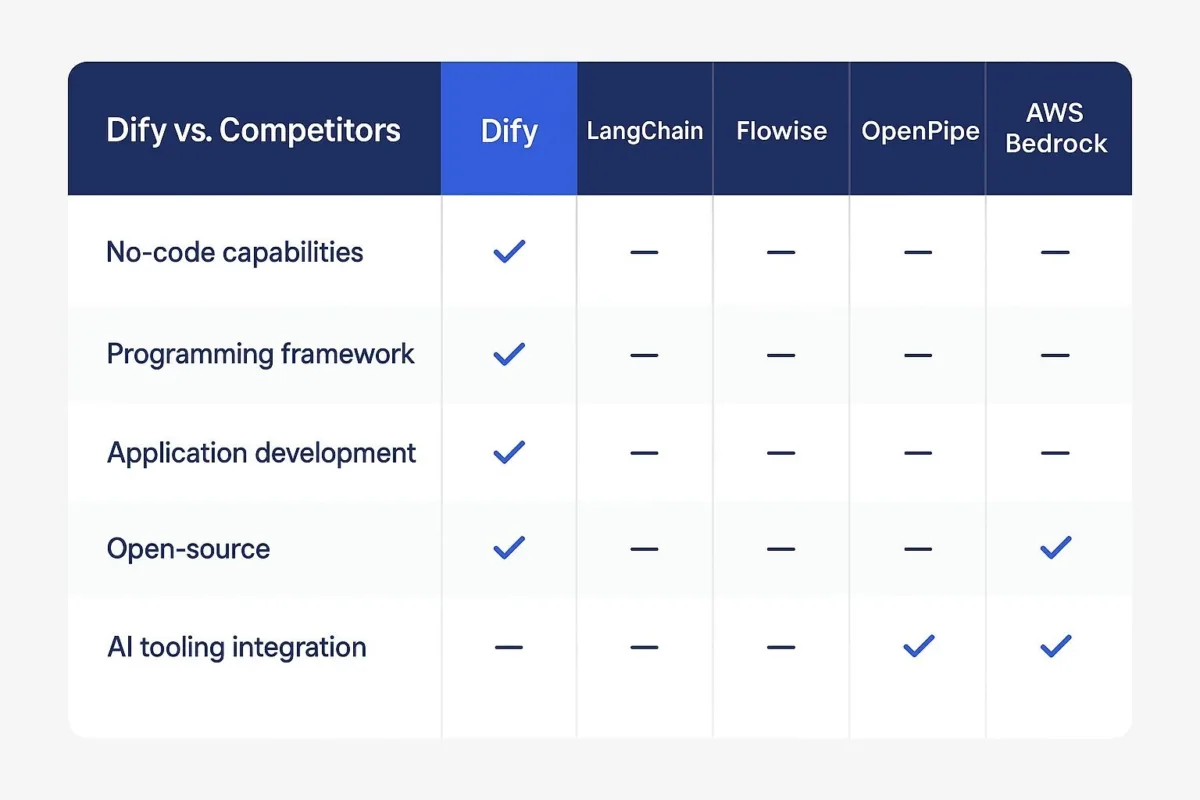
Dify operates in a crowded and rapidly evolving market for LLM application development platforms. Its primary open-source competitors are:
Flowise — A drag-and-drop LLM workflow builder built on top of LangChain. Flowise is lighter-weight (runs on 1 GB RAM vs. Dify's 4 GB minimum) and simpler to start with, making it attractive for individual developers building chatbots quickly. It lacks Dify's full production feature set (multi-model management, team workspaces, built-in observability). [Enterprise DNA]
Langflow — A visual LLM orchestration tool with strong LangGraph multi-agent support, custom Python nodes, and an MIT license. Considered the most technically flexible of the three leading open-source options, but with a steeper learning curve. [Enterprise DNA]
LangChain — A code-first Python/JavaScript framework that underpins many competing tools. LangChain is the choice for teams requiring deeply custom, complex enterprise integrations and developer-only workflows; it has no visual builder and is not no-code. Dify positions itself explicitly as a production alternative for teams that want LangChain-level power without pure-code implementation. [GPTBots]
n8n and Zapier — General-purpose workflow automation tools that have added AI/LLM nodes. They lack Dify's depth in RAG pipeline management and LLM-specific observability but may appeal to operations teams already embedded in those ecosystems.
Microsoft Azure AI Foundry / AWS Bedrock — Cloud-native managed services that provide similar workflow and model orchestration features within their respective clouds. They carry significant vendor lock-in and lack the open-source audit trail enterprises in regulated sectors often require.
Dify's most defensible differentiators are its open-source transparency (enabling private deployment in regulated industries), its knowledge base and RAG tooling depth, and its network of 142,000+ GitHub community contributors generating integrations and validation. [AI Agent Square]
Target Customers
Dify serves a wide spectrum, from individual developers evaluating LLM tooling via the free Community Edition to large multinational enterprises running private deployments across business units.
Enterprise and mid-market teams — Organizations in manufacturing, logistics, financial services, pharmaceuticals, and the public sector that need to deploy AI workflows on private infrastructure and meet strict governance requirements. Dify's vertical solution pages address banking, pharma and life sciences, semiconductors, logistics, and public sector specifically. [Dify official site]
Developer and product teams at technology companies — Teams building internal AI tooling (HR chatbots, IT support agents, code review assistants) or customer-facing AI products who want to prototype fast and graduate directly to production without rebuilding.
Citizen developers and domain experts — The no-code Workflow Studio targets business analysts, product managers, and domain specialists who need to build AI-powered workflows without dedicated engineering support. Ricoh cited this explicitly: Dify's approach "makes it highly accessible even for beginners, significantly accelerating citizen development." [Dify official site]
AI-native startups — Founders building products on top of LLMs who need to iterate on workflow logic, model selection, and knowledge bases rapidly without maintaining custom infrastructure.
The platform's industry-specific landing pages — covering assessment and testing (ETS is a named customer), manufacturing, consumer goods, professional services, logistics, public sector, banking, pharma, semiconductor, education, and internet/media — signal a deliberate enterprise vertical motion layered on top of the broad developer community base. [Dify official site]
Sources:
- Dify Official Website
- Dify Raises $30M: Tomorrow's Organizations Will Be Built by People and Agents – Dify Blog
- Dify Raises $30 Million Series Pre-A – BusinessWire
- This Middle School Dropout Built His AI Startup In China – Forbes
- Luyu Zhang joins wave of Chinese AI founders moving to US – VnExpress International
- 100K Stars on GitHub – Dify Blog
- Dify v1.6.0: Built-in Two-Way MCP Support – Dify Blog
- Dify – GitHub Repository (langgenius/dify)
- Dify 2026 Company Profile – Tracxn
- Dify 2026 Company Profile – PitchBook
- Dify.AI – Crunchbase
- How Dify Hit $3.1M Revenue – GetLatka
- Dify Pricing 2026 – CompareEdge
- Dify Pricing 2026 – Dupple
- Dify vs Flowise vs Langflow – Enterprise DNA
- Dify AI Review 2026 – GPTBots
- Dify Review 2026 – AI Agent Square
- Interview with Co-founder Richard Yan – GOSIM Foundation / Medium
- Dify Secures $30M Series Pre-A – The AI Insider