How Primaries Work: Who Picks the Candidates in American Elections
In brief
A primary is the election held before the main election, where voters choose who will appear on the November ballot for each party. In most countries, parties choose their own candidates. In the United States, the government runs the process and voters make the choice. That is why parties have so little control over who runs under their name.
Every state runs its primaries differently. As of today, 8 states use fully closed primaries that only party members may vote in, 15 use fully open primaries where any voter may pick either party's ballot, and the rest fall somewhere between or have dropped party primaries altogether.
Why primaries exist
For most of the 1800s, party leaders picked candidates at conventions and caucuses, and many of those decisions happened in back rooms. The Progressive movement of the 1890s and early 1900s saw this as the root of machine politics and corruption. Its answer was the direct primary, which handed the choice to voters. Louisiana Democrats held primaries from 1892, and Wisconsin, led by reformer Robert La Follette, adopted them by referendum in 1904. Most states followed within a generation.
Primaries also have an ugly chapter. In the one-party South, the Democratic primary was the real election, and parties used "white primaries" to keep Black citizens from voting in them. The Supreme Court struck the practice down in Smith v. Allwright (1944).
For president, primaries mattered little until 1968. That year Hubert Humphrey won the Democratic nomination without entering any of the 14 state primaries, and the party nearly tore itself apart. The McGovern–Fraser Commission that followed effectively required states to choose delegates through primaries or open caucuses, and Republicans soon followed. Since 1972, voters, not party bosses, have picked presidential nominees.
Who can vote: the six types of primary
States decide who may vote in a party's primary. The National Conference of State Legislatures (NCSL) sorts them into six groups:
| Type | Who can vote | States | Examples |
|---|---|---|---|
| Closed | Only voters registered with that party. Switching parties must be done well before the election | 8 | New York, Florida, Pennsylvania, New Jersey |
| Partially closed | Each party decides whether to let unaffiliated voters in | 9 | Connecticut, Oregon, Utah, Maryland |
| Open to unaffiliated | Party members vote in their own primary; independents may pick any one party's ballot | 8 | Arizona, Colorado, New Hampshire, North Carolina |
| Partially open | Any voter may pick a party's ballot, but doing so may count as joining that party | 5 | Illinois, Ohio, Iowa, Indiana |
| Open | Any voter picks either party's ballot privately on primary day, with no party registration at all | 15 | Texas, Michigan, Georgia, Wisconsin |
| Top-two / top-four / all-candidate | One ballot for every candidate of every party; the top finishers advance | 5 | California, Washington (top two), Alaska (top four), Louisiana, Nebraska |
What "registering with a party" means. In states that track it, party registration is a box on your state voter record. You choose it yourself, and you can change it by filing a form before the state's deadline. The party doesn't approve it and can't remove you. In open-primary states, the box doesn't exist at all.
Who can run
Getting on a party's primary ballot is also controlled by state law, not by the party. A candidate typically files paperwork, pays a fee or gathers a set number of voter signatures, and declares a party. The party can endorse a rival, deny funding or campaign against a candidate. In most cases it can't keep that candidate off its ballot.
Many states also have "sore loser" laws, which stop a candidate who loses a primary from running in November as an independent. These laws protect the primary result, not the party's preferences.
The result is that a party label works more like a brand than a club membership. Well-known examples:
- Bernie Sanders sits in the Senate as an independent but has run in the Democratic presidential primaries.
- Donald Trump was a registered Democrat in the 2000s before winning the 2016 Republican nomination.
- Crossover and "raiding." In open primaries, voters from one party can vote in the other's to help a weak candidate. Rush Limbaugh's 2008 "Operation Chaos" urged Republicans to vote in the Democratic primary. In 2022, Democratic groups paid for ads boosting far-right Republican candidates they thought would be easier to beat in November. In Vermont's 1998 Senate primary, crossover voters helped nominate Fred Tuttle, a retired dairy farmer running as a joke.
How the presidential nomination works
For president, primary voters don't directly pick the nominee. They pick delegates to the party's national convention, and the delegates nominate. A candidate needs a majority of the delegates.
The calendar. States vote one after another from about February to June. The order matters, because early winners gain money and media attention. For decades Iowa held the first caucus and New Hampshire the first primary. Republican rules bar any contest before the first Tuesday of February in the convention year.
How delegates are split:
| Democrats | Republicans | |
|---|---|---|
| Allocation | Proportional. A candidate needs at least 15% of the vote in a state or district to win delegates | States choose: winner-take-all, proportional, or a mix. Winner-take-all lets a front-runner pull ahead quickly |
| Party insiders | "Superdelegates" (party leaders and elected officials), just under 15% of delegates. Since 2018 they can't vote on the first ballot, only at a contested convention | 3 automatic delegates per state (chair, committeeman, committeewoman), about 7%. Since 2012 they must vote with their state's result on the first ballot |
Democrats created superdelegates through the Hunt Commission in 1982 to give party leaders a say again after the 1970s reforms. The 2016 race between Clinton and Sanders made them a target, which led to the 2018 limit.
Caucuses are a rarer variation. Voters gather at a set time, often in schools or churches, and vote openly, sometimes by standing in groups. Both parties have moved most states away from caucuses because turnout is low and the process is hard to follow.
Arguments for and against
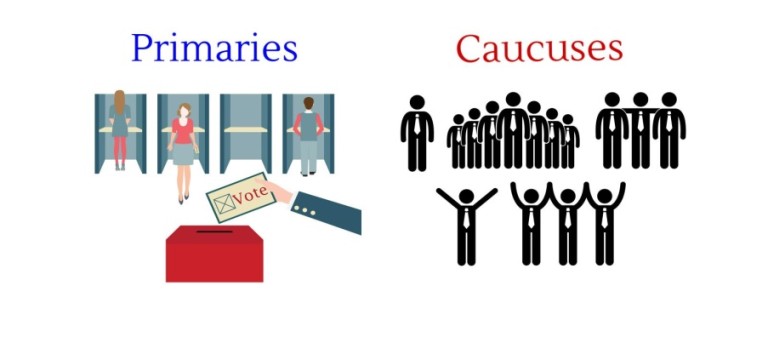
People disagree sharply about how primaries should work. Each design trades one value against another.
Closed primaries:
- For: The party's own members choose its candidates. Outsiders can't raid the contest, and a party label stays meaningful.
- Against: Independents, now one of the largest groups of voters, are shut out of the round that often decides the race, even though their taxes pay for it. Small, highly partisan groups of voters end up picking nominees.
Open primaries:
- For: All voters get a say, and candidates have to appeal beyond their own base.
- Against: Crossover raiding becomes possible, and a party can end up with a nominee most of its own members didn't want.
Top-two and top-four systems:
- For: Supporters say they reward candidates who appeal across party lines. Alaska's top-four system, paired with ranked-choice voting in the general election, is the best-known recent experiment.
- Against: Critics say they confuse voters and can produce November ballots with two candidates from the same party. Research has found lower turnout and little measurable effect on polarization.
A wider criticism applies to every type. Primary turnout is usually much lower than general-election turnout, and primary voters are more partisan than the average voter. In safe seats, where the primary is effectively the real election, a small and committed slice of voters picks the officeholder. Many political scientists point to this as one driver of polarization. Others argue the evidence is weaker than it seems.
The bottom line
American parties gave up control of their own nominations a century ago, in exchange for taking power away from party bosses. Today, voters, election law and the courts decide who carries a party's label, not the party. This explains how outsiders, insurgents and figures the party leadership dislikes can still become its nominees. It also explains why the clearest sign of what a party stands for is what its leaders choose to endorse, fund and condemn, not who registers under its name.
Sources
- State Primary Election Types (National Conference of State Legislatures): the six categories and state counts
- Primary elections in the United States (Wikipedia): history, Smith v. Allwright, 1968 and McGovern–Fraser, RNC calendar rule, Fred Tuttle, top-two systems, turnout and polarization research
- Superdelegate (Wikipedia): Hunt Commission, 2018 rule change, Democrats' 15% threshold, Republican automatic delegates
Bernie Sanders's and Donald Trump's party histories, "Operation Chaos" in 2008, Democratic spending in 2022 Republican primaries, sore-loser laws and Alaska's ranked-choice general election come from general knowledge and were not checked against these pages.