H. Res. 1490: The House's Official Denouncement of Socialism
On September 1, 2026, the U.S. House of Representatives passed one of the most politically charged non-binding resolutions of the 119th Congress: H. Res. 1490, formally titled "Providing for the condemnation and denouncement of socialism in all its forms, and for other purposes." The vote, which passed 220 to 192, was framed by Republicans as a necessary moral reckoning with a resurgent ideology and became an instant flashpoint for Democratic infighting, a referendum on the rising clout of the Democratic Socialists of America (DSA), and a calculated opening salvo in the GOP's 2026 midterm messaging strategy. Beneath its symbolic surface, however, the resolution carried substantive political consequences — fracturing Democratic unity, raising questions about what it means to be a mainstream Democrat in the 2020s, and foreshadowing ideological battles that will define the November elections.
Background and Introduction of the Resolution
Rep. Jeff Crank and the Resolution's Origins
H. Res. 1490 was introduced on August 27, 2026, by Rep. Jeff Crank, a Republican representing Colorado's 5th Congressional District — anchored in Colorado Springs and El Paso County. Crank, who has served since January 3, 2025, after defeating incumbent Republican Dave Williams in a 2024 primary, has been a consistent conservative voice on fiscal and national security issues. He has committee assignments on the House Armed Services Committee and the Committee on Natural Resources.
Crank formally introduced the resolution as both a policy statement and a political maneuver. In a press release from his congressional office, Crank cited the rapid growth of the DSA and the landmark 2025 electoral victory of Zohran Mamdani — the DSA-endorsed democratic socialist who defeated former Gov. Andrew Cuomo to win the New York City mayoral race — as catalysts for the resolution. Mamdani took office in 2026 and immediately became the highest-profile elected democratic socialist in the United States. Notably, the resolution was introduced the same week Mamdani made a high-profile visit to Washington — a symbolic coincidence that amplified the resolution's rhetorical impact.
"We must stand firm against an ideology making inroads among Democrats," Crank stated, arguing the resolution would force colleagues on the other side of the aisle to go on the record about their relationship with socialist politics.
The Republican Study Committee's Involvement
The Republican Study Committee (RSC), chaired in the 119th Congress by Rep. August Pfluger of Texas, enthusiastically backed the resolution. RSC members issued a joint statement blasting Democrats for "allowing dangerous ideology into the mainstream," pointing specifically to DSA platform positions such as abolishing prisons, eliminating the Electoral College, and allowing noncitizens and incarcerated individuals to vote in American elections. RSC press releases highlighted that endorsing the resolution was a commitment to rejecting "the policies of the DSA that seek to dismantle the system our Founding Fathers established."
What H. Res. 1490 Says: Key Provisions
The Core Condemnation
The central operative clause of H. Res. 1490 declares that the House of Representatives:
- Condemns and denounces socialism in all its forms, including the Democratic Socialists of America
- Opposes the implementation of socialist policies in the United States
- Reaffirms support for free, fair, and secure elections
- Reiterates that American elections are for American citizens only
- Recommits to upholding the Constitution of the United States
As a simple House resolution (H. Res.), the measure carries no force of law and does not require Senate consideration or a presidential signature. It is a statement of the sense of the House — non-binding, but politically consequential in election years when voting records become campaign advertisements.
The SAVE America Act Provision
Perhaps the most controversial element embedded within H. Res. 1490 is a provision calling for the enactment of the Safeguard American Voter Eligibility (SAVE) America Act. The SAVE Act requires voters to provide documentary proof of citizenship — such as a passport, military ID, or enhanced REAL ID — at the time of voter registration, and a photo ID at the time of voting in federal elections.
The House had already passed a standalone version of the SAVE Act in February 2026. While Senate deliberations on the bill were ongoing — with a potential scaled-back, incentive-based version under consideration — including its "enactment" in a non-binding resolution on socialism gave many Democrats a concrete, procedural reason to oppose H. Res. 1490 even if they personally opposed socialism. Rep. Chrissy Houlahan of Pennsylvania, who voted "present" rather than yes or no, explained her position precisely on this basis, saying the resolution "combines provisions she has previously supported with the unrelated SAVE America Act, which she has repeatedly opposed." She characterized it as an attempt to "consume time before the midterm elections" by forcing a difficult vote with a poison-pill attachment.
The Legislative Path: Committee, Rules, and the Floor
Committee Action
After introduction on August 27, H. Res. 1490 was referred simultaneously to the Committee on House Administration and the Committee on Financial Services. Those referrals reflected the resolution's dual scope — touching on both electoral procedures (via the SAVE Act provision) and economic ideology (via the anti-socialism condemnation).
The Rules Committee Vote
The House Rules Committee took up the resolution and reported it favorably on August 31, 2026, by a record vote of 7 to 4 — a partisan split consistent with the committee's Republican majority. The Rules Committee's approval was necessary to bring the resolution to the full House floor under a structured rule governing debate time and the amendment process.
The Procedural Near-Collapse: The 209-208 Rule Vote
Before the House could vote on the substantive resolution itself, it first had to adopt the rule — the procedural framework for floor debate. That vote nearly failed, and in doing so, it became the most dramatic episode surrounding H. Res. 1490.
Five House Republicans voted against the rule, depriving their own leadership of the simple majority needed to advance debate. With the rule on the verge of defeat, two moderate Democrats broke from their caucus to provide the decisive votes that rescued it:
- Rep. Jared Golden (D-Maine)
- Rep. Marie Gluesenkamp Perez (D-Washington)
The rule passed by the thinnest possible margin: 209 to 208.
The defection sent shockwaves through House Democratic leadership. Minority Leader Hakeem Jeffries (D-N.Y.) told reporters he had not been notified beforehand. In a rare public rebuke, Jeffries, Minority Whip Katherine Clark (D-Mass.), and Democratic Caucus Chair Pete Aguilar (D-Calif.) issued a joint statement: "The decision by two of our colleagues to blindside the entire House Democratic Caucus and join with the Republican majority to pass a procedural rule on the brink of failing represents a significant breach of trust. It is an action that necessitates a serious response, and we have asked the Committee on Caucus Rules to take this up in short order."
Jeffries subsequently vowed to explore formal consequences for Golden and Gluesenkamp Perez, raising the possibility of caucus rule enforcement action — a rare and significant escalation in House Democratic intraparty discipline.
The Floor Vote: 220-192
Final Tally
The House passed H. Res. 1490 on the evening of Tuesday, September 1, 2026, by a vote of 220 to 192, after the previous question had been agreed to by a vote of 212 to 205.
Every Republican present voted in favor. Eight Democrats crossed the aisle to vote yes, and two voted "present."
Democrats Who Voted Yes
All eight Democrats who supported the resolution represent competitive or marginal districts, and their votes reflect the electoral calculus of being tied — or not being tied — to socialist politics two months before a midterm election:
| Member | State | District Rating |
|---|---|---|
| Jared Golden | Maine | Toss-up |
| Marie Gluesenkamp Perez | Washington | Lean Republican |
| Vicente Gonzalez | Texas | Toss-up |
| Henry Cuellar | Texas | Lean Democrat |
| Don Davis | North Carolina | Toss-up |
| Kathy Castor | Florida | Toss-up |
| Darren Soto | Florida | Lean Republican |
| Gabe Vasquez | New Mexico | Toss-up |
Six of the eight "yes" votes come from districts rated "toss-up" or "lean Republican" by the Cook Political Report. Two others, Reps. Maggie Goodlander (D-N.H.) and Chrissy Houlahan (D-Pa.), voted "present."
Democrats Who Voted No
The 192 Democrats who voted against the resolution — including Minority Leader Jeffries, Minority Whip Clark, and Democratic Caucus Chair Aguilar — cited multiple reasons for opposing it: the bundled SAVE Act provision, the characterization of the vote as a "messaging stunt," and concern that supporting it would lend legitimacy to what they characterized as Republican fear-mongering ahead of the midterms.
Rep. Joseph Morelle (D-N.Y.), who led the Democratic floor debate against the resolution, called it "a distraction from considering more pressing issues in an election year" and decried it as a meaningless political exercise that does nothing to help Americans with everyday economic concerns.
Intraparty Dynamics: A Democratic Caucus Divided
The Democratic Counter-Amendment
House Democrats did not simply vote no and move on. Before the final vote, a group of four moderate-to-centrist Democrats — Reps. Josh Gottheimer (D-N.J.), Hillary Scholten (D-Mich.), Jared Moskowitz (D-Fla.), and Tom Suozzi (D-N.Y.) — introduced a counter-amendment that would have explicitly condemned both socialism and the DSA, but stripped out the SAVE Act provision. The amendment was blocked from the floor under the rule structure the Republicans had advanced, ensuring the only vote available was on the Republican-crafted version of the resolution.
The blocked amendment illustrated the dilemma Democratic leadership faced: many members personally opposed socialism but were unwilling to vote for a resolution that doubled as a vehicle for contested voting legislation. The counter-amendment strategy was, in effect, an attempt to vote for the ideological statement while rejecting the electoral-access package.
The Golden-Gluesenkamp Perez Fallout
The fury directed at Jared Golden and Marie Gluesenkamp Perez went beyond the ordinary grumbling of partisan politics. Their decision to rescue the rule from procedural defeat — giving Republicans the margin to hold the vote at all — was described within Democratic circles as an extraordinary breach of caucus norms. Helping the opposing party pass a procedural rule is described as nearly unheard of; it is an act that directly removes the minority's only check on floor scheduling.
Jeffries' invocation of "consequences" and formal caucus rule review reflects how serious the leadership viewed the breach — not just as a policy disagreement, but as a violation of the basic operational trust that holds a legislative caucus together.
Both Golden and Gluesenkamp Perez represent the same ideological strand within the Democratic Party: rural, moderate members whose electoral survival depends on differentiating themselves from national Democratic positioning. Golden, who has long positioned himself as one of the most independent Democrats in the House, has previously broken with leadership on a wide range of votes. Gluesenkamp Perez, who represents a district in Washington state that Donald Trump won in 2024, has similarly cultivated an image as a pragmatist who prioritizes constituent interests over party line.
The Broader Political Context: Socialism and the 2026 Midterms
The DSA's Rise and Republican Strategy
H. Res. 1490 did not emerge in a vacuum. It is the latest in a series of Republican efforts to put Democrats on the record regarding their relationship with socialist politics — and it arrives at a moment when the DSA's electoral footprint has expanded dramatically.
The DSA has reached over 120,000 members in 2026, making it the largest socialist organization in American history. A Brookings Institution analysis published in August 2026 found that as of August 12, 123 candidates endorsed or recommended by national, state, or local DSA chapters had won primaries this election cycle, the vast majority at the local and state level.
At the national level, the most visible symbol of the DSA's political momentum is Zohran Mamdani. His victory in the 2025 New York City Democratic mayoral primary — defeating the well-funded and establishment-backed Andrew Cuomo — was hailed by DSA as proof that democratic socialist politics can win in a major American city. Mamdani, who took office in 2026 on a platform of rent freezes, a $30 minimum wage, universal government-funded child care, and expanded public transit, has since become a national figure and the face of the democratic socialist wing of the Democratic Party.
Republicans have explicitly tied H. Res. 1490 to the Mamdani moment. Crank's press materials cited Mamdani's win as evidence that socialist politics is "making inroads" within the Democratic Party. The resolution passed the same week Mamdani visited Washington — a visit that Newsweek headlined as the backdrop for the House's anti-socialism vote.
A Dramatic Shift from 2025
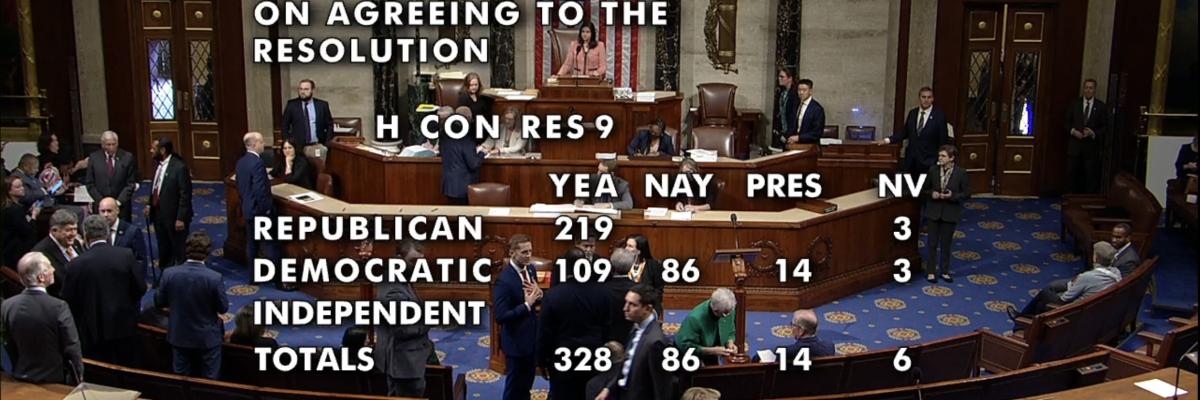
One of the most striking data points surrounding H. Res. 1490 is what happened to Democratic support between successive anti-socialism resolutions. In a comparable resolution the previous year — in 2025, when the House passed a resolution "denouncing the horrors of socialism" by 285 to 98 — 86 Democrats voted yes alongside 199 Republicans. In 2023, the comparable vote was 328-86-14, with 109 Democrats supporting it.
In September 2026, only 8 Democrats voted yes.
The Washington Times headlined this collapse in support: "Fewer Democrats back anti-socialism resolution than did last year, as DSA gains clout in their party." The data point is stark: in three years, Democratic support for formally condemning socialism in a House resolution fell from over 100 members to 8. Republicans pointed to this as evidence that the Democratic Party was drifting leftward; Democrats argued it reflected the poisoning of the well by the inclusion of unrelated voter ID legislation.
Both interpretations carry truth. The SAVE Act provision undeniably provided cover for Democrats who might otherwise have voted yes. But the trajectory across successive votes also reflects a genuine political reality: the DSA has organized itself into a force that Democratic incumbents — especially those in safe seats — are less willing to publicly antagonize.
Electoral Stakes
The 2026 midterms, set for November, are occurring in a landscape where Republicans control the House by a narrow margin and are seeking to hold their majority. With the economy, immigration, and energy policy all in play, Republicans have chosen to add ideological positioning to their toolkit, running a sustained messaging campaign that frames Democratic candidates as either socialists themselves or as unwilling to repudiate socialism.
The resolution gave Republicans a tangible vote record to weaponize in campaign ads. In districts where the Cook Political Report rates the race as "toss-up," a Democrat's refusal to vote for H. Res. 1490 can be framed in a 30-second ad as a vote against condemning socialism — even if the actual reasoning was about voter ID legislation.
Republican Arguments for the Resolution
Supporters of H. Res. 1490 made their case on multiple grounds:
Historical precedent of socialist harm. Republicans pointed to what they characterized as socialism's global record: economic collapse, political repression, the erosion of civil liberties, and, in the case of 20th-century communist regimes, mass death. RSC press releases cited the figure of over 100 million people killed under socialist and communist governments worldwide over the past century, referencing The Black Book of Communism and similar historical accounting.
The DSA's specific policy positions. Crank and RSC members highlighted DSA platform planks they regard as antithetical to constitutional governance: abolishing the Electoral College, ending cash bail, defunding police departments, allowing non-citizens to vote, and eliminating prisons. By explicitly naming the DSA in the resolution, Republicans sought to draw a direct line between a growing American political organization and its policy ambitions.
Forcing Democrats on the record. Rep. Crank was explicit that a key purpose of the resolution was to create a documented voting record heading into the midterms. "It's about making sure every member of this House has to answer: do you condemn socialism, yes or no?" he said.
Reaffirming election integrity. The SAVE Act provision was framed by Republicans not as a poison pill but as a natural complement to anti-socialist principles — arguing that allowing non-citizens to vote is itself a socialist-adjacent attack on democratic self-governance.
Democratic Arguments Against the Resolution
The opposing case rested on several overlapping arguments:
The SAVE Act attachment. The most broadly shared Democratic criticism was structural, not ideological: embedding the SAVE Act — a contested piece of voting legislation with implications for ballot access — inside an ideological condemnation resolution was characterized as a cynical maneuver. Democrats who supported the core idea of condemning socialism were put in an impossible position: vote yes and implicitly endorse voting restrictions they oppose, or vote no and hand Republicans a talking point.
Symbolic legislation as distraction. Rep. Morelle and others framed the resolution as legislative theater at a moment when Congress faced more urgent business. A non-binding resolution changes no law and allocates no resources. Critics argued floor time would be better spent on housing, healthcare costs, or infrastructure — the issues most polling identifies as top voter priorities.
Definitional vagueness. Some Democrats argued that "socialism in all its forms" is an undefined term that could sweep in policies — Medicare, Social Security, public libraries, subsidized school lunches — that enjoy broad popular support. They characterized the resolution as ideologically overreaching and analytically imprecise.
Political opportunism. The timing of the resolution — two months before midterm elections, the same week the most prominent democratic socialist in the country visited Washington — was widely read by Democrats as calculated political theater rather than genuine governance.
Reactions and Responses
Rep. Jeff Crank, sponsor: Expressed satisfaction with passage, framing it as Congress "standing firm" against an ideology that has historically delivered suffering when implemented. Characterized the 192 Democratic no votes as a revealing moment about the direction of the Democratic Party.
Rep. Hakeem Jeffries, House Minority Leader: Voted against the resolution and directed pointed criticism at the two Democrats who rescued the procedural rule vote. Described the episode as a "significant breach of trust" and pledged formal consequences through the Committee on Caucus Rules.
Rep. Joseph Morelle (D-N.Y.), Democratic floor manager against the resolution: Called the vote "a distraction" and said Republicans were using precious floor time for election-year posturing rather than substantive legislating.
Rep. Chrissy Houlahan (D-Pa.), voted present: Issued a formal statement explaining that while she personally condemns socialism, she opposed the resolution because it "combines provisions she has previously supported with the unrelated SAVE America Act." Framed her "present" vote as a principled objection to legislative bundling rather than an endorsement of socialist ideology.
RSC Members: Issued celebratory press statements blasting Democrats for "bringing dangerous ideology into the mainstream" and pledged to continue making socialism a central campaign issue.
Rep. Judy Chu (D-Calif.): Issued a statement against the resolution, characterizing it as ideologically motivated legislation designed to score political points ahead of midterms rather than address the needs of working Americans.
Historical and Comparative Context
H. Res. 1490 is not the first time the House has moved to formally condemn socialism. A brief history of comparable resolutions illustrates the evolving partisan and ideological dynamics:
- 2023 (118th Congress): The House passed a resolution "denouncing the horrors of socialism" by a vote of 328 to 86, with 109 Democrats voting yes. The relatively bipartisan support reflected a post-Trump moment in which moderate Democrats were comfortable with the symbolic gesture.
- 2025 (119th Congress, first session): A similar resolution passed 285 to 98, with 86 Democrats voting yes. Democratic support remained meaningful, suggesting that condemnation of socialism retained some bipartisan appeal.
- 2026 (H. Res. 1490): Democratic yes votes collapsed to 8 — a reduction of over 90 percent compared to 2023. Republicans gained a narrative and lost nothing; Democrats lost a defensible record while gaining a fractured caucus.
The trajectory maps almost precisely onto the DSA's growing influence within Democratic primaries and the mainstreaming of democratic socialist politics within the party's activist base. What was a safe symbolic vote for a mainstream Democrat in 2023 has become, in 2026, a vote that carries real risks of alienating a resurgent progressive wing — while voting no carries risks in competitive general elections.
Conclusion
H. Res. 1490 accomplished several things simultaneously: it passed a symbolic anti-socialism statement into the House record, embedded a call for contested voter ID legislation into that statement, exposed a dramatic fault line within the House Democratic Caucus, and handed the Republican Party a campaign-ready narrative heading into the 2026 midterms. Its 220-192 passage, while non-binding, was anything but inconsequential.
The resolution's most lasting political significance may be what it revealed rather than what it enacted. The collapse of Democratic support — from more than 100 members in 2023 to 8 in 2026 — reflects a Democratic Party navigating a structural transformation it has not yet resolved: how to hold together a coalition that stretches from democratic socialists in safe urban seats to moderate incumbents in competitive rural districts. The anger directed at Jared Golden and Marie Gluesenkamp Perez by Hakeem Jeffries — for the procedural act of letting a vote happen — illustrates how intensely leadership is managing that tension.
For Republicans, the resolution is a preview of their November strategy: force votes that divide Democrats ideologically, create documented records, and use the 2025 triumph of Zohran Mamdani in New York City as a symbol of what the Democratic Party, in their telling, has become. Whether voters in toss-up districts will find that argument persuasive remains to be seen. What is certain is that H. Res. 1490 has given both parties a new line of demarcation — drawn not in legislation, but in a 220-192 roll call vote — heading into one of the most consequential midterm elections in recent memory.
Sources:
- H.Res.1490 - 119th Congress (2025-2026) | Congress.gov
- H. Res. 1490 – House Committee on Rules
- H. RES. 1490 Full Text (Introduced-in-House) | GovInfo
- H.Res. 1490 – GovTrack.us
- House adopts Republican U.S. Rep. Jeff Crank's resolution condemning socialism, mostly along party lines - Colorado Politics
- House adopts resolution condemning socialism, with 8 Democrats joining Republicans | CBS News
- 8 House Democrats vote to condemn and denounce socialism and the DSA | Washington Examiner
- House Republicans Pass Resolution Denouncing Socialism | NOTUS
- Jeffries blindsided after Dems help force vote denouncing socialism | Washington Examiner
- Jeffries vows consequences for centrists who backed socialism vote | Washington Examiner
- House Dems overwhelmingly reject anti-socialism resolution after 2 moderates defy Jeffries | Fox News
- 'Socialism in all its forms' denounced by the House | Roll Call
- Now It's on the Record: House Votes to Condemn Socialism; 192 Democrats Vote No | RedState
- Fewer Democrats back anti-socialism resolution than did last year, as DSA gains clout in their party | Washington Times
- RSC Members Denounce Socialism in All Forms | Republican Study Committee
- Rep. Crank Introduces Resolution to Condemn Socialism in All Its Forms | Representative Jeff Crank
- Statement on my vote on H.Res.1490 | Rep. Chrissy Houlahan
- House Democrats offer amendment to GOP socialism resolution | The Hill
- Vulnerable Democrats vote to denounce socialism amid midterm pressure | The Hill
- Four House Democrats Put Forward Their Own Resolution Condemning the DSA | Mediaite
- Zohran Mamdani | Wikipedia
- Full List of Democrats Voting to Condemn Socialism as Zohran Mamdani Comes to Town | Newsweek
- House Passes Resolution Condemning Socialism Ahead of Mamdani White House Visit | Truthout
- Six Things to Know About the SAVE America Act | Bipartisan Policy Center
- Jeff Crank | Ballotpedia
- House approves resolution denouncing socialism | Deseret News