Graphene Device Measures Fractional Electric Charges in Quantum Physics
For decades, physicists have known that electrons in certain extreme conditions can behave as if they have shattered — splitting their charge into fractions of the elementary unit. Now, researchers have built a graphene-based device precise enough to directly measure these ghostly splinters of charge, a milestone that is reshaping both fundamental physics and the race toward fault-tolerant quantum computers.
The Measurement: One-Third of an Electron
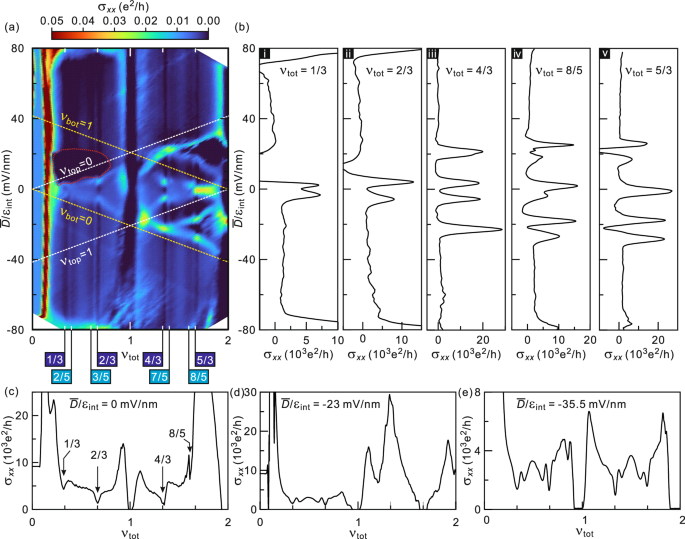
At the center of this story is a deceptively simple-sounding result: a team at the École Polytechnique Fédérale de Lausanne (EPFL), collaborating with the National Institute for Materials Science in Japan and Oxford's Rudolf Peierls Centre for Theoretical Physics, has directly measured a charge of e/3 — one-third of an electron's charge — inside a graphene device. That may sound abstract, but no free particle carrying a third of an electron's charge has ever been isolated in nature. What the team detected are quasiparticles: collective excitations that arise when electrons in a two-dimensional material interact so intensely that the individual electron effectively dissolves into something new.
The device works by engineering a tiny potential hill — an "antidot" — inside a bilayer graphene sheet, sandwiched between layers of hexagonal boron nitride and controlled by graphite gates. When the sheet is cooled to near absolute zero and subjected to a powerful magnetic field, the system enters the fractional quantum Hall state, where strongly interacting electrons fractionalize. The antidot acts as a bottleneck, and by measuring the conductance across it, the researchers can directly read out the charge of the quasiparticles tunneling through, as reported by Quantum Zeitgeist.
The team didn't stop at e/3. They also measured charges of 2e/3 and 3e/5, mapping out a menagerie of fractional charge states across different filling factors — the ratio of electrons to magnetic flux quanta threading the material. Each of these charges corresponds to a different emergent quantum phase, and each was previously extremely difficult to pin down with precision.
Non-Abelian Anyons: Particles That Remember
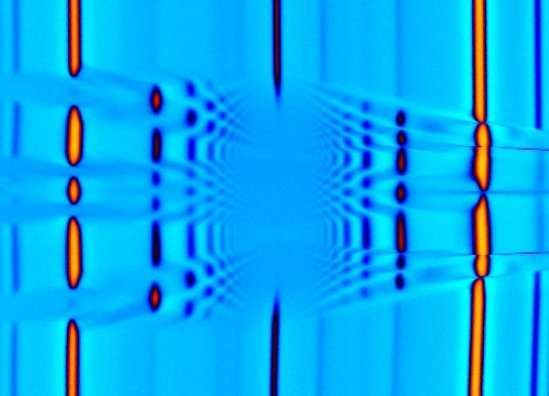
The EPFL result is part of a broader eruption of graphene-based discoveries in 2025–2026. In January 2026, a separate team from Israel's Weizmann Institute of Science and Japan's NIMS reported strong evidence for an even stranger class of particles — non-Abelian anyons — inside bilayer graphene tuned to an even-denominator fractional quantum Hall state.
In ordinary quantum mechanics, swapping two identical particles leaves only a simple phase factor in the wave function. Non-Abelian anyons break that rule: the order of their exchanges matters, and the system retains a kind of memory of past operations. This "history-aware" behavior, observed through Aharonov–Bohm interference patterns in a Fabry–Pérot interferometer, is precisely the property that makes these quasiparticles so attractive for quantum computing, according to Graphene-Info and Phys.org.
Separately, a controlled localization experiment demonstrated that anyons can be loaded onto and released from a gate-defined antidot in a graphene quantum Hall interferometer — a level of precision control that points toward real device architectures, as detailed on arXiv.
Why It Matters
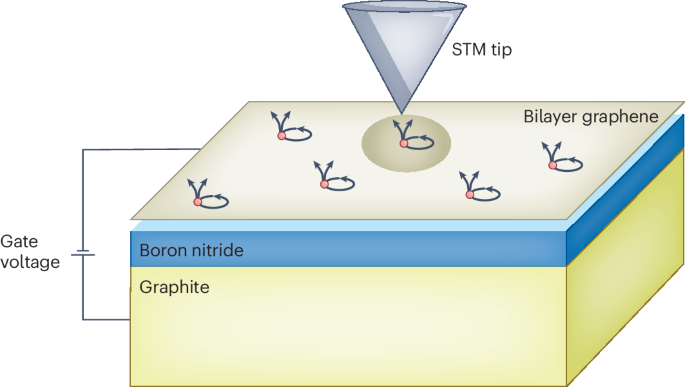
Graphene has become the proving ground for fractional quantum physics for a practical reason: it is extraordinarily clean. Unlike semiconductor heterostructures, graphene can be engineered to have almost no disorder, allowing fragile fractional states to survive long enough to study and manipulate. As MIT Physics and SciTechDaily have noted, these fractional electron states could serve as the physical substrate for topological quantum bits — qubits that store information in the global, topological configuration of anyons rather than in fragile local states, making them intrinsically resistant to decoherence.
The broader significance reaches beyond computing. Directly measuring fractional charges validates some of the most counterintuitive predictions of quantum field theory — the idea that the "elementary" electron is not always the relevant degree of freedom in strongly interacting matter. Every confirmed fractional charge is a vote for an entirely different way of thinking about what a particle is.
Key Takeaways
- **A graphene antidot device at EPFL has directly measured fractional electric charges of e/3, 2e/3, and *3e/5*** inside a fractional quantum Hall system — the clearest such measurements yet in a carbon-based platform.
- Bilayer graphene has now produced strong evidence for non-Abelian anyons, quasiparticles whose quantum state encodes a memory of past particle exchanges, a key ingredient for topological quantum computing.
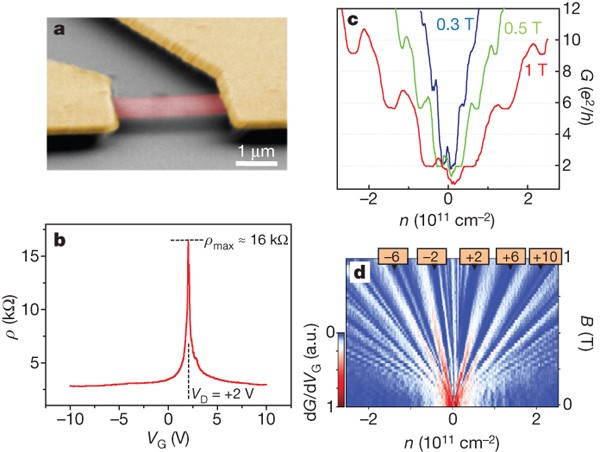
- Graphene's low disorder makes it the ideal testbed, enabling researchers to observe and control fractional states that are too fragile to survive in noisier materials.
- The path to fault-tolerant quantum computers runs through these results: demonstrating, measuring, and controlling fractionally charged quasiparticles are the foundational steps before any topological qubit architecture can be built.
Sources:
- Scientists Detect E/3 Charge In Graphene's Quantum Hall State – Quantum Zeitgeist
- Electrons become fractions of themselves in graphene – MIT Physics
- Fractional Electrons: MIT's New Graphene Breakthrough – SciTechDaily
- Aharonov–Bohm interference in bilayer graphene reveals history-aware anyons – Graphene-Info
- New evidence for a particle system that 'remembers' its previous quantum states – Phys.org
- Controlled localization of anyons in a graphene quantum Hall interferometer – arXiv
- Exotic quasiparticles glimpsed in graphene – Nature