Global Religion Tally: Faith, Doubt, and Demographic Destiny in the 21st Century
The religious map of humanity is being redrawn — not by conquest or edict, but by birthrates, migration, generational drift, and the quiet, private choices billions of people make about whether to believe. As of 2025, roughly 8.1 billion people inhabit the Earth. Among them, the devout, the doubting, and the definitively secular are distributed in patterns that would have been unrecognizable to observers just a century ago. Powered by the most comprehensive dataset yet assembled on global religion — the Pew Research Center's June 2025 report How the Global Religious Landscape Changed From 2010 to 2020, built from over 2,700 sources across 201 countries — we can now trace with precision how faith communities have grown, contracted, and transformed over a critical decade. The findings are striking: Islam is surging, Christianity is holding its global share while collapsing in Europe and stabilizing in the Americas, Buddhism is shrinking, and the irreligious are growing rapidly in the West even as they lose global market share to high-fertility religious populations in Africa and Asia.
This is the global religion tally.
The World's Major Religious Groups: A 2020 Snapshot
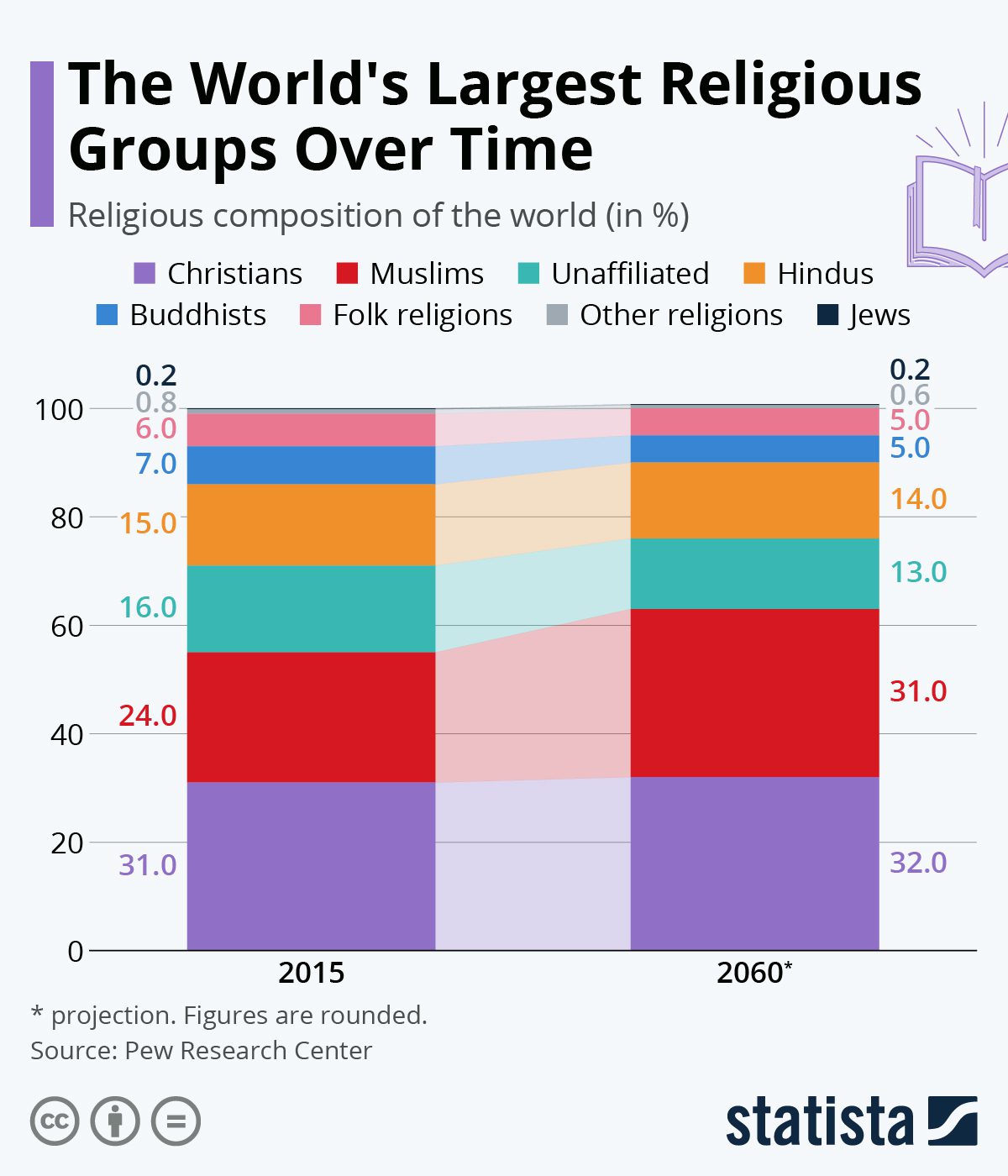
Before examining change, it helps to establish where things stood at the last fully measured moment. In 2020, the global population of approximately 7.7 billion was distributed across faith traditions roughly as follows:
| Religious Group | Estimated Population (2020) | Share of World Population |
|---|---|---|
| Christians | 2.38 billion | ~31% |
| Muslims | 2.0 billion | ~26% |
| Hindus | 1.2 billion | ~15% |
| Religiously Unaffiliated | 1.2–1.9 billion | ~16–24% |
| Buddhists | 324–507 million | ~4–7% |
| Folk/Traditional Religions | ~430 million | ~6% |
| Other Religions (Sikh, Baha'i, Jain, etc.) | ~172 million | ~2% |
| Jews | ~14.8 million | ~0.2% |
These figures carry inherent uncertainties. Religious self-identification differs from active practice; census categories differ from country to country; and governments in places like China actively suppress or distort religious data. Nevertheless, the broad contours are clear: Christianity and Islam together account for more than half of all human beings alive today.
Christianity: The Largest Faith, Under Pressure
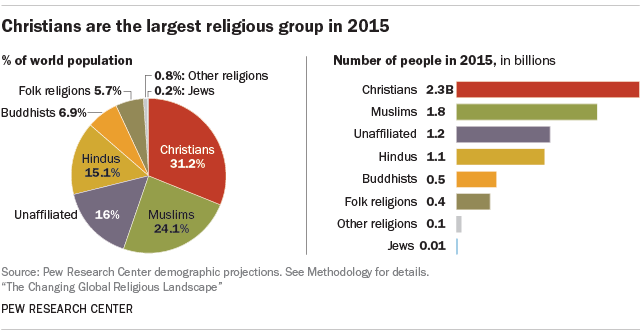
Christianity remains the world's largest religion, but its story in the twenty-first century is bifurcated. In absolute terms, it grew from approximately 2.17 billion in 2010 to 2.38 billion in 2020 — an increase of roughly 122 million people. That sounds like a healthy expansion. In percentage terms, however, Christians barely kept pace with global population growth, and their share of the overall pie has remained roughly flat or edged downward depending on the measurement used.
The more alarming story for Christianity lies in its regional composition. The faith's center of gravity has decisively shifted to the Global South. Sub-Saharan Africa and Latin America are now home to the majority of the world's practicing Christians, while the historic heartlands of the faith — Europe and North America — are experiencing what demographers and sociologists variously call "dechristianization," "religious switching," or simply secular drift.
The European Collapse
The Pew report's findings on Europe are stark. Between 2010 and 2020, the absolute number of Christians in Europe dropped by 9%, falling to approximately 505 million. France and the United Kingdom each lost their Christian majority during this period. The Netherlands, long associated with Protestant Calvinist heritage, now has an unaffiliated majority. In total, the number of European Christians fell by around 17 million in the decade, driven almost entirely by religious switching — people who were raised Christian but no longer identify as such as adults.
A cascading dynamic underlies this: when fewer children are raised with religious identities, fewer adults maintain them, and the intergenerational transmission of faith breaks down. Secularization in Western Europe is now self-reinforcing.
The American Plateau
In the United States, the trajectory has been less catastrophic but no less significant. In 2007, 78% of American adults identified as Christian, according to Pew. By 2024, that figure had fallen to between 60% and 64%. However — and this is an important nuance — a February 2025 Pew Research Center study titled Decline of Christianity in the U.S. Has Slowed, May Have Leveled Off found that the Christian share of the U.S. adult population had been relatively stable between 2019 and 2024, hovering between 60% and 64%.
This does not mean decline has reversed; it may mean the first, fastest wave of switching has already occurred, and the remaining Christians are those with stronger attachment. Gallup data, however, tells a sobering companion story: America's drop in religiosity has been among the largest recorded globally over the past two decades.
Christianity's Southern Resilience
The counterweight to Western decline is African and Asian growth. Sub-Saharan Africa's Christian population has expanded dramatically, with high fertility rates and vibrant evangelical and Pentecostal movements driving growth. Latin America maintains enormous Christian populations, though Pentecostalism has steadily displaced the Catholic Church's once-unchallenged dominance. The global Christian count still rises because of these regions, even as it falls in Europe and plateaus in North America.
Islam: The World's Fastest-Growing Religion
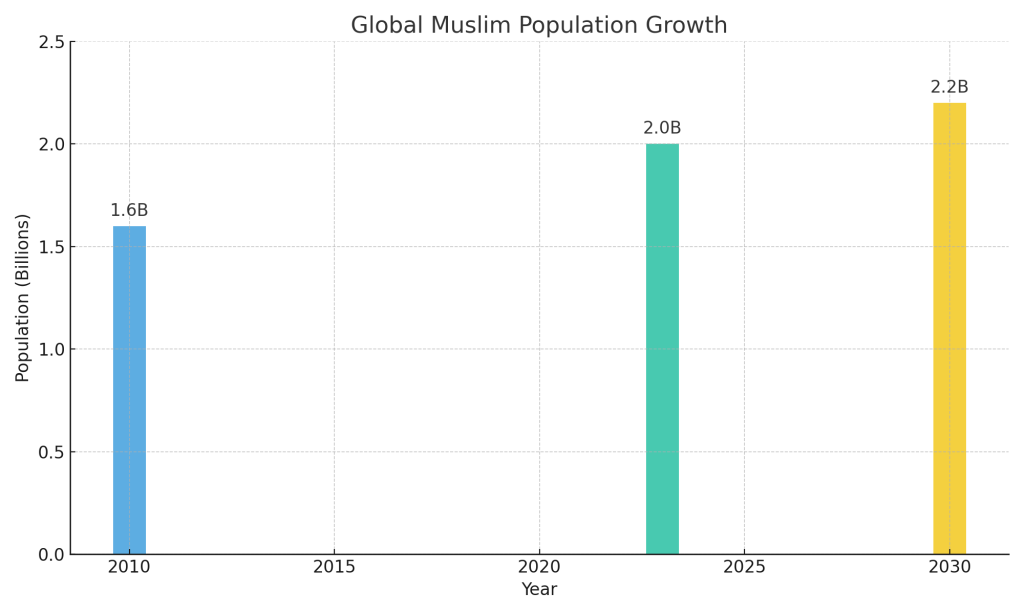
If one number defines the story of global religion in the early twenty-first century, it is this: Islam grew by approximately 327–347 million adherents between 2010 and 2020 — nearly three times the absolute growth of Christianity in the same period. From roughly 1.6 billion in 2010, the global Muslim population reached approximately 2 billion by 2020. That is an increase of more than 20% in a single decade.
By every major metric — fertility rate, age structure, geographic momentum — Islam is the world's fastest-growing major religion. Pew Research Center projections, first published in 2015 and continuously updated, suggest that by approximately 2070, Islam will surpass Christianity to become the world's largest religion, a milestone that would mark one of the most significant shifts in human religious history.
Why Islam Grows: The Demographic Engine
The sources of Islam's growth are overwhelmingly demographic rather than evangelical. Research published in 2025 by Vox Divini and consistent with Pew's demographic modeling attributes 90–95% of Muslim population increases to natural growth — births minus deaths — rather than conversion. Several structural factors drive this:
Fertility rates. Muslims have the highest fertility rate of any major religious group, averaging approximately 3.1 children per woman globally. This sits well above the global average and considerably above the replacement-level rate of 2.1. In sub-Saharan Africa, where Muslim fertility intersects with already-high regional rates, the figure can exceed 4–6 children per woman.
Young median age. The Muslim population is the youngest of any major faith. A higher proportion of Muslims are in or entering their peak childbearing years than adherents of any other religion, creating a demographic momentum that will persist for decades even if fertility rates eventually converge toward global norms.
Geographic concentration in high-growth regions. The vast majority of Muslims live in sub-Saharan Africa, South Asia, and Southeast Asia — regions with among the highest birth rates and youngest age profiles in the world.
Sub-Saharan Africa: Islam's New Frontier
Sub-Saharan Africa deserves particular attention. From 2010 to 2020, the region's share of the world's Muslim population grew from 15% to 18%. According to Pew's 2050 projections, the Muslim population in sub-Saharan Africa is expected to grow from 248 million to 670 million — a 170% increase — compared to a 115% increase for Christians in the same region. By 2050, approximately 24% of the world's Muslims will live in sub-Saharan Africa, up from 16% in 2010.
This is not merely a story of Islam spreading into new territory; it is a story of an already-substantial Muslim presence in one of the world's fastest-growing demographic regions compounding into global dominance.
Conversions: A Minor but Real Factor
While conversion is not the primary driver of Islamic growth, it is not negligible either. Western Europe has seen small but consistent numbers of converts — particularly women — and in parts of sub-Saharan Africa, Islam's association with trade networks, education infrastructure, and communal organization continues to attract adherents from indigenous traditions. But the net conversion impact remains, by demographic modeling, a rounding error compared to natural increase.
Hinduism: Stable, Deep-Rooted, and Growing Modestly

Hinduism, the world's third-largest religion, grew from approximately 1 billion adherents in 2010 to approximately 1.2 billion in 2020 — an increase of around 126 million, a rate broadly comparable to overall global population growth. Hindus represent approximately 14–15% of the global population, a share that has remained relatively stable.
This stability reflects Hinduism's unique demographic character: the vast majority of its adherents (over 90%) live in India, where fertility rates have fallen significantly over recent decades as economic development has progressed. Unlike Islam, Hinduism has neither the fertility-rate differential nor the geographic momentum to substantially expand its global share. Conversion into Hinduism is rare in most cultural contexts, and conversion out is also uncommon in India's deeply embedded social and caste structures.
India itself is home to approximately 1.093 billion Hindus — essentially the entire Indian Hindu population — making the fate of Hinduism almost entirely dependent on Indian demographics. As India's fertility rate has fallen toward replacement level, Hindu growth has moderated accordingly.
Buddhism: The Shrinking Giant
Buddhism presents one of the most counterintuitive data points in global religion: despite its image as a growing, globally appealing spirituality, the Buddhist population actually declined by approximately 5% between 2010 and 2020, from 343 million to roughly 324 million by Pew's most conservative measurement. Some broader-definition estimates place the 2024 figure higher, at approximately 507 million, by including practitioners who blend Buddhist practice with other traditions — a common pattern in East Asia.
The decline stems primarily from demographic trends in the faith's heartland: China, Japan, South Korea, and other East Asian countries where Buddhism is concentrated. These countries have among the lowest fertility rates in the world and rapidly aging populations. Japan's Buddhist temples are, in many regions, literally running out of parishioners. In China, official Buddhist affiliation statistics are further complicated by government reporting constraints and the syncretic nature of Chinese folk religion, where Buddhism blends with Taoism and Confucianism.
Buddhism's global future is also shaped by the near-total geographic concentration of its adherents: approximately 98% of the world's Buddhists live in the Asia-Pacific region. Without significant demographic growth in that region or successful conversion movements in the West — which exist but remain small in absolute terms — Buddhism's global share is likely to continue declining as a proportion of world population even if absolute numbers stabilize.
The Religiously Unaffiliated: A Complex Story of Growth and Limits
No group in the global religious landscape is harder to characterize, and few are more important to understand. The "religiously unaffiliated" — a broad category encompassing atheists, agnostics, and those who describe their religion as "nothing in particular" — constitute one of the fastest-growing categories in Western nations but face a paradox at the global scale: they are growing in the countries where population growth is slowest, and they are rare in the countries where population growth is fastest.
Global Numbers
The Pew 2025 report found that the global religiously unaffiliated population grew by approximately 17% between 2010 and 2020. Estimates of the absolute 2020 figure range from approximately 1.2 billion on conservative definitions to 1.9 billion under broader counting — the latter figure would make the unaffiliated the world's third-largest "group" after Christians and Muslims.
Across the globe, approximately 10% of people now identify as convinced atheists, up from 6% in 2005, according to survey data reviewed in 2025. The category of "agnostic" or "nothing in particular" adds substantially more.
The American Story
In the United States, the unaffiliated have grown from a marginal category in the mid-twentieth century to nearly a third of the adult population. As of 2025, the PRRI Census of American Religion found that 28% of Americans identify as having no religious tradition. Pew's 2023–24 Religious Landscape Study similarly found 29% of U.S. adults in the unaffiliated category.
The demographic pattern within the unaffiliated is striking. Among Americans aged 18–29, 38% now identify as religiously unaffiliated — the highest rate of any age cohort. Among young women aged 18–29 specifically, that figure rose to 43% in 2025, up from 29% in 2013. Young American women are now more likely to be religiously unaffiliated than young American men — a reversal of the historical pattern and one of the more remarkable findings in recent religious demography.
The European Story
Europe's unaffiliated population has grown even more rapidly than America's in relative terms. Between 2010 and 2020, the Netherlands, France, and the United Kingdom all saw significant expansions of their unaffiliated populations, with the Netherlands gaining an outright unaffiliated majority. This growth is driven primarily by the same mechanism identified across the West: people raised in nominally Christian households are simply not transmitting religious identity to the next generation.
The Global Paradox
Despite these Western gains, the global share of the religiously unaffiliated is expected to decline from approximately 16% to 13% by 2050. The reason: the unaffiliated are heavily concentrated in Europe, North America, East Asia (particularly China), and parts of Latin America — regions with low or below-replacement fertility rates. The religiously affiliated, especially Muslims and sub-Saharan African Christians, are having far more children. Demography, in this respect, is working against secularism at the global scale even as it advances in wealthy, low-fertility nations.
Seventy-six percent of the world's religiously unaffiliated people resided in the Asia-Pacific region in 2010 — predominantly China, where large populations hold no formal religious affiliation. As China's population ages and its share of global population declines, the unaffiliated's global percentage will follow.
Judaism, Sikhism, and Smaller Traditions
Judaism
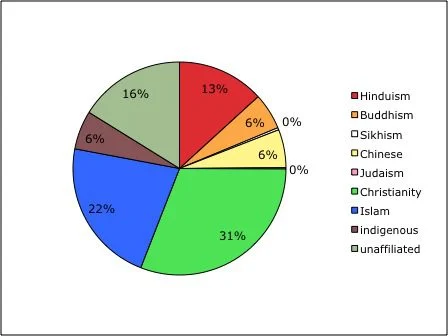
The Jewish population stood at approximately 14.8 million globally in 2020, representing around 0.2% of the world's population — a figure that has remained roughly stable for decades. The Jewish people are demographically concentrated in two countries: Israel (approximately 7 million) and the United States (approximately 6 million). Growth rates are modest, with intra-community variations between secular, Reform, Conservative, and ultra-Orthodox communities — the latter having significantly higher fertility rates and now representing a growing share of Jewish demographic counts, particularly in Israel.
Sikhism
Sikhism, founded in the Punjab region of South Asia in the fifteenth century, has approximately 25 million adherents globally, concentrated in India and in diaspora communities in the United Kingdom, Canada, the United States, and Australia. Sikhism is not a missionary faith, and its growth is driven primarily by natural increase within existing communities.
Folk and Traditional Religions
Approximately 430 million people globally practice folk or traditional religions — African traditional religions, Chinese folk religion, Indigenous American traditions, and Australian Aboriginal spiritualities. These traditions present significant measurement challenges, as practitioners often simultaneously hold formal affiliations with other religions. Sub-Saharan Africa and rural Asia are the primary loci. The 2025 Pew data shows this category holding at roughly 6% of global population.
Baha'i, Jainism, Taoism, and Other Traditions
The "other religions" category — encompassing the Baha'i Faith, Jainism, Taoism, Shintoism, Tenrikyo, Zoroastrianism, and dozens of additional traditions — collectively accounts for approximately 172 million people globally, or roughly 2.2% of world population. This share held steady from 2010 to 2020. Individually, these traditions range from the Jain community (approximately 4–6 million, mostly in India) to the Baha'i Faith, which claims millions of adherents across the globe in one of the more geographically dispersed faith communities in existence.
Ten-Year Change: A Decade in Numbers (2010–2020)
The clearest way to understand the directional momentum of global religion is to view the decade's changes side by side.
| Religious Group | 2010 Population | 2020 Population | Change | % Change |
|---|---|---|---|---|
| Christians | ~2.17 billion | ~2.38 billion | +122 million | +5.6% |
| Muslims | ~1.60 billion | ~2.00 billion | +327–347 million | +20–22% |
| Hindus | ~1.04 billion | ~1.17 billion | +126 million | +12% |
| Buddhists | ~343 million | ~324 million | -19 million | -5.5% |
| Jews | ~13.9 million | ~14.8 million | +0.9 million | +6.5% |
| Folk Religions | ~400 million | ~430 million | +30 million | +7.5% |
| Unaffiliated | ~1.1 billion | ~1.2–1.9 billion | +17% est. | +17% |
The dominant story in this table is Islam's extraordinary absolute and percentage growth. Christianity's raw growth of 122 million sounds significant but lagged behind global population growth, meaning Christianity's share of the global total effectively declined or held flat. Hinduism grew proportionally but without outrunning the global population increase. Buddhism's contraction makes it the only major world religion to have recorded a decline in absolute numbers over the decade.
The Fastest-Growing Religion: Islam's Structural Advantage
Islam is unambiguously the fastest-growing major religion in the world by every significant metric. Its combination of the highest fertility rate among major faiths (3.1 children per woman), the youngest median age of any global faith community, and strong geographic presence in the highest-birthrate regions of the world creates a compounding demographic engine with no close parallel among the world's other religions.
The Salt Lake Tribune, reporting in June 2025, summarized Pew's findings with a direct headline: "Islam is the fastest-growing faith." From 2010 to 2020, Muslims grew faster than the world population itself, meaning Islam's global share expanded — from approximately 23% in 2010 to approximately 25–26% in 2020. Pew's 2015 projections, which have proven remarkably accurate, forecast that Islam will account for 30% of the world's population by 2050, and that around 2070, the number of Muslims will surpass the number of Christians for the first time in history.
This growth is not driven by the appeal of Islamic theology to outsiders in the Western sense — though conversion does occur. It is driven by the same force that has shaped civilizational histories across time: who is having the most children, and where do those children live. Muslims in sub-Saharan Africa and South Asia are having more children than any other major religious group. Those children are being raised Muslim. The math is, at this point, largely settled.
The counterargument — that modernization will eventually reduce Muslim fertility rates just as it has reduced Christian and Buddhist rates — is both theoretically sound and historically supported. Economic development does correlate with declining fertility across all religious groups. The question is timing: will Muslim-majority societies modernize and lower their fertility fast enough to interrupt the demographic momentum already built up, or will the compounding advantage of the next two or three decades already have locked in Islam's global plurality?
Regional Hotspots and Emerging Trends
Sub-Saharan Africa: The World's Most Religious Region
No region shapes global religion's future more definitively than sub-Saharan Africa. The region has the world's highest fertility rates, the youngest population, and among the highest rates of religious adherence of any place on Earth. Both Christianity and Islam are growing rapidly there, with Islam growing faster in proportional terms. By 2050, sub-Saharan Africa will likely be home to the majority of the world's practicing Christians — a demographic inversion of the colonial-era map — and to nearly a quarter of the world's Muslims.
East Asia: Secular Drift in a Post-Religious Landscape
China presents a paradox: it has the world's largest Buddhist population in absolute terms (estimated at 254.7 million), yet Chinese society is also among the most formally irreligious. Official government tallies count only around 200 million religious believers — less than 15% of the population — though broader measures of Buddhist practice and folk religion suggest far higher participation. Protestant Christianity in China grew from 22 million to at least 38 million between 2010 and 2020, even under government pressure. Japan's Buddhist institutions face existential demographic challenges as the country's population ages and shrinks.
North America and Europe: The Post-Christian West
The United States, Canada, the United Kingdom, France, the Netherlands, and the Nordic countries are all experiencing the same broad phenomenon: a generation raised in nominally Christian households that is not passing religious affiliation to its children. Young Americans are now more likely to be religiously unaffiliated than to belong to any single Christian denomination. The plateau in U.S. Christian decline identified by Pew in 2025 is noteworthy, but the structural forces — younger generations skewing irreligious, an aging core Christian population — suggest that the long-term trajectory remains secular.
Latin America: From Catholic Monolith to Contested Pluralism
Latin America is experiencing its own religious revolution. Once almost entirely Catholic, the region now has substantial and rapidly growing Evangelical and Pentecostal Protestant communities. Brazil, the world's largest Catholic country by population, has seen the Catholic Church's share of the population fall from approximately 90% in 1960 to around 50% in recent surveys. The rise of Pentecostalism — with its emphasis on healing, prosperity theology, and direct spiritual experience — represents one of the most significant religious shifts of the past half-century.
What Drives Religious Growth and Decline?
The Pew Research Center's 2025 report on demographic and switching factors identifies three primary mechanisms:
1. Fertility differentials. Religious groups with higher fertility rates grow faster. Muslims currently have the highest rate; the unaffiliated and Buddhists have the lowest. Over time, this single factor explains more variance in religious group growth than any other.
2. Religious switching. In countries where individuals can freely change or abandon religious affiliation, switching has significantly reduced Christianity's numbers in Europe and North America. The U.S. was specifically identified as a major switching country, with large numbers of people raised Christian becoming religiously unaffiliated. Islam loses relatively few members to switching and gains some through conversion.
3. Age structure and mortality. A younger population produces more births per decade than an older one. Islam's younger median age means a larger share of Muslims are in childbearing years, amplifying the fertility differential over time.
Conclusion
The global religion tally of 2025 reveals a world in the midst of one of history's most consequential demographic and spiritual reshufflings. Christianity holds its position as the world's largest faith, counting some 2.38 billion adherents, but faces serious headwinds from secularization in the West even as it grows in Africa. Islam, with 2 billion followers and counting, is the fastest-growing major religion on Earth — driven not by mass conversion but by the relentless arithmetic of a young, high-fertility population concentrated in the world's fastest-growing regions. By around 2070, Islam is projected to surpass Christianity as the world's largest religion.
Hinduism holds steady at 1.2 billion, closely tied to India's own demographic trajectory. Buddhism, despite its cultural visibility in the West, is the only major faith to have shrunk in absolute terms over the past decade, a casualty of East Asia's aging populations. The religiously unaffiliated number somewhere between 1.2 and 1.9 billion globally, growing fast in wealthy Western nations while losing ground as a global percentage because they are concentrated in low-fertility societies.
The century ahead will not simply replicate these trends. Economic development in Africa and South Asia will eventually reduce fertility rates. Urbanization accelerates secularization in historically religious societies. Climate disruption may reshape migration patterns in ways that upend regional religious demographics entirely. But for now, the trajectories are clear: Islam grows, the secular West empties its pews, and sub-Saharan Africa — young, devout, and demographically explosive — increasingly holds the balance of humanity's spiritual future.
Sources:
- The World's Religious Groups: How Their Sizes Changed from 2010 to 2020 | Pew Research Center
- How demographics, religious switching drove global religious change, 2010-2020 | Pew Research Center
- Countries with the most people with no religion & global unaffiliated population change, 2010-2020 | Pew Research Center
- Countries with the most Buddhists & global Buddhist population change, 2010-2020 | Pew Research Center
- Why Islam is the fastest-growing religion in the world | Salt Lake Tribune
- The Future of World Religions: Population Growth Projections, 2010-2050 | Pew Research Center
- Decline of Christianity in the U.S. Has Slowed, May Have Leveled Off | Pew Research Center
- 2025 PRRI Census of American Religion | PRRI
- Religious Nones in America: Who They Are and What They Believe | Pew Research Center
- How religious groups' sizes changed in Europe, 2010-2020 | Pew Research Center
- Why Muslims are the world's fastest-growing religious group | Pew Research Center
- Projected Religious Population Changes in Sub-Saharan Africa | Pew Research Center
- Measuring Religion in China | Pew Research Center
- World's Major Religions by Population 2024 | Vedantu
- Religious Landscape: An Overview of Religion by Country, 2024 | CEOWORLD Magazine
- Debunking the Myth: Muslim Population Growth Is Driven by Birth Rates, Not Mass Conversions | Vox Divini
- Drop in U.S. Religiosity Among Largest in World | Gallup
- How the Global Religious Landscape Changed From 2010 to 2020 (PDF) | Pew Research Center