Introduction to Federalist No. 78
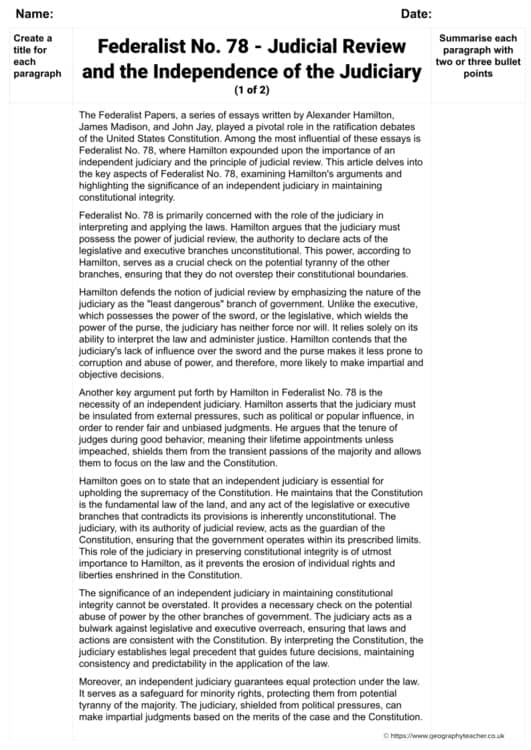
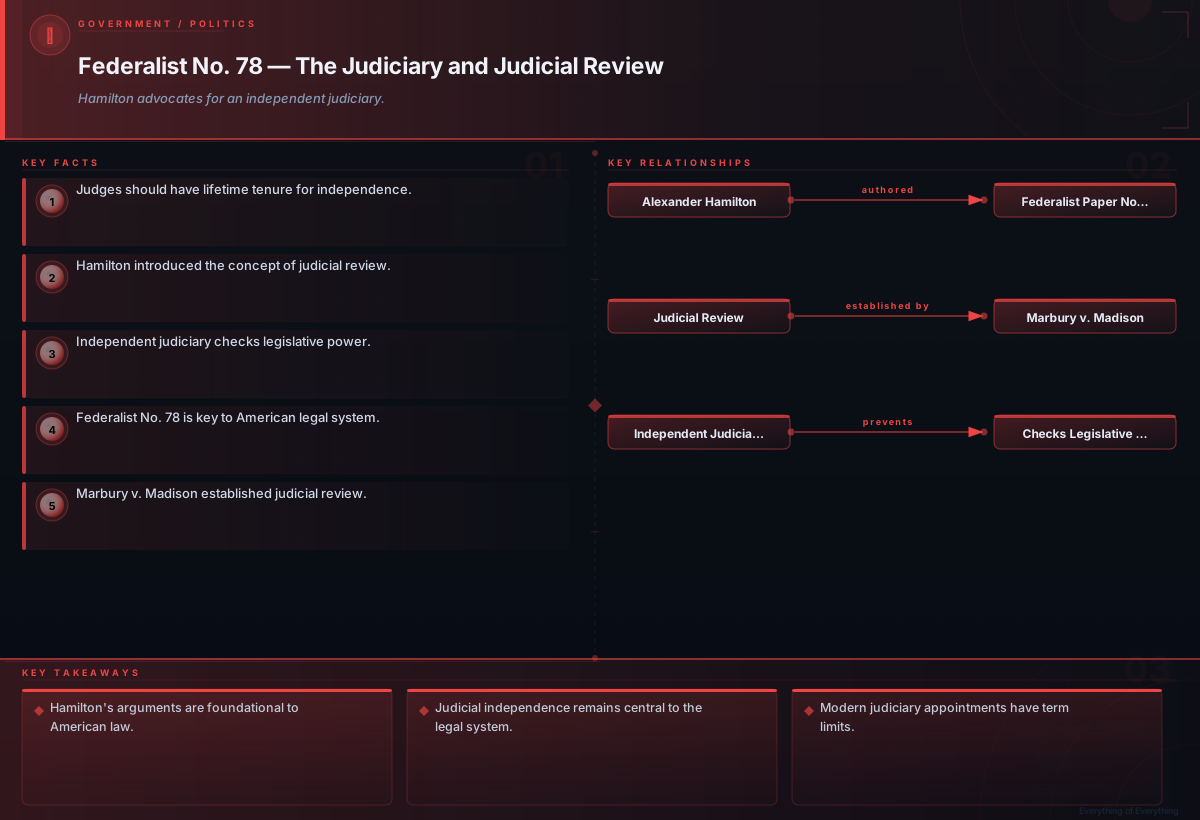
Written by Alexander Hamilton in 1788, Federalist Paper No. 78 is one of the eighty-five essays that constitute The Federalist Papers, a series of articles and essays written by several contributors in support of the ratification of the United States Constitution. Specifically dedicated to advocating for an independent judiciary, Hamilton's essay addresses the critical role of judicial review in ensuring a balance among the three branches of government: the legislative, executive, and judicial.
Hamilton's Defense of Lifetime Tenure for Federal Judges
Hamilton argued that judges should hold office for life to ensure their independence from both the executive and legislative branches. According to Hamilton, this permanence is crucial because "the judiciary is the weakest branch of our government" ([1]). Without lifetime tenure, judges could be removed by the other branches or by popular vote, undermining their impartiality and autonomy in interpreting the Constitution.
The Argument for an Independent Judiciary

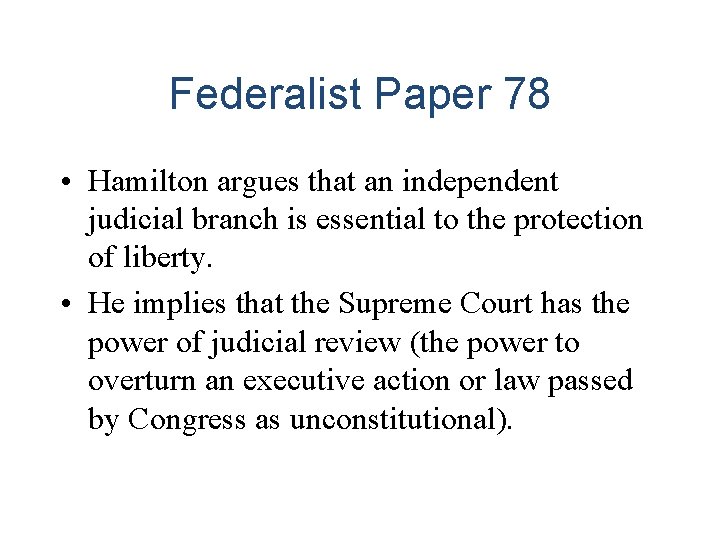
Hamilton contended that if the courts were not independent, they would lack the ability to effectively act as a bulwark against legislative overreach. An independent judiciary was necessary to check Congress's power and ensure that it did not encroach upon the rights of citizens ([2]). This view aligns with the broader Federalist perspective that a separation of powers is essential for maintaining liberty and preventing tyranny.
The Concept of Judicial Review
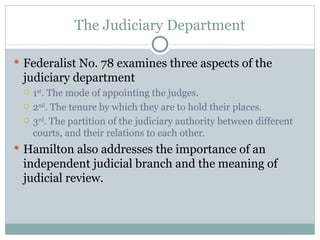
In Federalist No. 78, Hamilton also introduced the concept of judicial review—the power of courts to declare laws unconstitutional ([3]). He argued that this power was necessary to prevent the legislative branch from making laws that contravene the Constitution's limitations on government action. This legal doctrine would later be reinforced by the landmark Supreme Court case Marbury v. Madison in 1803.
The Significance of Federalist No. 78 for Modern Law
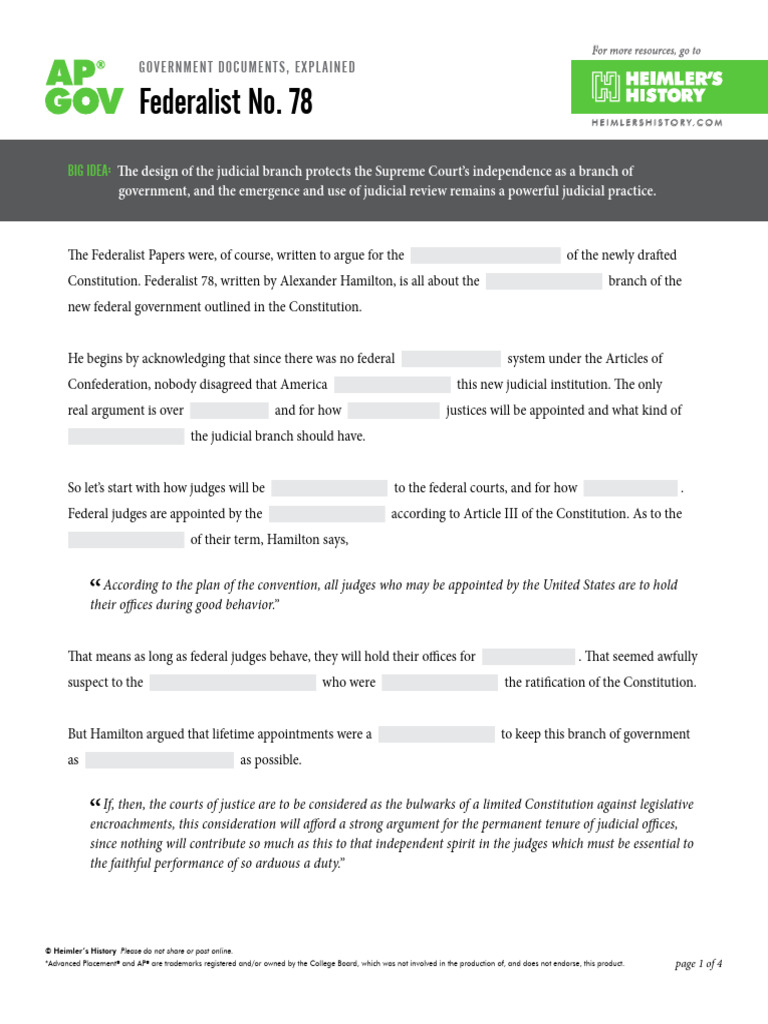
Hamilton's arguments laid a foundational intellectual basis for the development of American law, particularly regarding judicial independence and review. The concept of lifetime tenure for federal judges has been subject to interpretation over time. While modern judiciary appointments are not for life but rather for an unspecified term ("good behavior"), the principle of judicial independence remains central to the American legal system ([4]).
Marbury v. Madison (1803): A Milestone in Judicial Review
Marbury v. Madison, which originated from a political dispute between President Thomas Jefferson and his Federalist opponent John Marshall, Chief Justice at the time, effectively established the United States Supreme Court's right to judicial review [5]. Although Hamilton did not foresee this specific outcome, his arguments for an independent judiciary influenced the development of American legal thought up until this pivotal case.
The Evolution of Judicial Independence in the United States
The idea that federal judges should possess lifetime tenure has evolved over time. Despite initial support, there have been ongoing debates regarding judicial accountability and flexibility within the judiciary ([6]). Recent efforts to limit the terms of Supreme Court justices reflect a broader discussion about how to balance judicial independence with democratic principles.
Judicial Independence as a Contested Concept Today
The necessity of an independent judiciary remains both vital and contentious. Critics argue that lifetime tenure can insulate judges from public accountability, while proponents emphasize its importance for maintaining judicial integrity in the face of political pressure ([7]). This ongoing debate highlights the complex interplay between democracy and the rule of law.
Key Figures & Contributions
- Alexander Hamilton: Principal author of Federalist No. 78.
- John Marshall: Chief Justice who presided over Marbury v. Madison, cementing judicial review in U.S. law.
Current State & Recent Developments
The concept articulated in Federalist No. 78 has been a cornerstone for understanding the role of the judiciary in American democracy. However, recent calls for court reform and term limits reflect an evolving perspective on how to ensure that the judiciary remains responsive while maintaining its independence [8].
Key Takeaways
- Hamilton's arguments for lifetime tenure and judicial review have shaped American legal thought.
- Federalist No. 78 is crucial for understanding the balance among branches of government.
- Marbury v. Madison (1803) solidified judicial review as a constitutional principle in America.
- The concept of judicial independence remains central yet contested today.
Note: This article was created using information available up to July 2026. Further research may uncover additional insights and developments that can augment or modify this comprehensive overview of Federalist Paper No. 78.
Data Overview