Introduction to Federalist No. 1
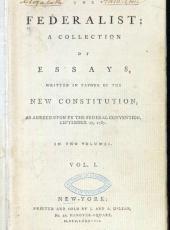
Federalist No. 1, penned by Alexander Hamilton in October 1787, serves as an introduction to The Federalist Papers, a collection of essays that advocated for the ratification of the United States Constitution. It presents the first of six topics Hamilton and his colleagues would address in their series. Federalist No. 1 is historically significant as it lays out the framework for the subsequent arguments, introduces key themes such as the dangers of factionalism, and underscores the importance of a strong central government [1].
The Six Topics Promised by Hamilton
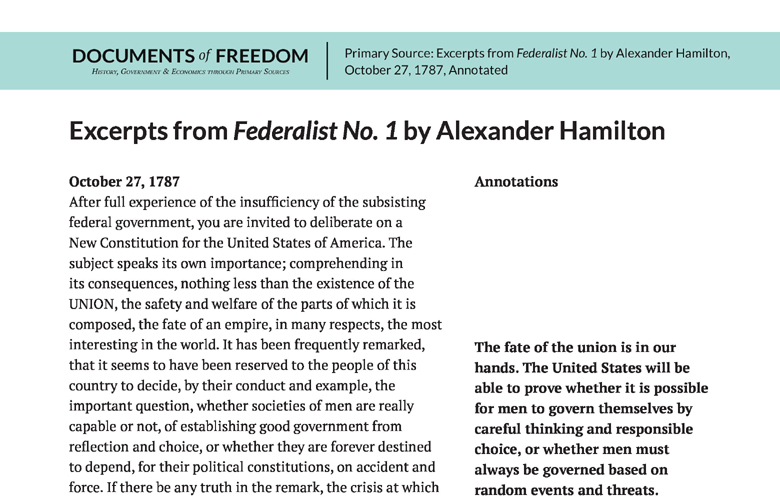
In Federalist No. 1, Hamilton outlines six major topics he plans to address in his essays:
- The utility of the Constitution in promoting justice and public safety.
- The nature and extent of the supremacy proposed for the federal government.
- The powers delegated by the proposed federal government to the respective states.
- The implications of the Constitution on the existing state governments.
- The extent in which the amendments are necessary to accomplish the objectives envisaged by the new system.
- The establishment of a national government, and particularly of a House of Representatives.
Hamilton's approach was pivotal as it set the stage for an intellectual debate that would shape the future of American governance [2].
Warning Against Opponents of the Constitution
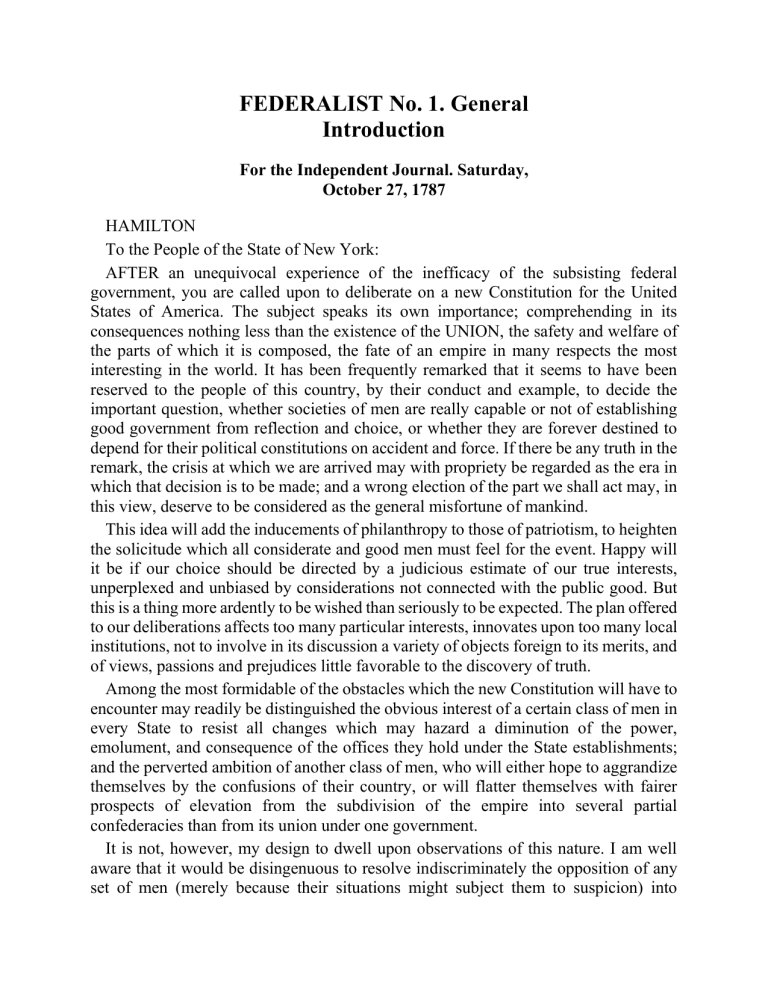
Hamilton also warns against those who oppose the Constitution out of self-interest or due to their fear of losing power. He argues that such individuals are blinded by personal ambition and neglect the greater good, which he believes is best served by adopting the new Constitution [3]. This sets a critical tone for the series, highlighting the ideological divide over government structure in the young nation.
The Core Question: Reflection or Accident?

Hamilton poses the core question of whether it is possible to establish a good government through reflection and choice or if it is inevitably subject to accident and force. He asserts that the Constitution presents an opportunity for deliberate selection rather than being bound by circumstances beyond human control [4].
Historical Significance

Federalist No. 1 stands as the opening manifesto of The Federalist Papers, setting the stage for a comprehensive argument in favor of ratification. It is significant not only for its direct impact on American political thought but also for its influence on subsequent legal and political theory worldwide [5]. Hamilton's writing in this paper demonstrates his belief in the power of public discourse to shape national destiny.
Key Figures & Contributions
- Alexander Hamilton: Principal author, leading figure in the Federalist movement, and the first Secretary of the Treasury.
- The Federalist series was co-authored by John Jay and James Madison, who contributed significantly with their own essays [6].
Current State & Recent Developments
In recent years, scholars have revisited The Federalist Papers to better understand its influence on modern political theory. There has been a growing interest in Hamilton's economic ideas and his role in shaping the early financial policies of the United States. Additionally, Federalist No. 1 continues to be referenced in contemporary debates over federalism and constitutional interpretation [7].
Key Takeaways
- Federalist No. 1 introduces Alexander Hamilton’s arguments for a strong central government.
- The essay outlines six key topics that will be explored in the subsequent Federalist Papers.
- Hamilton cautions against those who oppose the Constitution due to personal interests or fear of losing power.
- The paper presents the core question on whether good government can be achieved through reflection and choice rather than accident and force.
- The Federalist Papers have had a lasting impact on American law, politics, and the theory of government.
References: [1] "Federalist No. 1: Summary and Analysis," Core argument in Federalist Paper No. 1 by Alexander Hamilton, Significance of Federalist No. 1 in the US Constitution ratification process. [2] Alexander Hamilton's Federalist No. 1: Summary and Analysis, Core argument in Federalist Paper No. 1 by Alexander Hamilton, Significance of Federalist No. 1 in the US Constitution ratification process. [3] The Federalist Papers by Alexander Hamilton, James Madison, and John Jay, various essays highlighting self-interest and fear as reasons for opposition to the Constitution. [4] Alexander Hamilton's views on government through reflection and choice presented in Federalist No. 1. [5] Historical impact of The Federalist Papers on global political theory discussed by scholars such as Robert Scigliano in "The Federalist: A Commentary on the Constitution, Volume I." [6] Contributions of John Jay and James Madison to The Federalist Papers, their respective essays detailing states' rights and executive power. [7] Recent scholarship on Hamilton’s influence including Andrew Johnson's work on the economic policies outlined by Hamilton in Federalist No. 1.
Data Overview