Daniel Miessler: Security Sage, AI Synthesist, and the Architecture of Human Augmentation
The existing article frames Daniel Miessler primarily as an AI product developer — a builder of assistants evolving toward life platforms. That framing, while not entirely wrong, misses the more interesting story. Miessler is better understood as one of the rare technologists who has spent three decades at the intersection of adversarial systems thinking, epistemological humility, and practical philosophy. He is a cybersecurity professional who became an AI theorist, a tool-builder who became an essayist, and a pragmatist who took Stoic philosophy seriously enough to let it reshape his technical work. To understand what he's building now, you need to understand the full arc of what built him.
The Security Foundation: How Adversarial Thinking Shapes Everything

Most people encounter Daniel Miessler through one of two vectors: either his GitHub repositories or his newsletter. But the substrate beneath all of it is a career that began in the security trenches of the early 2000s, when application security was still a boutique specialty, SQL injection was fresh, and the idea of systematically enumerating attack surfaces across enterprise software was itself a novel methodology.
Miessler spent years doing penetration testing and security consulting at enterprise scale. His work brought him through roles at firms and organizations ranging from HP to consulting engagements across financial, healthcare, and government verticals. This was not the glamorous "hack the planet" cybersecurity of popular imagination — it was methodical, recursive, and deeply grounded in the discipline of building models of how attackers think.
What separates security professionals who become genuinely original thinkers from those who remain technically skilled but intellectually static is usually a willingness to ask why the adversarial model works — not just how to apply it. Miessler fell decisively into the former camp. His essays from the mid-2000s and onward show someone wrestling with second-order questions: Why do organizations keep making the same security mistakes? Why does threat modeling fail even when it's technically correct? What does it mean to understand a system rather than merely audit it?
These questions would eventually generate one of the most-used resources in the security industry.
SecLists: The Epistemology of Enumeration
If you have ever conducted a web application penetration test, run a fuzzing campaign, or done credential testing in a controlled environment, there is a reasonable chance you have used SecLists without necessarily knowing its provenance. The GitHub repository at danielmiessler/SecLists is one of the most-starred security-oriented repositories in the world — as of 2025, it sits well above 50,000 stars and has been forked tens of thousands of times.
What SecLists represents is not merely a technical convenience. It is a philosophy of knowledge organization applied to adversarial contexts. The repository collects, curates, and structures the raw material of security testing: usernames, passwords, URL patterns, file paths, fuzzing strings, network payloads, DNS entries, HTTP headers, and dozens of other categorical lists that penetration testers need to simulate real-world attack patterns.
The insight behind SecLists is deceptively simple but important: security testing is, at its core, an epistemological problem. An attacker succeeds not because they have access to exotic technical capabilities but because they know what to try. The defender fails not because of technical weakness alone but because they lack the vocabulary of threat — they don't know what a competent adversary would attempt. SecLists materializes that vocabulary into a structured, community-maintained, freely available resource.
This approach prefigures something Miessler would return to repeatedly in his later AI work: the idea that intelligence — artificial or human — is substantially about knowing the right questions, patterns, and lenses to apply to a given domain. Knowledge organization is not auxiliary to intelligence; it is intelligence, expressed as structure.
The SecLists project also established a pattern in how Miessler works: identify a gap where human knowledge exists but is poorly organized, build the scaffold that organizes it, and release it openly so the community can extend it. This is not the behavior of someone who views intellectual property as a moat. It is the behavior of someone who thinks the leverage is in the framework, not the content.
Application Security as Systems Thinking
Miessler's penetration testing work also gave him a systems-theoretic view of vulnerability that would prove transferable across domains. In application security, a single SQL injection or cross-site scripting vulnerability is less interesting than the class of error it represents — the implicit assumptions baked into how developers think about trust boundaries, input validation, and data flow.
Security thinking at this level requires you to hold two mental models simultaneously: how the system's designers believed it would be used, and how it can actually be used when you remove that assumption. This dual-model discipline — understanding designed behavior and actual behavior as separate things — is cognitively demanding and intellectually formative. It produces a particular kind of epistemic humility: a resistance to taking stated functionality at face value, a habit of probing for hidden assumptions, and an alertness to the gap between intention and implementation.
This discipline shows up throughout Miessler's writing in ways that are not immediately recognizable as security thinking. His essays on AI systems, on human cognition, on organizational behavior — all of them carry the fingerprints of someone trained to ask what happens when the design assumptions break. That is not a coincidence. It is a transferred methodology.
The Essayist: Unsupervised Learning and the Newsletter as Intellectual Form

Around 2014-2015, as newsletters were beginning their long comeback as a serious intellectual medium — well before Substack made the format fashionable — Miessler launched Unsupervised Learning, a weekly digest of security and technology news paired with original analysis. The name itself signals something: in machine learning, unsupervised learning refers to models that find structure in data without labeled examples, without being told in advance what the right answer looks like. It is learning by pattern recognition rather than instruction.
The choice of name is programmatic. Miessler positions himself and his readers as people who find structure in the noise of technological change without waiting for consensus to emerge, without deferring to institutional authorities about what matters. The newsletter's format reflects this: it synthesizes news across security, AI, technology, philosophy, and culture, and the synthesis is the product, not merely the curation.
Unsupervised Learning has grown into one of the more substantive technology newsletters covering the intersection of AI and security — a space that, as of 2025, has become perhaps the most consequential frontier in both fields. The newsletter is now also a podcast, allowing Miessler to develop arguments at greater length and engage with guests who represent different positions.
What distinguishes Unsupervised Learning from comparable newsletters is the deliberate integration of non-technical domains. Stoic philosophy, evolutionary biology, cognitive science, and epistemology are not decorative elements or appeals to intellectual credibility — they are load-bearing parts of the analytical framework. When Miessler writes about AI capabilities, he tends to situate the analysis in terms of what it means for human agency, human meaning-making, and human flourishing. This is not typical for technology newsletters, most of which oscillate between pure technical coverage and breathless futurism.
The Blog as Long-Form Laboratory
Miessler's personal blog at danielmiessler.com has been running for roughly two decades, which makes it one of the longer-running technology intellectual blogs still active. The archives contain hundreds of essays, and reading them chronologically is a way of tracking how his thinking evolved — from relatively focused security content in the early years to increasingly synthetic work that draws on philosophy, cognitive science, and social theory.
Several essays from the blog have circulated widely in technical communities. Pieces like "The Engineer's Episteme" and various essays on the nature of intelligence and learning reflect a thinker who found the technical domains he worked in philosophically interesting and who pursued those philosophical threads seriously.
The blog also serves as a laboratory for ideas that later appear in more finished form in other projects. Concepts around personal AI infrastructure, attention management, and the architecture of a deliberate life appear in early, exploratory form in blog posts years before they crystallize into projects like Fabric or PAI.
Fabric: The Tool That Explains the Philosophy
If SecLists is Miessler's contribution to the security tooling ecosystem, Fabric is his contribution to the AI augmentation ecosystem — and it is the project that best illuminates his overall intellectual architecture.
Fabric is an open-source framework hosted at danielmiessler/fabric on GitHub. At its technical core, it is a command-line tool that allows users to pipe text into AI language models and process it using a library of markdown files called "patterns." Each pattern is a structured prompt that instructs the AI to analyze or transform the input in a specific way. You might pipe a YouTube transcript through a pattern that extracts the core ideas and surprising claims. You might pipe a research paper through a pattern that identifies the key methodology and limitations. You might pipe your own writing through a pattern that checks it for logical consistency.
The architecture is deliberately modular and composable. Patterns can be chained. Custom patterns can be created and added to a personal library. The tool is designed to work with multiple AI providers, not locked to any single model. This is, again, a philosophy expressed as software: intelligence is about knowing what to ask and how to ask it; the patterns are that knowledge, externalized and reusable.
Why Fabric Matters Beyond Its Technical Function
Fabric arrived at a specific moment — the period after large language models became broadly accessible but before most people had developed coherent personal practices for working with them. The default mode of interacting with AI, for most people, was ad hoc: open a chat interface, type a question, get an answer, repeat. This approach works for simple queries but scales poorly. It doesn't build cumulative workflows. It doesn't encode expertise in reusable form. And it treats every interaction as context-free, ignoring the value of structured approaches developed through practice.
Fabric proposes a different model: AI as augmentation layer, patterns as accumulated wisdom, and the command-line interface as a deliberate choice that enforces specificity. This last point is more subtle than it appears. The graphical chat interface optimizes for conversational fluency. The command-line optimizes for precision and composability. By building Fabric as a CLI tool, Miessler makes a bet that the users who will get the most out of AI augmentation are those willing to invest in learning precise, composable patterns — not those who want AI to do everything through natural conversation.
This is a conceptual argument about AI use embedded in a design decision, which is characteristic of Miessler's approach generally: his technical choices carry philosophical implications, and he tends to be explicit about what those implications are.
The Pattern Library as Community Knowledge Structure
One of Fabric's more interesting social dynamics is that its pattern library is open-source and community-contributed. Miessler ships the tool with a core set of patterns — extract wisdom, create summary, analyze claims, generate questions, identify manipulation techniques — but the library is designed to grow through community contribution.
This creates a situation analogous to SecLists: a scaffold that the community fills in over time, where the value grows superlinearly with contribution. The pattern library becomes a repository of accumulated expertise about how to interact with AI productively across different domains and use cases.
There is also a meta-level insight here about AI and knowledge work. The bottleneck in AI-augmented productivity is frequently not the AI's capability but the human's ability to ask well-structured questions. Fabric's patterns are, in effect, high-quality question structures developed by practitioners, tested against real use cases, and shared as a commons. This is knowledge infrastructure — the same underlying impulse that produced SecLists, applied to a different domain.
PAI and LifeOS: Personal AI as Systems Architecture
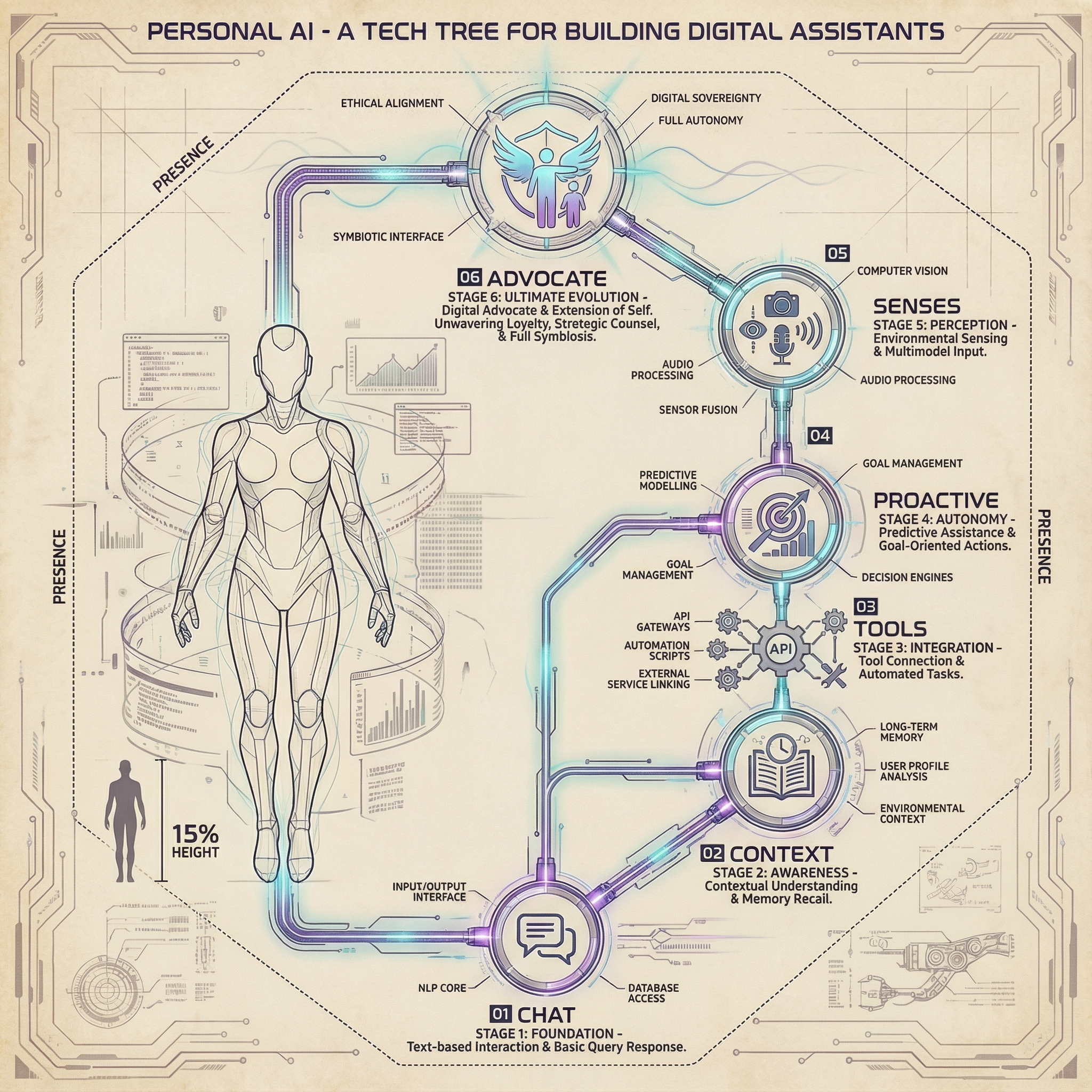
The existing article gestures toward PAI (Personal AI Infrastructure) and LifeOS without fully capturing what Miessler means by these concepts or why they matter. Neither is primarily a product — they are conceptual frameworks for thinking about how to integrate AI into a deliberate life.
PAI: The Personal AI Infrastructure
Miessler's concept of Personal AI Infrastructure starts from a premise that most people in the AI space are not emphasizing: that the way you build your relationship with AI systems is itself a design problem, and most people are approaching it with no design at all.
The PAI framework proposes thinking about your personal AI ecosystem the way you might think about any other important infrastructure — with deliberate choices about components, interfaces, data flows, and maintenance requirements. This means thinking about:
- Which AI tools you use and why
- How data flows between them
- What you train or customize versus what you take as-is
- How you maintain your own skills and judgment alongside AI assistance
- What contexts require AI augmentation versus deliberate non-augmentation
This is a more sophisticated position than either the AI-maximalist stance ("use AI for everything") or the AI-skeptic stance ("AI is a distraction from real thinking"). It is an engineering position: systems should be designed, not accumulated, and design requires explicit choices about architecture.
The PAI framework also addresses a problem that will become increasingly acute as AI tools proliferate: cognitive dependency. If you outsource enough of your thinking to AI systems, you risk atrophying the very capabilities that allow you to judge whether the AI's outputs are good. Miessler is explicit about this tension. His solution is not to avoid AI augmentation but to be deliberate about which cognitive capabilities remain in the human and which are extended into the AI layer — similar to how physical infrastructure decisions about automation have always required thinking about what human judgment remains essential.
LifeOS: Operating System as Metaphor
The LifeOS concept extends the infrastructure metaphor further. An operating system manages resources, schedules processes, provides interfaces between applications and hardware, and maintains state across sessions. If your personal AI infrastructure is the equivalent of installed software, LifeOS is the equivalent of the OS layer — the meta-system that coordinates everything else.
In practical terms, Miessler's LifeOS thinking involves designing how you capture information, how you process it, how you retrieve it, how you decide what to act on, and how you evaluate outcomes over time. This overlaps substantially with the "second brain" and personal knowledge management (PKM) traditions, but with a specific emphasis on AI integration at every layer and on the explicit design of the system rather than organic accumulation.
The LifeOS concept also draws on Miessler's philosophical interests in a direct way. Stoic philosophy is substantially about designing the conditions for a good life — not leaving it to circumstance but deliberately constructing habits, practices, and environments that make flourishing more likely. LifeOS is, in part, a technological implementation of this ancient design-your-life imperative.
The Philosophical Substrate: Stoicism, Epistemology, and Human Flourishing

To understand Miessler's technical work without understanding his philosophical commitments is to miss the load-bearing structure of the entire project. This is unusual in the technology industry, where philosophical interests are typically decorative — name-drops of Aristotle or Nietzsche that signal intellectual range without actually informing technical decisions.
Miessler's engagement with Stoic philosophy is different. Stoicism is not a brand element in his work; it is a methodology.
Stoicism as Engineering Framework
The Stoic philosophical tradition — Epictetus, Marcus Aurelius, Seneca — is primarily concerned with one practical question: given that most external circumstances are not under our control, how should we organize our attention, effort, and will to live well? The Stoic answer involves a fundamental distinction between what is "up to us" (judgment, intention, response) and what is not (circumstances, other people's actions, outcomes). Wisdom consists largely in not conflating these categories — not spending cognitive energy on what cannot be controlled, and not wasting attention on externals when internals are the actual domain of agency.
Applied to information work, this framework generates specific practical guidance. The contemporary information environment — characterized by infinite news, social media, notifications, and urgency — is specifically engineered to violate Stoic principles. It trains attention on externals (things that cannot be controlled) and fragments the sustained focus required for genuine judgment. Miessler's work on attention management, content curation, and deliberate AI integration is, in part, an engineering response to this problem: designing systems that protect the cognitive resources Stoic practice requires.
This is not a metaphorical application of Stoicism. It is fairly direct. Miessler explicitly frames questions about what information to consume, how to process it, and what to act on in terms of distinguishing between what is and is not within one's productive domain.
Epistemological Humility and the Security Mindset
There is a productive tension in Miessler's work between two epistemic stances. The security professional's stance is adversarial skepticism: assume the stated model is wrong, probe the edges, look for where the design assumptions break. The Stoic stance is something like humble engagement: accept what you cannot know, work with what you have, don't mistake confidence for competence.
These might seem to conflict — one is relentlessly skeptical, the other is accepting — but in Miessler's framing they are complementary. The security mindset applies to external systems and claims: be skeptical, probe assumptions, don't take interfaces at face value. The Stoic mindset applies to internal responses: don't let uncertainty generate paralysis, don't let skepticism become nihilism, maintain productive equanimity in the face of incomplete information.
This combination produces a distinctive intellectual style. Miessler's essays tend to be skeptical of received wisdom, willing to challenge consensus positions in both security and AI, but they avoid the cynicism or contrarianism that often accompanies that skepticism. The writing tone is measured, which is unusual for someone who frequently takes contrarian positions.
AI Safety, Alignment, and the Pragmatist's Critique
One of the more interesting dimensions of Miessler's thinking is his position on AI safety and alignment — a field that has grown enormously in prominence since the release of GPT-3 and accelerated with GPT-4 and its successors.
Miessler is not an AI safety skeptic in the dismissive sense. He takes the risks of advanced AI systems seriously and writes about them regularly. But he is skeptical of certain tendencies within the AI safety discourse — particularly what he sees as a disconnect between theoretical alignment frameworks and the practical reality of how AI systems are being developed and deployed.
The Capability-Safety Tension
A persistent theme in Miessler's AI writing is the tension between those who argue that capability development should be slowed until alignment problems are solved and those who argue that engagement with frontier capabilities is necessary to understand what alignment problems actually look like in practice. He tends toward the second position, though with important qualifications.
His argument, roughly, is that the most dangerous AI scenarios are not purely capability-driven but involve misuse by human actors — state actors, criminals, and organizations using AI to amplify existing harmful capabilities. From this perspective, the most important near-term security work is not building theoretical alignment frameworks but developing practical defenses against AI-augmented attacks on systems, institutions, and information ecosystems.
This positions Miessler as part of a pragmatist camp within AI security thinking — people who take long-run risks seriously but believe the proximate danger is from AI being misused by humans, not from AI systems becoming autonomously threatening. This view has implications for how you prioritize research, tooling, and policy — you focus more on threat detection, abuse prevention, and defensive AI than on grand theoretical alignment problems.
AI-Augmented Social Engineering: A Concrete Concern
One area where Miessler has been consistently prescient is the use of AI to enhance social engineering attacks. Traditional social engineering — phishing, pretexting, spear-phishing — depends on the attacker's ability to construct convincing false contexts. This requires language fluency, contextual knowledge about the target, and the ability to craft communications that don't trigger suspicion.
Large language models dramatically lower the cost of all of these requirements. Spear-phishing campaigns that previously required skilled human operators can now be generated at scale. Pretexting scripts can be customized automatically. Deepfake audio and video can impersonate known contacts. Miessler has written extensively about this threat vector and has argued that the security industry's traditional defenses — user education, email filtering, multi-factor authentication — are necessary but insufficient against AI-augmented social engineering at scale.
His proposed responses tend toward systemic rather than individual interventions: improving authentication infrastructure, building AI-based detection systems, and developing organizational policies that are robust to compromised communication channels. The emphasis on systemic response rather than individual user training reflects the security professional's realistic assessment of what individual actors can reliably do against sophisticated automated attacks.
The Intersection of Open-Source and Intelligence
One of the recurring themes in Miessler's work is the relationship between openness and intelligence — both artificial and human. This plays out in several different registers.
Open-Source as Epistemic Commons
Both SecLists and Fabric are open-source projects, and this is not merely a licensing choice. For Miessler, open-source represents a particular theory of how knowledge grows and how tools should relate to the communities that use them. The theory is roughly: lock knowledge behind proprietary barriers and you create artificial scarcity that slows the overall rate of learning; make knowledge open and the community extends it faster than any single organization could.
This is the standard open-source argument, but Miessler applies it with specific attention to what happens when AI augments open-source development. If an AI system can generate new security patterns, test them against real systems, and contribute them back to a shared repository, the rate at which the SecLists-style commons grows could accelerate dramatically. This is both an opportunity (defenders gain knowledge faster) and a risk (attackers gain the same knowledge equally fast).
The deeper question this raises — one that Miessler engages with but doesn't claim to resolve — is whether openness of AI tools and knowledge creates a net advantage for attackers or defenders. The security industry has debated this question about offensive security tools for decades. AI makes the stakes higher because the gap between attacker and defender capability is harder to assess when both sides can use the same AI systems.
Intelligence as Pattern + Context
There is a philosophical position buried in Fabric's architecture that is worth making explicit. By organizing AI interaction around patterns — structured prompts that encode domain expertise — Fabric embodies a particular theory of what intelligence is: intelligence is substantially the ability to apply the right pattern to a given situation, where "pattern" includes both the structural form of the inquiry and the relevant domain knowledge.
This is not a complete theory of intelligence, but it is a useful partial one for thinking about AI augmentation. The human's role in an AI-augmented workflow, on this view, is not simply to provide prompts but to select and refine patterns — to bring the domain expertise and contextual judgment that determines which pattern applies, when, and how to evaluate the output.
This view is more sophisticated than the simple "AI as tool" or "AI as assistant" framings. It positions AI augmentation as a partnership where the human brings structural knowledge and judgment while the AI brings processing speed and the ability to apply that structure at scale. The quality of the partnership depends on the quality of the patterns, which is why the pattern library is the intellectual core of the Fabric project.
Cross-Domain Synthesis: Where Security Meets Cognition
One of the underappreciated aspects of Miessler's work is the cross-domain synthesis it represents. Most technology practitioners work deeply in one or two domains. Miessler has developed genuine expertise across cybersecurity, AI systems, philosophy of mind, cognitive science, and information theory — and these domains interact in his thinking in non-trivial ways.
Threat Modeling and Cognitive Security
Threat modeling — the security practice of systematically identifying how a system can be attacked — has an obvious analog in cognitive security: systematically identifying how your own reasoning and decision-making can be manipulated, distorted, or exploited. Miessler has written about this connection, arguing that the same adversarial mindset that makes security professionals good at finding vulnerabilities in technical systems can be applied to finding vulnerabilities in reasoning processes.
Cognitive biases, in this framing, are not just psychological curiosities — they are known attack vectors that bad actors (and bad information environments) exploit. The practice of epistemic hygiene — being deliberate about sources, incentives, and reasoning patterns — is analogous to security hygiene in technical systems. Both involve making explicit the implicit assumptions and dependencies that create vulnerability.
This framing has practical implications. If cognitive bias is an attack vector, then defenses against misinformation and manipulation are not primarily technical (fact-checking tools, content moderation algorithms) but cognitive — involving the development and maintenance of reasoning capabilities that are robust to adversarial conditions. Miessler's writing on this tends to emphasize the need for sustained practice rather than technical fixes, which is the Stoic inflection: the defenses that matter are internal, not external.
Information Theory and Attention Economics
Miessler's thinking about information consumption is informed by concepts from information theory — the field founded by Claude Shannon that deals with the quantification, storage, and transmission of information. One of Shannon's key insights is that information has value in proportion to how much it reduces uncertainty; messages that are entirely predictable carry no information by definition.
Applied to contemporary media and knowledge work, this framework suggests that a great deal of what appears to be information — news cycles, social media, opinion commentary — is actually very low in information content because it is highly predictable. It cycles through familiar patterns, confirms existing beliefs, and generates little genuine reduction in uncertainty about the world.
This connects to Miessler's curation philosophy in Unsupervised Learning and his content consumption practices more broadly: actively seek high-information content, which typically means going to primary sources rather than commentary, seeking out perspectives that genuinely challenge existing models rather than elaborate on them, and being willing to sit with uncertainty rather than filling it with low-quality inference.
Fabric's pattern for identifying "surprising" insights in content is a direct implementation of this principle: it instructs the AI to flag claims that are unexpected, counter-intuitive, or that challenge common assumptions — the claims that carry the most information precisely because they violate prior expectations.
Controversies, Critiques, and Open Tensions
No serious intellectual project is without its critics, and Miessler's work has attracted several lines of critique that are worth taking seriously.
The CLI Elitism Problem
Fabric's command-line interface design is a deliberate choice, but critics have noted that it creates a de facto accessibility barrier. The users who will invest in learning CLI tools are predominantly already technically sophisticated — developers, security professionals, researchers. The users who might benefit most from structured AI interaction patterns — knowledge workers without a technical background, educators, journalists — are also the users least likely to adopt a CLI tool.
This is a real tension. Miessler's response is essentially that Fabric is not designed to be a mass-market tool; it is designed for the technically sophisticated user who wants to go deep. But this raises questions about whether the knowledge infrastructure being built through the pattern library is effectively available to the broader community, or whether it creates a two-tier information economy where technically sophisticated users get AI augmentation that amplifies their advantage over less technically fluent users.
This concern extends to the broader AI augmentation project. If the tools and practices that best leverage AI capability require substantial technical investment to use, then AI augmentation may increase inequality in knowledge work rather than democratizing it — a possibility that Miessler acknowledges but does not claim to have fully resolved.
The Productivity Trap
A persistent critique of personal productivity systems — PKM, life-operating-system approaches, second-brain frameworks — is that they can become objects of optimization in themselves, absorbing the attention they were supposed to free. People spend more time building and refining their systems than actually using them to produce work.
Miessler is aware of this critique and his writing shows it. He tends to emphasize outputs over systems, asking whether the system is producing actual work rather than merely organizing knowledge. But the critique lands more sharply against the LifeOS concept than against Fabric: a tool with a clear use case is harder to turn into a meta-optimization project than a comprehensive life operating system, which by its nature invites indefinite elaboration.
The Stoic philosophical framework is supposed to guard against this — the Stoics were deeply skeptical of complexity for its own sake and emphasized practical action over theoretical elaboration. But embedding philosophical guardrails in complex systems is notoriously difficult; the system tends to grow regardless of the philosophy that was supposed to constrain it.
Security-Focused AI Caution vs. Rapid Adoption Advocacy
There is a tension in Miessler's work between his security professional's habits of mind — which emphasize threat modeling, attack surfaces, and caution about new dependencies — and his advocacy for rapid AI adoption and integration. Security professionals are generally among the most skeptical voices about adding new, complex, opaque systems to critical infrastructure. Yet Miessler argues for integrating AI deeply into personal and professional workflows.
His resolution of this tension involves distinguishing between AI augmentation of human decision-making (which he advocates) and AI replacement of human judgment in high-stakes contexts (about which he is more cautious). But critics have argued this distinction is harder to maintain in practice than in theory — that augmentation systems tend to become dependency systems as users lose the habits that the augmentation was supplementing.
This is an empirical question that the field is only beginning to be able to study, as the cohort of heavy AI users grows large enough to observe over meaningful time periods.
The Broader Impact: Building Vocabulary for a New Practice
Perhaps the most underrated aspect of Miessler's contribution is not any specific tool or framework but the vocabulary and conceptual structure he has developed for thinking about AI augmentation as a serious practice rather than a novelty or a threat.
Before frameworks like PAI and concepts like the AI augmentation pattern library existed, the conversation about personal AI use was mostly either breathless enthusiasm or reactive skepticism. Miessler contributed something more valuable: a vocabulary for design decisions. What should be augmented versus kept human? How should patterns be developed and shared? What is the infrastructure underlying a productive AI-human workflow?
These conceptual contributions propagate more slowly than tools — people don't star a conceptual framework on GitHub — but they are often more durable. The practitioners who have internalized the PAI framework will continue to think about AI integration differently even as specific tools change. The conceptual vocabulary shapes the design decisions they make even when they're not using Fabric directly.
Influence on the Security-AI Convergence Community
The intersection of cybersecurity and AI has become one of the most consequential frontiers in technology, and the community of practitioners working across both domains is still relatively small. Miessler is one of the more influential figures in this community — not primarily as a researcher producing academic papers but as a practitioner-intellectual helping the community develop shared language and frameworks.
This is a particular kind of influence: more like a node in a network than a source of a river. His Unsupervised Learning newsletter synthesizes and translates research and developments from both fields, making the intersection more legible to practitioners who are deep in one domain but not the other. Security professionals who don't follow AI research closely get enough context through Miessler's synthesis to make better decisions about AI-adjacent security questions, and AI practitioners who don't follow security closely get a clearer picture of the threat landscape their systems are entering.
Current Research Frontiers and Where Miessler Fits
As of 2025-2026, the research frontiers most relevant to Miessler's work include several areas where the intersection of security and AI is generating genuinely novel questions.
Prompt Injection and AI System Security
Prompt injection attacks — where adversarial inputs to AI systems manipulate their behavior in unintended ways — have emerged as a significant new attack surface as AI systems are integrated into consequential workflows. This is precisely the kind of problem where Miessler's dual expertise is most useful: understanding the security implications of AI systems requires both an adversarial security mindset and a technical understanding of how large language models actually process inputs.
Fabric's pattern architecture has some implications for prompt injection defense: by providing structured, controlled prompts that define the expected behavior, well-designed patterns can limit the surface area for injection attacks. But this is not a complete solution, and the field of AI security is actively developing more comprehensive defenses.
AI-Generated Synthetic Media and Authentication
The proliferation of AI-generated synthetic media — deepfake audio, video, and text — creates new challenges for authentication and verification that are fundamentally security problems but require understanding of AI capabilities. Miessler has written about this intersection extensively, and it is an area where the security community's threat modeling expertise is directly applicable to questions that might otherwise be treated as purely AI policy problems.
Agentic AI and Trust Boundaries
The emergence of agentic AI systems — AI that takes actions in the world, not just produces text — raises new questions about trust boundaries and authorization that map directly onto classic computer security problems. When an AI agent can browse the web, execute code, send emails, and interact with APIs, the question of what permissions it should have and how those permissions should be scoped is isomorphic to longstanding questions in computer security about process permissions and least-privilege design.
Miessler's security background positions him well to contribute to this conversation, and his writing on agentic AI has made explicit the connection to security architecture principles that many AI practitioners are only beginning to recognize.
The Question of Lasting Contribution
When assessing a figure like Daniel Miessler, it is worth asking what the lasting contribution is likely to be — not in the sense of legacy or reputation, but in the practical sense of what will have actually changed the way people work and think.
SecLists seems likely to remain a durable contribution simply because it solves a real problem with a community-maintained solution that has had years to accumulate value. The security testing vocabulary it encodes will remain useful as long as the attack surface categories it covers remain relevant, and many of them — web application vulnerabilities, authentication weaknesses, enumeration targets — show no signs of disappearing.
Fabric's lasting contribution is harder to assess because it depends on whether the pattern library approach to AI interaction proves more durable than alternative approaches. If AI interfaces become sufficiently sophisticated that structured prompting becomes less important — if natural conversation with AI systems converges in effectiveness with carefully engineered patterns — then Fabric's specific architecture may become less relevant even as the underlying insight about knowledge structure remains valid.
The conceptual vocabulary — PAI, LifeOS, the AI augmentation framework — may prove the most durable contribution precisely because it is the hardest to make obsolete. As long as people are making decisions about how to integrate AI into consequential workflows, the questions that vocabulary helps ask will remain relevant, regardless of which specific tools are answering them.
Open Questions
Several significant open questions attend Miessler's project, and they are worth naming explicitly:
Can the pattern library remain high-quality as it scales? Community-maintained repositories of knowledge suffer from quality degradation as they scale — the community that contributes to a library of 50 patterns is different from the community that contributes to one of 5,000. The curation challenge grows faster than the contribution rate, and the expertise required to evaluate a pattern's quality may not be uniformly distributed among contributors.
Does AI augmentation actually improve outcomes, or does it improve outputs? There is a difference between producing more content and producing better decisions. Productivity tools can optimize for the wrong metric. Whether Fabric and PAI actually improve the quality of knowledge work outcomes — measured by consequential decisions made, not content produced — remains an empirical question.
How does the Stoic framework scale to community? Stoic philosophy is fundamentally a philosophy of individual practice. Its prescriptions are about what the individual practitioner can control. But many of the most important problems Miessler engages with — AI safety, cognitive security against misinformation, organizational resilience — are fundamentally collective problems that require coordinated responses. The tension between an individual practice philosophy and collective-action challenges is not resolved in his work.
What does mastery look like when the tools change this fast? Both the security field and the AI field are characterized by rapid capability change. The patterns that work well against today's AI systems may be less relevant when the systems change substantially. Expertise in a rapidly changing domain has a different character than expertise in a stable one — it requires more emphasis on first principles and less on accumulated technique. How the PAI and LifeOS frameworks adapt to this is unclear.
Conclusion: The Synthesist's Role
Daniel Miessler occupies a specific and valuable role in the technology landscape: the practitioner-intellectual who works in the gap between deep technical practice and broader intellectual context. This role is less common than either the pure technologist or the pure commentator, and it is harder to sustain — it requires genuine expertise in both dimensions simultaneously, without letting either degrade.
His career arc — from security practitioner to security toolbuilder to AI augmentation theorist to philosophical writer — follows an unusual logic that is only legible when you understand the common thread: a persistent interest in the question of how intelligence, human and artificial, can be organized, shared, and deployed to make systems — technical, personal, and social — more capable and more resilient.
SecLists organized the adversarial vocabulary that security professionals needed. Fabric is attempting to organize the AI interaction patterns that knowledge workers need. The PAI and LifeOS frameworks are attempts to organize the design principles for integrating AI into deliberate lives. Unsupervised Learning synthesizes the weekly developments that make it possible to track where all of this is going.
None of these projects, taken individually, represents a complete vision. What they represent, taken together, is a coherent project: building the intellectual and practical infrastructure for the age of AI augmentation, informed by security thinking's adversarial rigor, Stoic philosophy's focus on what is actually within human agency, and information theory's unsparing view of what constitutes genuine knowledge.
That is a project worth taking seriously, not because Daniel Miessler has solved the problems it engages with, but because he has made the problems themselves more legible — and in rapidly evolving fields, identifying the right questions is most of the work.
Sources and further reading: danielmiessler.com; github.com/danielmiessler/fabric; github.com/danielmiessler/SecLists; Unsupervised Learning newsletter; cybersecuritysummit.com speaker archive. For philosophical context: Marcus Aurelius, Meditations; Epictetus, Discourses and Enchiridion; Claude Shannon and Warren Weaver, The Mathematical Theory of Communication (1949).