The 1440 Paradox: Bias, Business, and the Architecture of "Neutral" News
The Problem That 1440 Thinks It Has Solved
Every serious student of journalism history has encountered some version of the same impossible claim: that a news organization can rise above the human conditions of selection, emphasis, and interpretation to deliver something called objectivity. Walter Lippmann articulated the aspiration in Public Opinion (1922); the Society of Professional Journalists codified it into a code of ethics; and generations of reporters have invoked it as a professional shield. Every generation has also discovered, usually painfully, that the aspiration and the practice diverge in ways that are not accidental but structural.
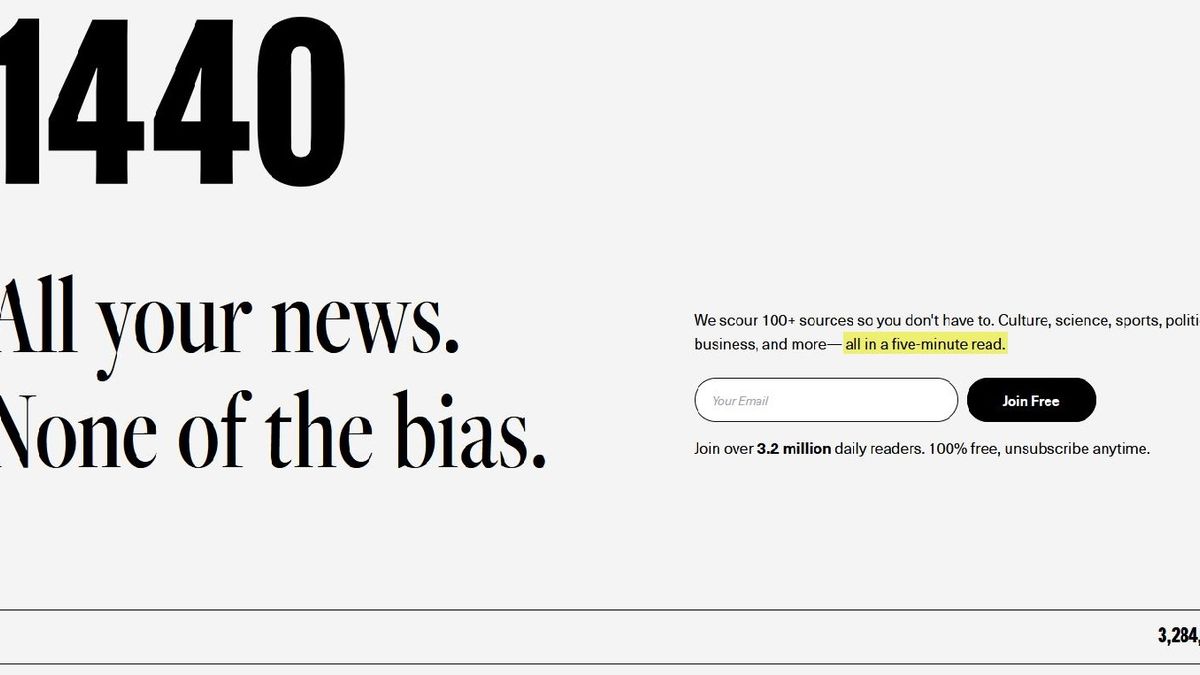
1440.com — specifically the company behind the "1440 Daily Digest," a free email newsletter that delivers a curated summary of the day's major news stories — enters this centuries-old debate with a tagline both confident and commercially savvy: All of the news, none of the bias. The promise is elegant. The mathematics are built into the brand name: 1,440 is the number of minutes in a day, and the implicit offer is that your daily news intake can be accomplished efficiently, neutrally, and without the partisan taint that readers increasingly associate with legacy media brands.
For a reader fatigued by polarized cable news and algorithmically inflamed social media, that promise is genuinely appealing. And 1440's growth metrics — billions of emails sent, hundreds of millions of opens, subscriber counts in the millions — suggest that millions of Americans are hungry for exactly this kind of product. But the more carefully one examines the architecture behind the promise, the more complex and philosophically interesting 1440 becomes. It is not a simple story of either deception or deliverance. It is a case study in what happens when a legitimate media-market problem (partisan information saturation) meets an inherently contested solution (the claim of objectivity), wrapped inside a sophisticated growth-stage business model operating in one of the most competitive newsletter markets in American media history.
This article goes substantially beyond the surface-level examination of whether 1440 is or is not biased. It examines the company's origins and the specific people behind it, the mechanics of its business model and how that model shapes content incentives, the theoretical frameworks for understanding media objectivity and their application to curation journalism, the political economy of the newsletter industry, and the deeper question of what "unbiased news" would even mean if it were achievable — and whether achieving it would necessarily be desirable.
Origins: The 1,440-Minute Premise and Its Founding Story
The existing narrative around 1440's founding tends toward the vague. The company was founded circa 2017-2018 — not 2015, as sometimes reported — as 1440 Media LLC, headquartered in Colorado Springs, Colorado. The founding team includes Tim Huelskamp, a fact that the existing article conspicuously omits and that is essential to any rigorous examination of the platform's claimed neutrality.
Tim Huelskamp served as a Republican member of the United States House of Representatives from Kansas's 1st congressional district from January 2011 through January 2017. He was a member of the Tea Party Caucus and the House Freedom Caucus — among the most ideologically conservative factions in the Republican Party during the Obama era. He was sufficiently confrontational in his conservatism that he was removed from the House Agriculture Committee in 2012 by then-Speaker John Boehner, a rare disciplinary move that reflected how far right of the Republican center Huelskamp sat. He lost his Republican primary in August 2016 to Roger Marshall, partly because his ideological rigidity had cost his district committee assignments critical to agricultural constituents in one of America's most farming-dependent congressional districts.
After leaving Congress, Huelskamp joined the conservative think tank Thomas More Society in various capacities and then became involved in 1440 Media. His co-founders include Andrew Kaufman and other figures whose backgrounds are less publicly documented.
The significance of Huelskamp's founding role cannot be overstated, not because it necessarily determines what 1440 publishes, but because it creates a context that complicates the "none of the bias" positioning in ways the company has never publicly addressed. A newsletter claiming ideological neutrality that was co-founded by one of the most conservative members of Congress in the Obama era — someone removed from a committee for being too partisan — faces an obvious credibility burden. The question is not whether Huelskamp's former political career directly dictates editorial decisions, but whether the structural incentives and cultural values he helped install in the organization are genuinely compatible with the neutrality the brand promises.
This is not a gotcha. Plenty of media organizations have been founded by people with strong prior political views and have nonetheless achieved meaningful editorial independence from those views. The New York Review of Books was co-founded by people with clear left-leaning sympathies but has published work that challenges progressive orthodoxies. The Economist was founded explicitly to advocate for free trade but has endorsed both left and right candidates over its 180-year history. The question of whether a founder's personal ideology maps onto an organization's editorial output is empirical, not axiomatic. But it is a question 1440 has not publicly engaged with, and that silence is itself a form of editorial positioning.
The Business Architecture: What 1440 Is Actually Selling
Understanding 1440 requires understanding that the newsletter is not, in any traditional sense, a journalism operation. It is primarily a media business built around audience aggregation. The distinction matters enormously.
1440's revenue comes almost entirely from sponsored content and display advertising within the newsletter. Sponsors — which have included companies like MasterClass, Shopify, Robinhood, and various financial services and consumer product companies — pay 1440 to reach its subscriber base. The newsletter itself is free to subscribers. This means 1440's financial health is determined entirely by the size, engagement rate, and demographic profile of its audience, not by the quality or depth of the journalism it aggregates.
This creates a specific and underappreciated incentive structure. A traditional newspaper's financial model, even an advertising-dependent one, creates some pressure toward quality journalism because quality journalism attracts and retains readers. 1440's model creates pressure primarily toward subscriber count and open rate, which are the metrics that determine advertising rates. The most efficient path to both is not necessarily the most accurate or fair coverage of complex issues; it is content that feels comfortable and reassuring to the broadest possible demographic slice of the American news consumer.
The Subscriber Acquisition Machine
One of 1440's most notable (and least discussed) achievements is its subscriber acquisition operation. The newsletter has grown primarily through paid social media advertising, particularly on Facebook and Instagram, where targeted ads invite users to "get smarter in 5 minutes" or similar prompts. This is a well-established playbook in the newsletter industry — The Hustle, Morning Brew, and dozens of other newsletters have used similar paid acquisition models — but it has implications for audience composition and content strategy.
When you acquire subscribers through targeted advertising, you are not building an audience that sought you out because of your editorial reputation; you are building an audience that responded to a marketing message. The people who respond to "get today's news without the bias" are people who already believe mainstream news is biased and are looking for an alternative. This creates a self-selection effect: 1440's subscriber base likely skews toward people who are skeptical of legacy media and predisposed to find 1440's curation style more credible than sources they associate with bias — which may make them less rather than more critical of 1440 itself.
The company has never publicly disclosed its subscriber acquisition costs, churn rates, or the demographic breakdown of its audience. These are standard metrics in the newsletter industry, and their absence from public disclosure represents a significant transparency gap for an organization making strong claims about its relationship with readers.
The Curation Model and Its Economics
1440 does not employ a large traditional newsroom. Instead, a relatively small editorial team reads articles from across the media landscape and produces brief summaries of major stories. The "sources" they link to include major news outlets across the ideological spectrum — Reuters, AP, The New York Times, The Wall Street Journal, Fox News, and others — which contributes to the surface impression of balance.
But here is where the model becomes philosophically interesting. Curation, by definition, requires selection. Every story that appears in 1440 was chosen over dozens or hundreds of other stories that could have appeared. Every story not included was implicitly deprioritized. The criteria for these decisions — which editors at 1440 make every single day — constitute an editorial policy that shapes what 1440 readers understand to be "the news." The company has never published a detailed account of its editorial criteria for story selection, story prominence, or story framing.
This is not unique to 1440. All editorial organizations make these choices. The difference is that most organizations that make these choices do not simultaneously claim to be delivering "none of the bias." The very act of claiming to transcend editorial bias creates a higher burden of transparency that 1440 has consistently declined to meet.
Media Bias Measurement: What the Research Actually Says
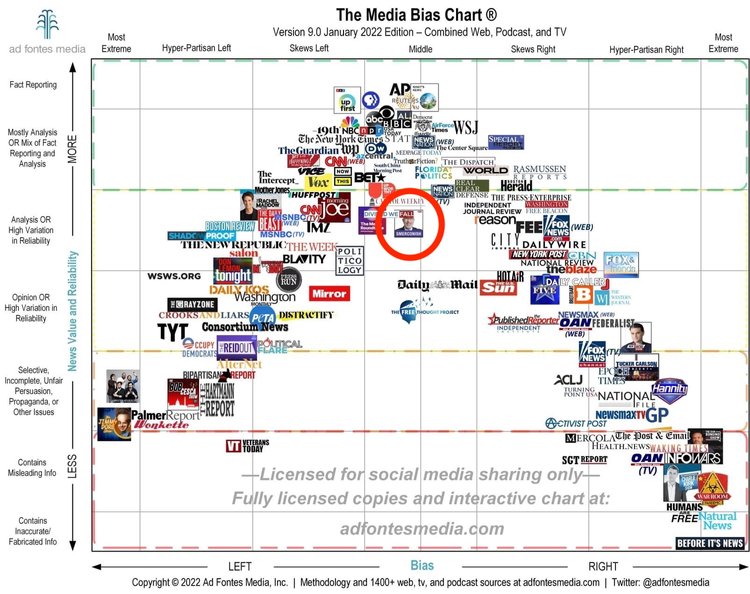
The existing article gestures toward 1440's bias ratings but doesn't examine the methodologies behind those ratings in any depth. Understanding what those ratings actually mean — and what they cannot tell us — is essential to evaluating 1440 fairly.
AllSides and Its Methodology
AllSides is the organization most frequently cited in discussions of 1440's bias rating. AllSides rates news sources on a five-point spectrum from Left to Right, with Center in the middle. Their methodology uses a combination of blind surveys (where raters evaluate content without knowing the source), editorial review, and public feedback. 1440 has received a "Center" rating from AllSides.
But AllSides' methodology has limitations that its proponents often understate. First, the center of the AllSides spectrum is not a fixed philosophical position; it is a statistical mean of American partisan positions at a given moment in time. What registers as "center" in 2024 is not the same as what registered as "center" in 2004. A source that consistently tracked the center of American opinion over time would necessarily have shifted its substantive positions dramatically, which is not the same as being neutral.
Second, AllSides measures partisan balance — roughly, whether a source treats Republicans and Democrats equivalently — which is not the same as accuracy, fairness, or depth. A source could be perfectly balanced between partisan perspectives while being systematically wrong about empirical questions (climate science, vaccine efficacy, economic data) or while consistently omitting perspectives that don't fit into the two-party framing.
Third, AllSides' ratings are partly crowd-sourced, meaning they reflect the opinions of AllSides' user base, which may itself not be representative of the general population.
Media Bias / Fact Check
Media Bias/Fact Check (MBFC), another frequently cited rating organization, uses a different methodology. Their researchers evaluate sourcing quality, factual accuracy, story selection, and headline vs. story congruence. MBFC has generally given 1440 moderate ratings — neither extreme left nor extreme right — while noting that the aggregation model makes full evaluation challenging.
MBFC's limitations are different from AllSides'. Their ratings depend heavily on which stories and sources are sampled at the time of evaluation, and curation outlets like 1440 are particularly difficult to rate because their "bias" (if any) is distributed across thousands of daily story-selection decisions that no rating organization can fully audit.
The Academic Research on News Aggregation
Academic research on news aggregation and its effects on public understanding is surprisingly rich and largely absent from popular discussions of 1440. Several key findings are relevant:
Agenda-setting theory, developed by Maxwell McCombs and Donald Shaw in their landmark 1972 study of the 1968 presidential election, established that news media doesn't tell people what to think but powerfully shapes what they think about. An aggregator like 1440, by selecting which stories rise to the level of "today's most important news," exercises precisely this agenda-setting function while simultaneously denying that it exercises any editorial judgment at all.
Framing theory, associated with Erving Goffman's Frame Analysis (1974) and applied to media by Robert Entman in his influential 1993 paper "Framing: Toward Clarification of a Fractured Paradigm," holds that even the choice of language and emphasis within a factually accurate story constitutes a form of ideological positioning. When 1440 summarizes a complex story about immigration enforcement in two or three sentences, the choice of which facts to include, which context to provide, and which actors to emphasize constitutes framing — regardless of whether the editors intend it as such.
Confirmation bias research in cognitive psychology, particularly work by Peter Wason and later Daniel Kahneman (in Thinking, Fast and Slow, 2011), suggests that readers process information through pre-existing frameworks that shape what they perceive as neutral. A newsletter that feels "unbiased" to its audience may feel that way precisely because it mirrors the audience's existing assumptions — which, given 1440's subscription demographic (likely skewing older, suburban, and broadly centrist-to-conservative given its Facebook ad targeting), may itself be a form of ideological positioning.
The Philosophy of Objectivity: What "Unbiased" Could Even Mean

The claim that a news product can contain "none of the bias" requires a theory of what bias is and what its absence would look like. This is where 1440's positioning encounters its deepest intellectual difficulty.
Three Competing Models of Journalistic Objectivity
The history of Anglo-American journalism has produced at least three distinct models of what objectivity means, and they are mutually incompatible.
The Mirror Model holds that objective journalism simply reflects reality as it is, without distortion. This is the model implied by 1440's tagline. Its philosophical problem is that there is no unmediated reality to reflect. Events must be selected from the infinite stream of human activity, described in language that always carries connotations, contextualized by reference to other events and frameworks, and presented in an order and format that shapes reader comprehension. Every one of these operations is a human judgment that reflects values and assumptions. The mirror model is philosophically incoherent as a complete account of objectivity, though it remains rhetorically powerful.
The Balance Model holds that objective journalism presents "both sides" of contested issues with equal weight. This is roughly what AllSides measures, and it's the implicit model behind 1440's practice of sourcing from both left- and right-leaning outlets. Its problem is well-documented: false balance. If one side of a "debate" is supported by overwhelming scientific consensus and the other is not, presenting both with equal weight misrepresents the actual state of human knowledge. On issues like climate change, vaccine safety, or the 2020 election results, the balance model produces content that is simultaneously politically balanced and factually misleading.
The Transparency Model holds that objectivity is not achievable but accountability is. Under this model, pioneered by press critics like Jay Rosen (NYU), the goal of journalism is not to transcend perspective but to disclose it clearly — to tell readers who is reporting, what values guide their selection decisions, who funds their operations, and what interests may be influencing their coverage. This model would evaluate 1440 primarily on how much it discloses about its own operations, and by that standard, 1440 performs poorly. The company does not publicly identify its editorial team, does not disclose its funding sources or investor list, does not publish editorial guidelines, and does not systematically acknowledge its own limitations.
The Null Bias Fallacy
There is a specific logical error embedded in 1440's marketing that deserves a name. Call it the Null Bias Fallacy: the assumption that the absence of detectable partisan bias is equivalent to the absence of bias altogether.
A news product could be perfectly balanced between Republican and Democratic perspectives while systematically over-representing corporate interests relative to labor interests, urban perspectives relative to rural ones, English-language sources relative to non-English ones, American perspectives relative to international ones, or the concerns of older demographics relative to younger ones. None of these would show up as partisan bias on the AllSides scale. All of them constitute real constraints on what readers learn.
1440's audience, presumably, consists almost entirely of English-speaking Americans who receive news about approximately the same set of major American and international stories each day. Stories that fall outside the mainstream American media agenda — municipal politics, local environmental regulation, labor organizing, indigenous rights, developments in countries that don't register in the AP wire — simply do not appear in 1440, not because they were evaluated and found unimportant, but because they don't show up in the sources 1440 aggregates. This is not partisan bias. It is structural bias, and it shapes the worldview of 1440 readers in ways they are unlikely to be aware of.
The Newsletter Economy: 1440 in Industry Context
Understanding 1440 requires situating it in the broader newsletter industry that emerged as a significant economic force in the 2010s and matured in the early 2020s. 1440 is simultaneously a media product, a technology business, and an advertising platform, and it competes in all three dimensions simultaneously.
The Newsletter Boom and Its Drivers
The newsletter renaissance of the 2010s was driven by a specific set of structural conditions: the fragmentation of social media attention, the decline in trust in algorithmic content curation (Facebook's news feed, Twitter's trending topics), the rise of email open rates as stable engagement metrics in an era of declining website traffic, and the maturation of email marketing technology that enabled sophisticated targeting and personalization.
By 2020, newsletters had become serious businesses. Morning Brew raised $75 million from Insider Inc. in October 2020, valuing the newsletter at approximately $75 million on ~2.5 million subscribers. The Hustle was acquired by HubSpot in February 2021 for a reported $27 million. Axios raised $100 million in 2021 and went on to be acquired by Cox Enterprises for $525 million in 2022. Substack grew to hosting thousands of paid newsletters and raised venture capital valuing the company at approximately $650 million.
1440's competitors in the "daily digest" space include The Morning Brew (business-focused, acquired by Insider), Need 2 Know (general news digest), theSkimm (which initially targeted millennial women), Axios AM (similar concise format, more explicitly political), and dozens of smaller entrants. 1440 competes primarily on its "neutrality" positioning, which is its primary differentiator in a crowded market.
Monetization and Its Implications
1440's monetization strategy is more sophisticated than a simple banner-ad model. Like Morning Brew, it relies primarily on native advertising — sponsored sections within the newsletter that are formatted similarly to editorial content, with disclosure language indicating that they are advertisements. The newsletters typically sell "sponsorships" to advertisers who want access to their audience, with rates determined by subscriber count and open rates.
The ethical implications of this model are nuanced. Native advertising is legal and standard practice across the newsletter industry. The best-run newsletters disclose their sponsors clearly and maintain editorial firewalls between their advertising teams and editorial teams. But the model creates structural pressure that affects editorial decisions in subtle ways.
First, because subscribers are the fundamental asset, editorial decisions that might alienate subscribers are costly in a direct way that would not apply to a subscription-funded outlet. A newsletter that alienated readers by consistently covering uncomfortable truths would face immediate, measurable consequences in subscriber churn. This creates pressure toward comfortable, affirming content that the existing article accurately notes but doesn't fully develop.
Second, because advertisers typically want to avoid brand association with controversy, newsletters like 1440 have financial incentives to avoid deeply contentious coverage — which means, in practice, covering polarizing issues in ways that are carefully hedged and balanced even when the underlying facts are not, in fact, balanced.
Third, because growth through paid social media advertising is the primary subscriber acquisition mechanism, the brand must continuously reinforce the "no bias" message to justify advertising spending on subscriber acquisition — which means the marketing positioning and the editorial positioning become deeply entangled in ways that can compromise editorial decision-making.
Curation Journalism: A Theoretical Examination
1440 operates in a space that media scholars have called curation journalism or aggregation journalism. This is a practice with a history, a set of ethical debates, and a body of academic research that the popular discussion of 1440 almost entirely ignores.
From Wire Services to Aggregation: A Brief History
Aggregation is not new to journalism. The wire services — AP, Reuters, UPI — were fundamentally aggregation businesses from their founding in the mid-19th century. They aggregated reporting from member newspapers and redistributed it, standardizing a style (the inverted pyramid) and a set of conventions (attribution, datelines, sourcing) that were explicitly designed to enable one set of editors to describe events for readers they would never meet.
The Drudge Report, launched in 1994, was one of the first internet-era aggregators — and its creator, Matt Drudge, was explicit that his work was curation rather than reporting, and that his curation reflected his own political and cultural sensibilities. The Drudge Report's influence on American political media has been extensively documented by researchers including Tucker Carlson, who worked with Drudge, and media critics including Tom Rosenstiel and Bill Kovach, whose book The Elements of Journalism (2001) grappled with what the rise of aggregation meant for professional journalism ethics.
Google News, launched in 2002, was the first large-scale algorithmic aggregator — an aggregator that explicitly replaced human editorial judgment with algorithmic curation. This raised the question of whether algorithmic aggregation was more or less biased than human aggregation, a debate that continues today. Research by Tim Groseclose (Left Turn, 2011) attempted to quantify bias in news aggregation with mixed methodological results.
The Ethics of Curation
The Society of Professional Journalists' Code of Ethics, revised most recently in 2014, addresses original reporting extensively but says relatively little about aggregation and curation. This gap reflects the profession's difficulty in integrating the aggregation model into its ethical frameworks.
Jeff Jarvis, a journalism professor at CUNY and author of What Would Google Do? (2009) and Geeks Bearing Gifts (2014), has argued that curation is a valuable form of journalism that helps readers navigate information abundance — that the ability to identify and synthesize the most important reporting across the media ecosystem is a genuine skill that adds genuine value. Jarvis sees aggregators like 1440 as potentially democratizing access to good journalism that readers might not otherwise find.
C.W. Anderson, whose book Apostles of Certainty: Data Journalism and the Politics of Doubt (2018) examined how data and algorithmic practices were changing journalism, has been more skeptical — arguing that aggregation often obscures the labor of reporting while claiming some of its credibility, and that the aggregator's relationship with the sources it aggregates is ethically complex in ways the industry hasn't adequately resolved.
Margaret Sullivan, the former public editor of the New York Times and media critic at the Washington Post, author of Ghosting the News (2020), has written about how aggregation-oriented business models systematically underinvest in original local reporting — the kind of journalism that holds local governments accountable — because local reporting is expensive to produce and hard to aggregate profitably. If 1440 readers get a summary of a Reuters story about a national policy, they are not receiving the kind of granular accountability journalism that requires reporters embedded in communities for years.
Copyright and the Economics of Aggregation
There is a legal dimension to aggregation journalism that rarely surfaces in popular discussions of 1440 but that shapes its relationship with the news industry. The practice of summarizing articles from paid outlets without paying those outlets raises questions under copyright law's "fair use" doctrine. While brief summaries and links are generally protected under fair use, the practice of systematically summarizing articles from subscription-funded outlets for a free audience constitutes a form of economic free-riding — benefiting from the reporting investment of others without contributing to it.
This tension came to a head in December 2023 when the New York Times filed suit against OpenAI and Microsoft over the use of Times content in training AI models. The underlying legal question — when does using copyrighted content to create a derivative product constitute infringement? — applies with somewhat different force to curation newsletters like 1440, but the ethical question is essentially the same: what obligations does a business that profits from others' reporting owe to those who do the reporting?
1440 has not publicly addressed this question, which is perhaps unsurprising given that engaging with it would require the kind of transparency about business model and editorial process that the company has consistently avoided.
Political Economy: What Neutral Really Means in 2024
The claim of political neutrality is never made in a vacuum. It is made in a specific historical moment, against a specific political backdrop, and its meaning — and the interests it serves — are shaped by that context.
The Rise of "Anti-Media" Sentiment and Its Exploitation
The growth of outlets positioning themselves as alternatives to biased mainstream media — including 1440, but also Bari Weiss's The Free Press, Matt Taibbi's Substack, and dozens of others — has been driven by a genuine and documented decline in public trust in mainstream media. Gallup polling has tracked this decline for decades: trust in mass media fell from roughly 72% in 1976 to 34% in 2019, with particularly sharp declines among Republican and Republican-leaning independent voters after 2016.
This trust deficit creates a market opportunity, which is exactly what 1440 is exploiting. The irony is that the people most likely to respond to 1440's "no bias" marketing are the people most skeptical of legacy media — which, as research by Pew Research Center and others has documented, skews toward conservative and Republican-leaning Americans. If 1440's subscriber base skews toward people who distrust the New York Times and the Washington Post, then 1440's "balance" may read as more credible to those readers precisely because it regularly includes Fox News and the Wall Street Journal in its source mix — which is a form of political curation, even if it's not partisan bias in the AllSides sense.
The "Both Sides" Problem in the Trump Era
The political landscape of 2016-2024 posed a particular challenge for news organizations claiming to provide balanced coverage. During this period, one of the two major political parties made a series of claims — about election fraud, about immigration, about climate science, about vaccine safety — that were flatly contradicted by the scientific and factual record as established by independent researchers, government agencies, and courts of law. For an outlet committed to "both sides" balance, the question became acute: does balance require treating claims as equivalent even when one of them is false?
1440's record on this challenge has not been independently audited in any systematic way. The Snopes investigation referenced in the existing article examined a limited sample of 1440 coverage and found a general centrist orientation, but did not evaluate how 1440 handled specific factual controversies where the evidence was not balanced between partisan positions.
The academic literature on this problem is extensive. Thomas Patterson of Harvard's Shorenstein Center has documented what he calls "false equivalence" in American journalism — the tendency to present asymmetric political realities as symmetric in the name of balance. His book Is the Republican Party Destroying Itself? (2023) examines how mainstream journalism's balance norms struggled to accommodate a period of asymmetric political extremism. Lee McIntyre's Post-Truth (2018) examines how false factual claims have been legitimized partly through media balance norms. Neither Patterson nor McIntyre is arguing for partisan journalism; both are arguing that balance is not a substitute for accuracy.
The Behavioral Science of News Consumption
One of the most underexplored dimensions of 1440's operation is what it does to its readers' information processing — not in the political sense of making them more or less partisan, but in the cognitive sense of how consuming aggregated, summarized news shapes understanding of complex issues.
Compression and Comprehension
1440's fundamental value proposition is that it compresses the news into a manageable daily digest. This compression is genuinely valuable for time-constrained readers. But cognitive research on reading comprehension suggests that the depth of understanding achieved through a 3-sentence summary of a complex policy story is qualitatively different from the understanding achieved through reading the full story — and that this difference is not merely one of detail but of causal understanding.
Daniel Kahneman's System 1 / System 2 framework is relevant here. System 1 thinking is fast, intuitive, and pattern-matching; System 2 thinking is slow, deliberate, and analytical. Reading a brief news summary primarily engages System 1 — it tells you that something happened, gives you a rough sense of its significance, and fits it into existing mental models. Understanding the complex causes, contested evidence, and downstream implications of policy issues requires System 2 engagement that brief summaries structurally cannot provide.
This is not a criticism unique to 1440; it applies to all summary journalism. But it matters particularly for 1440's specific claim. If reading 1440 gives you a feeling of being well-informed — "all of the news" — while actually giving you a System 1 understanding that feels complete but isn't, the newsletter may be fostering a specific kind of epistemic overconfidence that is arguably worse than the alternative of knowing less but knowing it was incomplete.
The Satisficing Trap
Herbert Simon's concept of satisficing — choosing an option that is "good enough" rather than optimal — has been applied to information behavior by researchers including Sheila Tobias and David Levy. Applied to news consumption, it suggests that access to a satisfactory summary of the news removes the motivation to seek deeper coverage. If 1440 provides a daily digest that feels complete, its subscribers are less likely to also read long-form investigative journalism, subscribe to local newspapers, or consult primary sources on policy questions.
This is the satisficing trap: a news product that is good enough at providing a sense of information adequacy may be systematically reducing the depth of information engagement of its audience — not through bias in the partisan sense, but through a structural effect on information behavior.
Cross-Domain Connections: What 1440 Reveals About the Information Ecosystem
1440 is a useful prism through which to examine several larger phenomena that extend well beyond the newsletter industry.
The Platform-Publisher Boundary
1440 operates in a legal and ethical gray zone that the digital media industry has never fully resolved: the space between a platform (which carries others' content without editorial responsibility) and a publisher (which makes editorial decisions and bears editorial responsibility for what it publishes). This distinction has enormous legal and regulatory consequences — it's the distinction that determines Section 230 liability protection in the United States — and 1440 benefits from the ambiguity.
By characterizing its work as "curation," 1440 implicitly claims platform-like qualities (we just organize what others report) while its editorial team makes genuinely publisher-like decisions every day. This framing serves 1440's legal and commercial interests but muddles its accountability to readers.
The Attention Economy and its Distortions
1440 is a participant in the attention economy that Tim Wu analyzed in The Attention Merchants (2016). Wu's thesis is that the commercialization of human attention — the business of capturing and selling it — necessarily shapes what is said in the process of capturing it. If attention is the resource being sold, then content is the tool used to capture attention, and the incentive is to maximize attention capture regardless of informational depth or accuracy.
In 1440's case, the product being sold to advertisers is audience attention. The editorial product — the newsletter — is the mechanism for capturing and retaining that attention. The incentive is therefore to produce a newsletter that maximizes open rates and reduces unsubscribes, which is not identical to maximizing informational quality or depth. These goals often align; they do not always align.
The Local News Crisis and National Aggregators
1440's success exists against the backdrop of one of the most serious structural crises in American journalism: the collapse of local news. Between 2004 and 2022, according to the Northwestern University Medill Local News Initiative, the United States lost more than one-fourth of its newspapers — roughly 2,500 outlets — with an accelerating rate of loss after 2019. This collapse is not evenly distributed; it is concentrated in small and medium-sized markets, in economically distressed communities, and in rural areas.
The people who have lost local news coverage are not well-served by 1440, which is a national aggregator of national and international stories. The accountability journalism that documents local government corruption, school board decisions, zoning changes, and public safety issues cannot be replaced by a newsletter that summarizes AP and Reuters dispatches. 1440 is filling a gap in one part of the information ecosystem (national news overload) while the most critical gap in another part (local news collapse) goes unaddressed.
This is not a criticism of 1440 — no single newsletter can address the entire local news crisis. But it is a context that the platform's marketing elides when it claims to provide "all of the news."
Open Questions and Contested Terrain
The Transparency Question
The most fundamental unresolved question about 1440 is not whether it is biased in the partisan sense but whether its claims about itself are transparently supported by disclosed information. The company has not:
- Published a detailed account of its editorial criteria for story selection
- Disclosed its investor list or funding sources
- Identified its full editorial team publicly
- Published a transparency report of any kind
- Addressed publicly the political history of its co-founder
Until 1440 provides this information, its claims about neutrality cannot be fully evaluated — which is itself a form of answer to the question it raises.
The Huelskamp Question
The relationship between Tim Huelskamp's founding role and 1440's editorial practice is an open empirical question. It is possible that Huelskamp's political history has no meaningful influence on 1440's daily editorial decisions. It is also possible that the company's overall orientation — its choice of sources, its handling of conservative vs. progressive perspectives, its framing of political stories — reflects cultural values that Huelskamp brought to the organization. No independent researcher has conducted the kind of systematic content analysis that would allow this question to be definitively answered.
The Effects Question
What does reading 1440 actually do to its subscribers? Does it make them more or less informed about the issues they care about? Does it change their political views? Does it change their media consumption habits? These questions are entirely unanswered in the public record. 1440 has not commissioned or published any research on reader outcomes. Academic researchers have not, to this author's knowledge, studied 1440 subscribers specifically.
These are not rhetorical questions designed to make 1440 look bad; they are genuine empirical questions whose answers would substantially clarify the newsletter's role in the information ecosystem.
The Deeper Paradox: Why Unbiased News May Be the Wrong Goal
The final and perhaps most important dimension of 1440's story is the least discussed: whether the goal of unbiased news, even if achievable, is actually what a healthy democracy needs from its media.
Walter Lippmann believed in something close to 1440's model — a corps of neutral, expert information intermediaries who would translate complex events into digestible form for citizens who lacked the time and expertise to engage with them directly. John Dewey, Lippmann's great contemporary antagonist, argued that this model was fundamentally paternalistic and antidemocratic — that democracy required not just informed citizens but participating citizens who were embedded in communities where local deliberation happened, and that no amount of neutral information delivery could substitute for the kind of active public life that sustained democratic self-government.
Dewey's critique has been elaborated by contemporary democratic theorists including James Fishkin (Democracy When the People Are Thinking, 2018), who has experimented with "deliberative polling" — structured processes where citizens engage with evidence and argument before forming political views — and Hélène Landemore (Open Democracy, 2020), who argues for participatory institutions that include ordinary citizens rather than media intermediaries in the formation of public judgment.
If these thinkers are right, then 1440's offering — efficient, neutral, digestible daily news — is solving for the wrong variable. The problem of American democracy is not that citizens lack access to a summary of today's major news stories. It is that they lack the institutional structures, the deliberative habits, and the community embeddedness that would allow them to convert information into genuine collective judgment. A newsletter, however neutral, cannot provide those things.
This doesn't make 1440 useless or harmful. It makes it a product of its era — an elegant solution to a real problem (information overload) that leaves the deeper problem (democratic disengagement) entirely untouched.
Real-World Implications: Who Is 1440 For?
The practical question for anyone evaluating 1440 is not whether it achieves perfect neutrality — it doesn't, and nothing does — but whether it is a net positive or net negative addition to a specific reader's information diet.
For a reader who currently consumes no news at all, 1440 is almost certainly a net positive: daily engagement with major national and international stories is better than no engagement. For a reader who currently relies on a single strongly partisan source, 1440's cross-spectrum sourcing provides genuine exposure to reporting they wouldn't otherwise encounter.
For a reader who already engages with multiple high-quality news sources, 1440 offers limited marginal value — and the satisficing effect discussed earlier may actually reduce their information engagement if it substitutes for deeper reading.
For a researcher, policy professional, or citizen activist who needs deep knowledge of specific issue areas, 1440 is inadequate by design.
The honest answer to "Who is 1440 for?" is: people who want to feel broadly informed about national and international developments without investing significant time or money in media. This is a large market, and serving it well has genuine social value. But "feeling broadly informed" and "being broadly informed" are different things, and the gap between them is exactly where 1440's "none of the bias" claim lives.
Toward a More Honest Framing
What 1440 could say, honestly, is something like this: We curate a daily selection of major news stories from across the political spectrum, using sources we believe are reliable, in summaries we try to make fair and accurate. We are not a replacement for deep engagement with complex issues, and our selection process reflects human judgments that inevitably involve perspective. But we work hard to provide a balanced overview of the day's most significant events for people who don't have time to read multiple outlets.
This framing would be less marketable than "All of the news, none of the bias." But it would be more honest, more defensible, and more informative to readers who are making decisions about how to allocate their information diet.
The fact that 1440 has chosen a more dramatic marketing claim, and has declined to support that claim with the kind of transparency that would allow it to be evaluated, is ultimately more telling than any content analysis of its newsletters. Organizations committed to honest information-sharing tend to be committed to honesty about themselves. The gap between 1440's self-presentation and its transparency is, itself, data.
Conclusion: The Unresolved Tension at the Heart of 1440
1440.com is, simultaneously, several things: a genuinely useful product for time-constrained news consumers, an elegant growth-stage media business built on the anxiety Americans feel about partisan information saturation, an intellectually incoherent claim about the possibility of unmediated news, an enterprise co-founded by a partisan political actor who has never publicly addressed the tension this creates, and a participant in a broader newsletter economy whose effects on journalism, democracy, and civic knowledge are still being worked out.
None of these dimensions cancels the others. 1440 can be a good daily digest and also be less transparent than its claims require. Its co-founders can have strong prior political views and also be genuinely committed to balanced curation. Its business model can create structural pressures toward comfortable content and also produce genuinely useful journalism. These tensions do not resolve neatly into a verdict of "biased" or "unbiased," "good" or "bad."
What they resolve into is a provocation: the next time you encounter a media product that claims to have solved the bias problem, the right response is not credulity or cynicism but curiosity. Ask who funds it, who runs it, what they leave out, what their story selection decisions assume about what is important, and what their self-presentation omits about their own limitations. Those questions — asked of 1440 and every other media organization — are not hostile. They are the questions that honest journalism has always asked of others, and that honest journalism owes to itself.
The 1,440 minutes of your day are genuinely valuable. How you choose to spend the five of them you might give to a newsletter like this one is a choice with consequences that extend well beyond the feeling of being caught up on the news.
Further Reading: Maxwell McCombs & Donald Shaw, "The Agenda-Setting Function of Mass Media" (Public Opinion Quarterly, 1972); Robert Entman, "Framing: Toward Clarification of a Fractured Paradigm" (Journal of Communication, 1993); Jeff Jarvis, Geeks Bearing Gifts (CUNY Journalism Press, 2014); Tim Wu, The Attention Merchants (Knopf, 2016); Thomas Patterson, Is the Republican Party Destroying Itself? (University of Chicago Press, 2023); Margaret Sullivan, Ghosting the News (Columbia Global Reports, 2020); Northwestern Medill Local News Initiative annual reports.