The Communist Control Act of 1954: Power, Paradox, and the Limits of Democratic Self-Defense
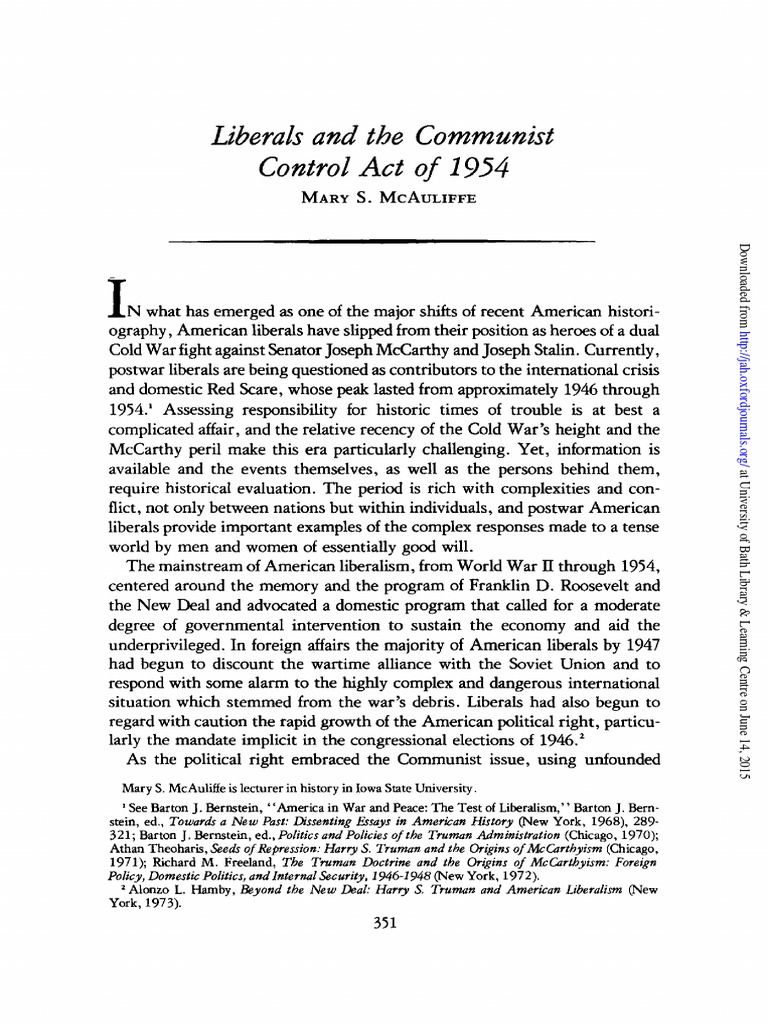
A law was signed into existence on August 24, 1954 that remains one of the most constitutionally peculiar statutes ever enacted by the United States Congress. The Communist Control Act declared that the Communist Party of the United States of America was "not entitled to any of the rights, privileges, and immunities attendant upon legal bodies created under the jurisdiction of the laws of the United States or any political subdivision thereof." In plain terms, Congress had attempted to strip a political organization of its legal existence — without quite making membership in it explicitly illegal, without ever enforcing the law's core provisions against a single defendant, and without any court ever ruling definitively on its constitutionality. The law is still on the books today.
That paradox — a law that outlaws a party without quite abolishing it, enacted in a rush by politicians who privately doubted its constitutionality, signed by a president who expressed reservations, and never actually enforced — tells us something profound about the Cold War United States that a simple recounting of its provisions cannot. The Communist Control Act was not primarily a law in the functional, enforceable sense. It was a political performance, a piece of legislative theater staged at a precise and fraught moment in American history, and its effects rippled outward through institutions, careers, and legal doctrine in ways that its drafters neither fully intended nor anticipated.
To understand it properly requires going well beyond the standard narrative — beyond McCarthy, beyond the Red Scare, beyond the familiar arc of civil liberties versus national security. It requires examining the Act's extraordinary legislative history, its structural constitutional flaws, its ambiguous relationship to the broader ecosystem of Cold War repression, the surprising identity of its most enthusiastic sponsors, the organizational responses of those it targeted, and its strange ongoing presence in American law nearly seventy years after enactment.
The Legislative Sprint: Forty-Eight Hours and a Major Statute
The most remarkable fact about the Communist Control Act — the one that should give any reader pause — is how fast it was written, debated, and passed. The bill that became law in August 1954 was substantially drafted and pushed through both chambers of Congress in roughly a week. The Senate debate lasted two days. There were no committee hearings in the traditional sense. The House of Representatives, presented with the Senate-passed bill, approved it with minimal deliberation.
This legislative sprint took place in the closing days of the 83rd Congress, immediately before the 1954 midterm elections. The timing was not coincidental. Republicans faced the prospect of losing their congressional majorities, and anti-communism had been their signature political issue since 1946. Democrats, seeking to neutralize Republican attacks, were equally motivated to demonstrate toughness on the communist question. The result was a competitive race to the ideological bottom, in which both parties sought to outflank the other by proposing ever more severe measures against the Communist Party.
The bill emerged from a confluence of proposals. Senator Karl Mundt of South Dakota, a Republican and veteran anti-communist crusader who had co-authored the 1950 Subversive Activities Control Act with Pat McCarran, provided much of the structural framework. But the most dramatic intervention came from an unexpected direction: Hubert H. Humphrey of Minnesota, among the most prominent liberal Democrats in the Senate and a future Vice President and presidential nominee, introduced an amendment that would have gone further than anything Mundt proposed — stripping the Communist Party of all legal rights and making mere membership a federal crime.
Understanding why Humphrey did this is essential to understanding what the Act actually was.
The Humphrey Gambit: Liberal Democrats and the Politics of Preemption
Hubert Humphrey in 1954 was simultaneously the champion of civil rights liberalism and one of the most aggressive advocates for the Communist Control Act. This is not a contradiction that can be resolved by calling him a hypocrite or a coward, though historians have accused him of both. The political logic he was operating under was coherent, if ruthless.
Democrats in 1954 were in a bind created largely by Senator Joseph McCarthy. McCarthy's technique was to accuse Democrats — specifically the Roosevelt and Truman administrations — of having harbored communist infiltrators. The charge was grossly exaggerated but not entirely fabricated: there had been Soviet intelligence penetration of the federal government, most famously in the cases of Alger Hiss and the Rosenbergs. Democrats could defend themselves by pointing to their own anti-communist records (Truman had instituted the federal loyalty program in 1947), but McCarthy's relentless accusations kept them on the defensive.
Humphrey's response was preemptive escalation. If Republicans wanted to demonstrate anti-communist credentials, Democrats would outbid them. Where Mundt proposed stripping the CP of legal standing, Humphrey proposed making membership itself a felony, punishable by up to five years in prison and a $10,000 fine. Some Humphrey allies framed this as calling McCarthy's bluff — if you truly believed communists were dangerous, you would make membership illegal rather than just requiring registration. If McCarthy and the Republicans balked at Humphrey's proposal, they would expose themselves as preferring the communist issue as a campaign weapon rather than as a genuine threat requiring direct action.
The strategy had a certain cynical brilliance. It also, as historian Ellen Schrecker noted in Many Are the Crimes: McCarthyism in America (1998), represented a significant abandonment of principle by liberal Democrats who knew perfectly well that the legislation was constitutionally dubious. Humphrey was not ignorant of the First Amendment; he simply calculated that the political cost of appearing soft on communism exceeded the cost of voting for bad law.
Senator John Marshall Butler of Maryland, another key figure, introduced provisions that specifically addressed "communist-infiltrated organizations" — a category deliberately broad enough to encompass labor unions and other civil society groups with any CP-associated members or leaders. This provision, which eventually became Section 4 of the Act, represented a significant expansion beyond the CP itself.
The final roll call was extraordinary. The Senate approved the bill 79–0, with only Estes Kefauver of Tennessee and William Langer of North Dakota voting against. In the House, the margin was 265–2. These numbers do not reflect genuine consensus or considered judgment; they reflect the political terror of being recorded as having voted against legislation titled the "Communist Control Act" weeks before a congressional election. As Senator Langer, one of only two dissenters in either chamber, put it during floor debate: "I don't agree with the Communist Party. I don't like them. But I do believe in the Constitution."
What the Act Actually Said: Text, Ambiguity, and Internal Contradiction
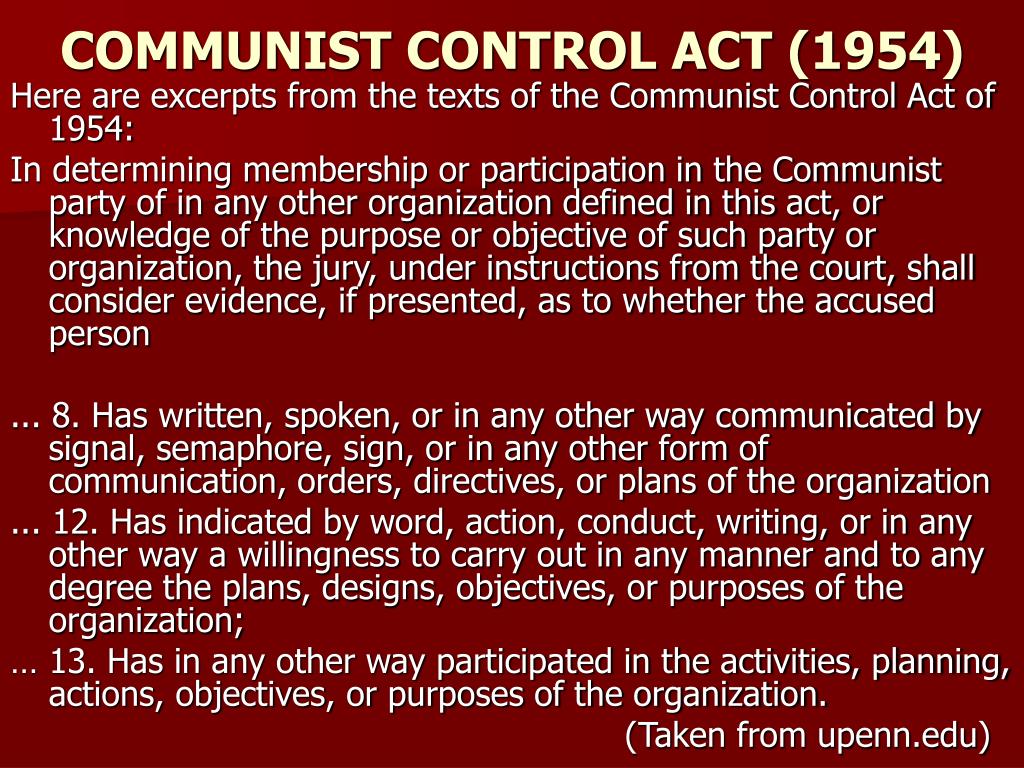
The full text of the Communist Control Act, codified at 50 U.S.C. §§ 841–844, is worth examining in some detail because its actual provisions are frequently mischaracterized — including in the existing broad accounts.
The Act opens with a series of congressional findings (§ 841) declaring that the Communist Party of the United States, "although purportedly a political party, is in fact an instrumentality of a conspiracy to overthrow the Government of the United States" and that its activities constitute "a clear, present and continuing danger to the security of the United States." These findings do significant legal work: by characterizing the CP as a foreign-directed conspiracy rather than a domestic political party, Congress attempted to position the law outside First Amendment protection. A conspiracy to overthrow the government, the reasoning went, is not protected political speech or association.
Section 842 contains the core operative provision: the Communist Party is "not entitled to any of the rights, privileges, and immunities attendant upon legal bodies created under the jurisdiction of the laws of the United States." This language is striking for what it does not say. It does not say that the Communist Party is abolished. It does not make membership illegal. It does not criminalize advocacy of communist doctrine. It strips the organization of legal personhood — its ability to sue in court, to own property as an organization, to appear on ballots — without actually prohibiting it from existing.
This distinction would prove immensely consequential. Because the Act did not explicitly criminalize membership, prosecutions under it alone were legally problematic from the outset. The act of belonging to the Communist Party remained separately prosecutable only under the Smith Act of 1940's membership clause (which the Supreme Court had interpreted narrowly in Scales v. United States, 367 U.S. 203, 1961, to require proof of "active" membership with specific intent to further illegal aims), not under the Communist Control Act itself.
Section 843 extended related provisions to "communist-infiltrated organizations," defined in Section 3(3) as organizations that: (A) are substantially directed or controlled by the Communist Party, (B) are substantially used by the Party as an instrument to further its objectives, or (C) actively cooperate with the Party in carrying out its activities. This section required such organizations to register with the Subversive Activities Control Board (SACB), a body established by the 1950 McCarran Act.
The registration requirement was where the Act's enforcement mechanism was supposed to reside — and where it immediately ran into devastating constitutional problems.
Constitutional Fault Lines: Three Structural Defects
Legal scholars recognized almost immediately that the Communist Control Act was constitutionally vulnerable on at least three independent grounds. None of these challenges was ever definitively adjudicated as applied to the 1954 Act specifically, which is itself a revealing fact about the Act's enforcement history. But the theoretical vulnerabilities were clear.
The Bill of Attainder Problem
Article I, Section 9 of the Constitution prohibits Congress from enacting bills of attainder — legislative acts that impose punishment on specific named individuals or groups without judicial trial. The Supreme Court had interpreted this clause in United States v. Lovett (1946) to prohibit Congress from specifically naming individuals and cutting off their pay because of their alleged communist associations. The Communist Control Act is, on its face, an extraordinarily explicit bill of attainder: it names a specific organization, makes findings about that organization's character, and imposes penalties (loss of legal rights) without any judicial determination in an individual case.
The counterargument — one that proponents made during debate — was that the bill of attainder clause applies to punishments for past acts, while the Communist Control Act was a regulatory measure directed at present organizational activity. This distinction, while not frivolous, has never been tested. The Act's "findings" section reads very much like a bill of indictment, not a prospective regulatory framework, which makes the bill of attainder argument substantial.
The First Amendment Association Problem
NAACP v. Alabama (1958) and related cases established that the freedom to associate for political purposes is constitutionally protected under the First Amendment, even when applied to organizations some might find distasteful or dangerous. While the Supreme Court had permitted restrictions on communist organizations under certain narrowly drawn circumstances — particularly where membership was shown to involve specific intent to further illegal overthrow of the government — the Communist Control Act's blanket stripping of the CP's legal rights without any individualized finding was a far blunter instrument than the Court had approved.
The subsequent trajectory of First Amendment jurisprudence moved steadily toward protecting political association even for unpopular causes. By the time Brandenburg v. Ohio (1969) was decided — holding that advocacy of illegal action is protected unless directed to inciting and likely to produce imminent lawless action — the theoretical foundation for the Communist Control Act's "clear and present danger" rationale had been substantially eroded.
The Fifth Amendment Self-Incrimination Problem
The registration requirements attached to the Act — and to the underlying 1950 McCarran Act — required Communist Party members and officers to identify themselves to the government. This created a direct Fifth Amendment problem: compelling someone to register as a member of a group whose membership could expose them to prosecution was functionally compelled self-incrimination.
This problem was not hypothetical. In Albertson v. Subversive Activities Control Board, 382 U.S. 70 (1965), the Supreme Court unanimously held that requiring CP members to register under the McCarran Act violated the Fifth Amendment's self-incrimination clause. This decision gutted the registration mechanism that was the Act's primary enforcement tool. Without compelled registration, there was no practical way to identify "communist-infiltrated organizations" or impose penalties on them. The SACB, already moribund, became wholly vestigial; Congress eventually abolished it in 1973.
The Albertson decision effectively rendered the Communist Control Act a legal dead letter — if it had ever been a live letter in the first place.
The Judicial Reception: Deliberate Avoidance
A striking pattern in the Act's judicial history is how carefully the federal courts avoided ruling on its constitutionality directly. No case squarely presenting the question — does the Communist Control Act's stripping of the CP's legal rights violate the Constitution? — ever reached final Supreme Court adjudication.
This was not accident. The Justice Department under both Eisenhower and subsequent administrations declined to pursue enforcement actions under the Act's core provisions. The CP itself, advised by counsel who understood the legal landscape, chose litigation strategies that challenged the Act on narrow procedural grounds where possible, avoiding the broad constitutional confrontation that might have produced an unfavorable precedent even if ultimately resolved in their favor.
The closest the courts came to engaging with the Act's core provisions was in a series of state ballot access cases. Several states, invoking the Communist Control Act as authority, attempted to deny the Communist Party access to election ballots. Courts were inconsistent in their responses. Some state courts held that the federal Act preempted state ballot exclusion attempts; others permitted exclusion on state law grounds without reaching the federal constitutional question.
The broader pattern of judicial handling of communist-related legislation in the 1950s is itself instructive. In Dennis v. United States (1951), the Court upheld Smith Act convictions of CP leaders using a modified "clear and present danger" test. But the Court subsequently pulled back from Dennis: Yates v. United States (1957) sharply narrowed the Smith Act's reach by distinguishing advocacy of abstract doctrine from advocacy of illegal action, effectively ending Smith Act prosecutions. Scales (1961) permitted membership prosecutions only with proof of specific criminal intent. The trajectory suggests that had the Communist Control Act's core provisions been squarely presented to the Warren Court, they would likely have fared poorly.
The Ecosystem of Repression: The Act Was Not Alone
Understanding the Communist Control Act requires situating it within what legal historian Geoffrey Stone, in Perilous Times: Free Speech in Wartime (2004), calls the "ecosystem of repression" — the interlocking web of legislation, executive action, administrative procedure, and private enforcement that constituted McCarthyism as a social phenomenon.
The 1954 Act did not operate in isolation. It was superimposed upon:
The Smith Act of 1940, which made it illegal to advocate or teach the violent overthrow of the government, or to be a member of any organization that did so. This had already produced criminal convictions of CP leaders before the 1954 Act was even conceived.
The Internal Security Act of 1950 (McCarran Act), which established the SACB registration system, authorized emergency detention of suspected subversives, and barred CP members from holding defense industry jobs or obtaining passports. The Communist Control Act amended and extended this framework.
The Taft-Hartley Act of 1947, which required union officers to file non-communist affidavits as a condition of using NLRB services. This had already forced the CIO to expel eleven communist-led unions between 1949 and 1950 — a purge that removed some of the most effective labor organizers in industries from electrical manufacturing to longshoring.
Executive Order 9835 (1947) and its successor E.O. 10450 (1953), Truman's and Eisenhower's federal loyalty-security programs, which subjected federal employees to investigations, required proof of loyalty, and permitted dismissal on grounds of "reasonable doubt" — a standard easily met in the prevailing atmosphere.
The FBI's COINTELPRO operations, beginning in 1956, which used surveillance, infiltration, disinformation, and harassment to disrupt not only the CP but civil rights organizations, anti-war groups, and other leftist movements. The Communist Control Act's findings provided ideological cover for these operations even when specific prosecutions were not pursued.
Within this ecosystem, the Communist Control Act served a specific function: it provided a statutory declaration of the CP's illegitimacy that could be invoked in a wide range of administrative and civil contexts — passport denials, employment discrimination, housing authority exclusions — without ever requiring a criminal prosecution. The Act's real enforcement was not through criminal courts but through the thousand bureaucratic and social mechanisms by which people were disadvantaged, excluded, and harassed for perceived communist associations.
On the Ground: What Happened to Actual Party Members
The abstract constitutional analysis can obscure what the Communist Control Act's passage meant for real human beings. By 1954, the Communist Party USA had already been substantially weakened. Membership had peaked around 100,000 during World War II, when the Soviet alliance made communist sympathies more socially acceptable. By 1954, membership had fallen to somewhere between 25,000 and 50,000, and the FBI estimated (in a figure that should be treated cautiously, given the Bureau's institutional incentives to exaggerate the threat) that perhaps a third of the party's members were Bureau informants.
Party members in 1954 lived under conditions of systematic harassment. Many were unemployed or unemployable in their professions due to blacklisting. Many had been subpoenaed by HUAC or Senate committees and faced the choice of naming names — implicating friends and colleagues — or invoking Fifth Amendment rights and being cited for contempt. Some had been prosecuted under the Smith Act.
The Communist Control Act added several specific new burdens:
Passport denial: CP members were systematically denied passports under State Department regulations, using the Act's findings as additional authority. The Supreme Court partially checked this practice in Aptheker v. Secretary of State (1964), striking down a McCarran Act provision denying passports to CP members as an unconstitutional restriction on the right to travel.
Labor exclusion: The Act strengthened legal arguments for excluding CP members from union offices and from defense-industry employment. Workers who had been organizers in the expelled CIO unions found themselves effectively locked out of industrial employment through combinations of management blacklisting and union exclusion.
Housing and social services: Public housing authorities in several cities used the Act's findings to exclude known CP members from public housing. This was particularly devastating in New York City, where many working-class leftists lived in public developments.
State employment: Teachers, professors, and state employees faced intensified loyalty oath requirements buttressed by the Act's findings. The purge of left-wing academics from American universities — documented in Ellen Schrecker's No Ivory Tower: McCarthyism and the Universities (1986) — accelerated in the Act's aftermath.
What is notable is that these harms were largely inflicted not through criminal prosecution but through administrative exclusion, private blacklisting, and social ostracism. The Communist Control Act rarely appeared in a courtroom. It appeared in hiring decisions, in housing applications, in passport offices, and in the quiet phone calls through which personnel officers warned each other about job applicants with suspicious political histories.
The Communist Party's Organizational Response
The Communist Party of the United States did not simply dissolve in the face of the Act. Its response was complicated, internally divisive, and ultimately contributed to its own accelerating decline — though the causes were multiple.
In the immediate aftermath of the Act's passage, the CP's leadership debated whether to continue operating openly or to go underground. The party had significant experience with underground operations from its early years, when it had operated clandestinely to maintain connections with the Communist International. But underground organization was expensive, difficult, and — as FBI infiltration demonstrated — not particularly secure.
The CP adopted a strategy of partial dispersal. Some structures were formally dissolved to avoid registration requirements under the McCarran Act's SACB mechanism. Members were encouraged to reduce visible party activity. But the party continued to publish The Daily Worker (until 1958, when it became The Worker), continued to run Gus Hall as a presidential candidate in subsequent elections, and continued to operate as a formal organization.
The more devastating blow to the CP came not from the Communist Control Act but from Nikita Khrushchev's "Secret Speech" in February 1956, revealing Stalin's crimes. The Daily Worker ultimately published the speech (after initial reluctance), provoking an internal crisis that led many members to resign. The Soviet invasion of Hungary in October 1956 accelerated the hemorrhage. By the late 1950s, CP membership had fallen below 10,000. The organizational survival of the CP into the present era — it still nominally exists, with perhaps a few thousand members — had little to do with the Communist Control Act's provisions and everything to do with the internal crises of international communism and the FBI's systematic disruption operations.
Cross-Domain Effects: Labor Unions, Hollywood, and the Academy
The Communist Control Act's "communist-infiltrated organizations" provision (Section 4) cast a wider net than the CP itself, and its effects on specific institutional sectors deserve examination.
The Labor Movement
The American labor movement of the 1930s and 1940s had a complex relationship with communism. CP-affiliated organizers were often the most skilled and committed union builders; they had played central roles in organizing the auto workers, the electrical workers, the longshoremen, and other major industrial unions. The Taft-Hartley Act's non-communist affidavit requirement had already forced a crisis, and the CIO expelled its communist-affiliated unions in 1949–1950.
The Communist Control Act provided additional statutory ammunition for employers, rival unions, and the NLRB to challenge the standing of unions with any remaining CP connections. The electrical workers' unions — particularly the International Union of Electrical Workers (IUE), which had been created to absorb the membership of the expelled United Electrical Workers (UE) — used the Act's findings in organizing campaigns to discredit the UE as a "communist-controlled" organization. The UE survived these campaigns but remained a diminished force.
More broadly, the Act contributed to a long-term narrowing of permissible union politics. Discussions of socialism, nationalization, or structural economic transformation — common in labor discourse before the war — became increasingly dangerous for union officials who feared the "communist-infiltrated" label. Labor historian Nelson Lichtenstein, in State of the Union: A Century of American Labor (2002), argues that this political narrowing was one of the most consequential long-term effects of the anti-communist legislation of the period: it produced a labor movement that confined itself to collective bargaining and abandoned the broader social vision that had animated the CIO's founders.
Hollywood and the Entertainment Industry
The Hollywood blacklist, initiated by the studios in response to HUAC pressure following the Hollywood Ten cases of 1947–1948, was already well established by 1954. The Communist Control Act did not create the blacklist, but it reinforced the legal and political framework that sustained it. The Act's statutory declaration that the CP was a conspiracy against the United States provided employers in the entertainment industry — already deeply nervous about congressional investigations — with additional grounds for refusing to hire individuals with CP connections.
The blacklist's specific mechanisms were varied and often obscured. Clearance was obtained through industry intermediaries like American Business Consultants, publishers of Red Channels (1950), a pamphlet listing 151 entertainment industry figures with alleged communist connections. The Communist Control Act's enactment reinforced the credibility of such lists and made it harder for studios to resist clearance demands.
The Academy
The purge of left-wing academics from American universities was, in some respects, the most culturally significant consequence of the entire period of anti-communist legislation, including the 1954 Act. Ellen Schrecker's detailed accounting in No Ivory Tower documents hundreds of cases in which faculty were fired or forced out for refusing to cooperate with investigators, for CP membership (past or present), or simply for holding heterodox political views.
The Act provided a new rhetorical resource for university administrators who wanted to dismiss faculty but preferred to avoid direct confrontation with principles of academic freedom. The statutory declaration of communist organizations' illegitimacy made it easier to argue that CP membership was incompatible with the professional obligations of an academic — not because membership was formally illegal, but because the organization had been legislatively declared a conspiracy rather than a legitimate political party.
The chilling effect on academic discourse extended far beyond actual CP members. Scholars who studied Soviet history, Marxist economics, or labor organizing found their fields politically contaminated. The social sciences, in particular, underwent a significant narrowing of permissible inquiry. The long-term intellectual consequences — the impoverishment of certain research traditions, the premature closure of certain scholarly debates — are difficult to quantify but were recognized by contemporaries like Robert Lynd, who argued that American sociology was becoming incapable of asking the questions that most needed asking.
International Comparisons: How Other Democracies Confronted Communist Parties
The Communist Control Act becomes more interpretable when situated within the broader international debate about how liberal democracies should respond to communist parties that proclaimed loyalty to a foreign power and the goal of fundamental social transformation.
West Germany: The Federal Republic's Basic Law of 1949 included Article 21(2), which permitted the banning of political parties that "seek to undermine or abolish the free democratic basic order." The Federal Constitutional Court used this provision to ban the Communist Party of Germany (KPD) in 1956 — a more straightforward prohibition than the American approach, backed by judicial process and constitutional text. The German approach required the government to bring a formal case before the Constitutional Court and prove that the party threatened constitutional order; the American approach attempted to achieve similar ends through statutory declaration without judicial determination.
United Kingdom: Britain took a notably different approach, declining to ban the Communist Party of Great Britain despite its small membership and explicit Soviet connections. The CPGB continued to operate legally throughout the Cold War period. British intelligence monitored the party intensively through MI5, but the political system did not adopt legislative measures comparable to the American or German approaches. This reflected both the different constitutional tradition (parliamentary sovereignty makes the concept of unconstitutional legislation structurally different) and a political calculation that legal suppression would create martyrs and drive activity underground.
France and Italy: These countries presented the most pointed contrast. Both had large, electorally significant communist parties — the PCF in France and the PCI in Italy regularly received 20–30% of the national vote in the 1950s. Neither government attempted to ban these parties, in part because doing so would have been politically catastrophic and in part because both parties operated within democratic electoral frameworks even while maintaining Soviet connections. The American pressure on these governments to marginalize communist parties was substantial; the CIA covertly funded rival parties and trade unions in both countries. But the legal approach adopted domestically in the United States — quasi-outlawing a party by legislative declaration — was not replicated by either government.
Australia: The Menzies government attempted to ban the Communist Party through the Australian Communist Party Dissolution Act of 1950, but the High Court of Australia struck down the law as exceeding Commonwealth legislative powers. A subsequent referendum to amend the constitution to permit such legislation was defeated by the Australian public in 1951, 50.5% to 49.5% — a remarkably narrow margin that reflected the genuine popular ambivalence about using legal mechanisms against unpopular political organizations.
The American case was thus unusual among comparable democracies: a legislative quasi-ban that was never enforced, never definitively adjudicated, and never repealed, producing a kind of zombie statute that remained legally in force while being functionally inoperative.
Schools of Thought: How Historians Interpret the Act
Historiographical interpretation of the Communist Control Act has evolved significantly across several distinct scholarly traditions.
The Liberal Consensus School (dominant in the immediate post-McCarthy period, roughly 1955–1970) treated the Act as an aberration — a product of mass hysteria and political opportunism that deviated from normal American democratic practices. Scholars like Richard Rovere (Senator Joe McCarthy, 1959) and Daniel Bell (The Radical Right, 1963) emphasized the irrational, emotional character of McCarthyism and implicitly assumed that American institutions would self-correct, which in a narrow sense they did: McCarthy was censured, the Supreme Court narrowed anti-communist prosecutions, and the SACB withered. This interpretation tended to minimize structural features of the period and to treat McCarthyism as primarily a political pathology rather than a reflection of deeper conflicts.
The Revisionist School (emerging from the 1970s) challenged the consensus view by emphasizing the bipartisan nature of anti-communist repression and its roots in elite consensus rather than mass hysteria. Historians like Alan Theoharis (Seeds of Repression: Harry S. Truman and the Origins of McCarthyism, 1971) argued that Truman's loyalty program created the apparatus that McCarthy exploited, and that the New Deal establishment was deeply complicit in the creation of the surveillance state that targeted the left. The Communist Control Act, on this reading, is not an aberration but the logical culmination of a decade of bipartisan anti-communist politics.
The New Left Synthesis (Ellen Schrecker, Michael Belknap, Landon Storrs) produced the most detailed empirical work on the period's effects and resisted simple narrativization. Schrecker's concept of "McCarthyism" — which she uses to describe not primarily McCarthy himself but the broader system of political repression — emphasizes the institutional dimensions: the role of the FBI, the HUAC, the loyalty programs, the private blacklists, and the law itself as interlocking components of a system of control. On this reading, the Communist Control Act matters less for its direct enforcement than for its contribution to a legal and cultural atmosphere in which the expression of heterodox political views carried concrete risks.
The Security-Oriented Scholarship (Harvey Klehr, John Earl Haynes, and their collaborators) has used declassified Soviet archives and the Venona Project intercepts — decrypted KGB communications from the 1940s — to argue that the threat of Soviet espionage in the United States was genuine and substantial, and that many of those accused of communist sympathies were in fact involved in intelligence activities for the Soviet Union. This scholarship does not straightforwardly defend the Communist Control Act — its authors acknowledge civil liberties concerns — but it challenges the liberal narrative that treats anti-communist fears as primarily paranoid projections. The debate between Schrecker and Haynes/Klehr has been among the most productive in recent American historiography.
Critical Race and Intersectional Perspectives (more recent) have emphasized the disproportionate impact of anti-communist repression on African American political organizations and activists. The Civil Rights Congress, the Council on African Affairs, and similar organizations that combined anti-racism with socialist or communist politics were specifically targeted by the loyalty apparatus. W.E.B. Du Bois — stripped of his passport, indicted (though ultimately not convicted) as an unregistered foreign agent — is the most prominent example of a figure whose civil rights activism was entangled with the period's anti-communist repression. The Communist Control Act's passage occurred at the moment when the Supreme Court was beginning to dismantle school segregation in Brown v. Board of Education (1954); the entanglement of anti-communism with the suppression of civil rights activism is a crucial but frequently underexamined dimension of the Act's context.
The Act's Strange Afterlife: Seventy Years on the Books
One of the most peculiar facts about the Communist Control Act is that it has never been repealed. It sits in the United States Code, at 50 U.S.C. §§ 841–844, as inert and yet formally valid as the day it was enacted.
Congressional efforts to repeal or substantially amend the Act have been few and unsuccessful. A 1973 proposal by Senator Edward Kennedy to repeal several Cold War security statutes, including the Communist Control Act, went nowhere. The SACB, the administrative body that would have implemented the Act's registration requirements, was abolished by Congress in 1973 — eliminating the primary enforcement mechanism — but the underlying statute was not touched.
The continuing textual presence of the Act in the code creates occasional legal curiosities. State laws and regulations that incorporate federal definitions of "subversive organizations" can potentially invoke the Act's language. Employment and security clearance regulations that reference "advocacy of overthrow of the government" draw on a legal tradition of which the Act is part. More directly, the Act has been cited in contemporary political controversies.
The most notable recent instance occurred in the context of the 2025 New York City mayoral race, in which Zohran Mamdani — a democratic socialist state assemblyman of Ugandan-Indian origin who had previously described himself as a communist — ran as a Democratic candidate and won the Democratic primary. His opponents, including elements of the mainstream Democratic Party, cited the Communist Control Act as potentially disqualifying him from holding federal office or receiving federal security clearances. Legal analysts who examined the question generally concluded that: (a) the Act does not straightforwardly apply to Mamdani's self-description as a socialist or former communist, (b) its provisions regarding loss of rights have never been enforced and their constitutionality is untested, and (c) the Act's registration requirements are moot given the SACB's abolition. Nevertheless, the controversy demonstrated that a law enacted in 1954 with virtually no enforcement history retains political salience in the twenty-first century.
The Paradox of Democratic Self-Defense
The Communist Control Act exemplifies a fundamental tension in democratic theory: the paradox of democratic self-defense. Democracies must protect themselves from forces that would, if they achieved power, abolish democracy — but the methods available for such protection risk eroding the democratic principles being defended.
This paradox was first formulated with precision by Karl Popper in The Open Society and Its Enemies (1945), which argued that unlimited tolerance must be prepared to defend itself against the intolerant: "If we extend unlimited tolerance even to those who are intolerant, if we are not prepared to defend a tolerant society against the onslaught of the intolerant, then the tolerant will be destroyed, and tolerance with them." Popper's formulation, however, included a crucial caveat: suppression of intolerant philosophies should be a last resort, invoked only when rational argument and public debate have failed and when the threat is direct and imminent.
The Communist Control Act's proponents invoked something like Popper's logic: the CP was, in their view, not a legitimate political party but an instrument of foreign subversion, and democracy need not extend its protections to those dedicated to its destruction. But the Act's critics noted that Popper's argument requires a demonstrated threat, not merely a declared one. The CP in 1954 had perhaps 25,000 members in a country of 163 million and was a demonstrably declining organization. The Soviet intelligence penetration that had been real in the 1940s had been substantially disrupted by prosecution, counterintelligence, and the CP's own declining credibility. A law enacted against a real threat would be of doubtful necessity; a law enacted against a diminishing threat raises stronger questions about its actual purpose.
The political scientist Giovanni Sartori's concept of "anti-system parties" — parties that challenge the legitimacy of the political system as a whole, not merely the party in power — offers another analytical lens. The CP, on this account, was not simply a party with heterodox policy preferences but an organization that rejected the legitimacy of the constitutional order. However, Sartori and subsequent comparative politics scholars have generally argued that the appropriate response to anti-system parties is political rather than legal — competition, argument, and the discrediting of their programs — rather than legal prohibition, which tends to confirm their narrative of persecution and can drive them underground without eliminating the underlying social conditions that produced them.
Open Questions and Ongoing Controversies
Several substantial questions about the Communist Control Act remain unresolved, both historically and legally.
Was the Act a net benefit or harm to national security? The conventional wisdom among national security scholars is that the Act was largely irrelevant to actual security outcomes. Soviet espionage was countered by counterintelligence operations (Venona, FBI surveillance) and by the prosecution of specific individuals under existing statutes, not by the Communist Control Act's provisions. The Act's effect on CP membership and organizational capacity was marginal compared to the 1956 Khrushchev revelations. On the harm side, the Act contributed to an atmosphere that drove genuine civil society organizing underground, complicated the collection of intelligence on actual threats by making cooperation with investigative authorities politically toxic, and damaged American standing in the international liberal community. The net security calculus is difficult to compute but few scholars argue that the Act's passage made the country demonstrably more secure.
What was the Act's long-term effect on the First Amendment? The Warren Court's trajectory — narrowing anti-communist prosecutions, expanding First Amendment protection — suggests that the Act's passage may have been partly responsible for the subsequent expansion of civil liberties doctrine. Courts responding to cases arising in the Act's wake were repeatedly forced to articulate principled limits on governmental suppression of political association, producing precedents that strengthened First Amendment protection across a wide range of contexts. The "chilling effect" doctrine, developed in this period, has been one of the most consequential contributions of Cold War jurisprudence to contemporary First Amendment law.
Was the Act a form of constitutional bad faith? Several historians and legal scholars — most pointedly Arthur Kinoy in Rights on Trial: The Odyssey of a People's Lawyer (1983) — argue that politicians who voted for the Act knew it was unconstitutional and voted for it anyway, making it a deliberate act of constitutional bad faith: legislation enacted not to be enforced but to signal political commitments and create a legal climate of intimidation. If this interpretation is correct, the Act represents a significant case study in the use of legislation as political theater at the expense of constitutional principle.
Should the Act be repealed? This question, occasionally raised in legal and civil liberties circles, has a straightforward answer on civil liberties grounds: a statute declaring that a political organization is "not entitled to any of the rights, privileges, and immunities attendant upon legal bodies" has no place in the legal code of a country that prides itself on First Amendment freedoms. The practical case for repeal is more complex: the Act is unenforced and likely unenforceable, its administrative mechanism has been abolished, and repealing it might create a political controversy (who wants to be recorded voting to "rehabilitate" the Communist Party?) out of proportion to any practical legal effect. Nevertheless, the Act's continued presence in the code is a symbolic anomaly in a legal system that otherwise strongly protects political association.
Conclusion: What the Act Reveals
The Communist Control Act of 1954 rewards sustained attention not because it was an effective piece of legislation — it was not — but because of what it reveals about the political and legal system that produced it.
It reveals the fragility of civil liberties commitments in conditions of perceived external threat, demonstrated by the bipartisan unanimity with which a constitutionally dubious statute was enacted in a matter of days.
It reveals the complex interplay between electoral calculation and principle in democratic politics, demonstrated by Hubert Humphrey's sponsorship of provisions he had reason to doubt were constitutional, in service of a partisan strategy of preemptive anti-communist credentialing.
It reveals the importance of enforcement — or the lack thereof — in determining a law's actual social effects. The Communist Control Act's real impact was not in courtrooms but in offices, housing authorities, passport bureaus, and personnel departments, where its statutory declarations provided cover for discrimination that was largely invisible and largely unremedied.
It reveals the relationship between law and atmosphere: a statute that is never enforced can still structure social reality by declaring what is legitimate and what is not, who belongs and who does not, what political positions are acceptable in a democratic society.
And it reveals the strange persistence of political history: a law enacted in a moment of Cold War panic, never meaningfully enforced, its administrative infrastructure long since abolished, still technically on the books, still occasionally invoked in political controversy, still raising questions that American democracy has never fully resolved about the limits of political tolerance and the appropriate methods of democratic self-defense.
The Act stands as a monument to a particular kind of political failure — not the failure of malice but the failure of courage, the failure of legislators who knew better and voted badly because the political costs of principled dissent seemed too high. In that sense, it is a more instructive failure than most: it shows how civil liberties can be eroded not by fanatics who genuinely believe in repression but by pragmatists who are merely unwilling to pay the price of defending them.
Key Sources and Further Reading
- Schrecker, Ellen. Many Are the Crimes: McCarthyism in America. Princeton University Press, 1998.
- Schrecker, Ellen. No Ivory Tower: McCarthyism and the Universities. Oxford University Press, 1986.
- Stone, Geoffrey R. Perilous Times: Free Speech in Wartime. W.W. Norton, 2004.
- Haynes, John Earl, and Harvey Klehr. Venona: Decoding Soviet Espionage in America. Yale University Press, 1999.
- Lichtenstein, Nelson. State of the Union: A Century of American Labor. Princeton University Press, 2002.
- Kinoy, Arthur. Rights on Trial: The Odyssey of a People's Lawyer. Harvard University Press, 1983.
- Theoharis, Athan. Seeds of Repression: Harry S. Truman and the Origins of McCarthyism. Quadrangle Books, 1971.
- Storrs, Landon R.Y. The Second Red Scare and the Unmaking of the New Deal Left. Princeton University Press, 2012.
- Belknap, Michal R. Cold War Political Justice: The Smith Act, the Communist Party, and American Civil Liberties. Greenwood Press, 1977.
- Communist Control Act of 1954, 50 U.S.C. §§ 841–844.
- Albertson v. Subversive Activities Control Board, 382 U.S. 70 (1965).
- Scales v. United States, 367 U.S. 203 (1961).
- Yates v. United States, 354 U.S. 298 (1957).
- Brandenburg v. Ohio, 395 U.S. 444 (1969).
- Aptheker v. Secretary of State, 378 U.S. 500 (1964).