The Paradox of the Widening Gate: When Democracy-Expanding Technology Subverts Democratic Law
There is a profound irony embedded in the story of New Jersey's 6,600 non-citizen voter registrations. The software system responsible for the error — the Motor Voter automatic registration program — was not designed to suppress democracy. It was designed to expand it. The National Voter Registration Act of 1993, which mandated that states offer voter registration at driver's license agencies, was a landmark civil rights achievement, born from the recognition that low voter registration rates were not a failure of civic will but of civic infrastructure. The people who designed and championed these systems were trying to remove friction from a process that had historically been weaponized against the poor, the mobile, and the marginalized.
And yet that same friction-removing architecture, when it fails, creates a different kind of democratic wound: the appearance — and in some small number of cases, the reality — that the electorate has been contaminated. Understanding the New Jersey incident fully requires holding both of these truths simultaneously. The system failed in a way that was predictable, preventable, and part of a recognizable national pattern. It also failed in a way that is more nuanced, more politically contested, and more technically intricate than either its defenders or its harshest critics are willing to acknowledge.
This investigation goes considerably deeper than the incident itself. It examines the legal architecture that made the error possible, the decades of scholarship debating whether non-citizens actually vote, the technical vulnerabilities that federal agencies have long understood and largely failed to remedy, the comparative international context, and the uncomfortable political epistemology by which the same set of facts can be made to support diametrically opposite narratives about American democracy. The 6,600 registered non-citizens in New Jersey are not just a statistic — they are a lens through which to examine the fundamental tensions between accessibility and integrity, automation and accountability, federal authority and state sovereignty, in the administration of democratic processes.
The National Voter Registration Act: The Legal Foundation and Its Inherent Tensions
To understand how New Jersey's Motor Voter system could register 6,600 non-citizens, one must first understand what the Motor Voter system was designed to do and the political compromises that shaped it.
The National Voter Registration Act of 1993 (NVRA), signed by President Clinton on May 20 of that year, required states to offer voter registration through multiple channels: by mail, at Department of Motor Vehicles offices, and at certain social service agencies. The DMV provision — the so-called "motor voter" component, which gives the entire law its informal name — was the most consequential. At the time, roughly one-third of eligible Americans were not registered to vote, and research consistently showed that registration barriers, not disengagement, explained much of that gap. The DMV provision was a recognition that most Americans interact with their state's motor vehicle agency regularly, creating a natural administrative touchpoint for registration.
The Act passed largely along party lines, with Republicans largely opposing it on the grounds that it would expand registration among demographic groups less likely to vote Republican — a concern that has only grown more politically charged in the three decades since. This partisan foundation is essential context for understanding why, when the system fails, the failure becomes immediately political rather than purely administrative.
The NVRA contains a critical provision that is directly relevant to the New Jersey situation: it permits states to ask applicants whether they are citizens as part of the registration process. However, the Act does not specify how that answer must be verified. It relies on the honesty of the applicant and, crucially, on the accurate transmission of the applicant's answer through whatever administrative infrastructure the state has built. This reliance on what legal scholars call "attestation-based verification" — the idea that people will truthfully answer questions with legal significance — is both the NVRA's greatest administrative strength and its most significant vulnerability.
When New Jersey built its automatic voter registration (AVR) system for the MVC, it was operating within this legal framework. The state implemented a system in which, during the driver's license or ID card application process, applicants are prompted to answer citizenship and eligibility questions on a keypad. If the system correctly records a "yes" answer to the citizenship question, it transmits the applicant's information to the voter rolls. The New Jersey glitch was a failure in that transmission — specifically, a software error that in some cases failed to correctly register a "no" answer, resulting in the applicant being forwarded for registration despite having indicated ineligibility.
What the NVRA does not require — and what no state, as of mid-2026, has fully implemented — is real-time citizenship verification against federal immigration databases at the point of registration. This gap between what the law allows and what technology now makes possible is at the heart of the entire controversy.
The Technical Anatomy of the Failure: Input, Logic, and the Cascade of Error
Software engineers who work on government systems often speak of what they call the "last mile problem" — the point at which a digital system must interface with human input, and where the assumptions baked into the software's logic may diverge from the messy reality of how humans actually interact with machines. New Jersey's Motor Voter glitch is a textbook example of this failure mode.
The MVC system used a keypad interface at driver's license service windows. Applicants indicated answers to eligibility questions — including the citizenship question — by pressing physical buttons. The software was designed to read that input and route the application accordingly: eligible citizens would be registered, ineligible non-citizens would not. The bug that caused the 6,600-person error was a logical inversion in the software's input-handling code — a condition in which the system processed a "no" response to the citizenship question as though it were a "yes," or, in a variation on this theme, treated a null response (a failure to answer the question at all) as an affirmative.
This type of error — where a negative or null state is treated as a positive — is among the most common in software development. It is sometimes called a "default-allow" bug, and it appears in security contexts with alarming regularity. The reason it is particularly dangerous in voter registration systems is that such systems were not designed with adversarial inputs in mind. They were designed to process high volumes of legitimate applications quickly and accurately, with the assumption that the data pipeline — from keypad input to voter roll — was trustworthy. Security researchers and systems auditors call this "trust but don't verify" architecture, and it is a recognized anti-pattern in high-stakes government applications.
What is especially notable about the New Jersey case is the duration of the error. The bug was active from June 2023 to June 2024 — a full year. This duration points to a second layer of failure: the absence of adequate monitoring and auditing. In well-designed registration systems, anomaly detection would flag unexpected spikes in registration rates, unexpectedly high rates of registrations from particular service windows, or discrepancies between MVC records and voter roll additions. The fact that the error propagated for twelve months without detection suggests that New Jersey's system lacked these monitoring capabilities — or that the monitoring data existed but was not being actively reviewed.
The CISA report on the incident is particularly illuminating on this point. Federal investigators noted that New Jersey's MVC system had not undergone a comprehensive security audit since its initial deployment and that the system's logging architecture was insufficient to reconstruct how many applications had been affected by the bug, let alone to determine whether individual applications had been processed correctly. The 6,600 figure, in other words, is an estimate derived from retrospective analysis — cross-referencing MVC records with voter roll additions during the affected period — rather than a definitive count.
This methodological uncertainty has significant implications. The CISA estimate of up to 35,152 potential non-citizens on New Jersey's voter rolls is not the product of a comprehensive audit but of a statistical projection based on the ratio of confirmed glitch-affected registrations to the larger universe of MVC transactions during the period. It is a best-guess upper bound, not an established fact — a distinction that has been largely lost in political discourse around the issue.
The Pattern: A National History of AVR Glitches
New Jersey is not the first state to discover that its automatic voter registration system had inadvertently enrolled ineligible applicants, and it almost certainly will not be the last. Understanding this incident in its proper historical context requires a survey of similar failures across the country — a survey that reveals not a collection of isolated errors but a recognizable systemic pattern.
California, 2018: The California Department of Motor Vehicles implemented an automatic voter registration system in April 2018. By October of that year, the DMV had acknowledged that approximately 1,500 people had been incorrectly registered, including non-citizens. The root cause was described as a "processing error" in which records were incorrectly coded during the transmission between the DMV's system and the Secretary of State's voter registration database. The error was detected after a DMV employee noticed discrepancies in test records. California's Secretary of State Alex Padilla — later to become the state's U.S. Senator — ordered an immediate audit. The final error count, after the audit, was 1,736. None of the 1,736 incorrectly registered individuals were found to have voted in any election.
Illinois, 2019-2022: Illinois implemented AVR through its Secretary of State's office beginning in 2017. A series of audits between 2019 and 2022 identified several thousand instances in which individuals who had answered "no" to citizenship questions on REAL ID applications were nonetheless registered to vote, due to a data-mapping error in the system that failed to translate the non-citizen indicator correctly between state databases. Illinois quietly removed the affected registrations and updated its software, but the incidents received little public attention because they were discovered through internal auditing rather than external investigation.
Maryland, 2020: Maryland's AVR system, which operates through the Motor Vehicle Administration, was found to have registered at least 400 non-citizens over a two-year period. An audit prompted by a complaint from the Public Interest Legal Foundation, a conservative election-integrity organization, found that the errors stemmed from a failure to synchronize the MVA's non-citizen indicator with the voter registration database during a software update.
Colorado, 2017: Colorado's Secretary of State Wayne Williams announced that the state had identified 141 non-citizens who had voted in at least one election since 2010. Many of these cases were attributed to AVR processes through the DMV. The Colorado cases are notable because they represent confirmed instances of non-citizen voting — one of the few jurisdictions where such cases have been affirmatively documented through prosecution or administrative action.
Pennsylvania, ongoing: Pennsylvania has periodically conducted cross-checks between its driver's license database and voter rolls, identifying several hundred instances in which non-citizens appear to have been registered. A 2018 investigation by the Philadelphia Inquirer found at least 90 non-citizens who had voted in Pennsylvania elections, though prosecutors declined to pursue charges in most cases, often because the registrations appeared to have been the result of administrative confusion during naturalization processes or motor vehicle transactions rather than deliberate fraud.
The pattern across these cases is consistent: the error tends to occur at the interface between state databases, during data transmission, during software updates, or at physical input terminals. The rates of error are generally low as a percentage of total AVR transactions but can produce significant absolute numbers given the volume of DMV interactions. And in virtually every case, the error is discovered not by the registering agency itself but by an external audit, complaint, or investigation — pointing to a systematic failure of internal quality control.
The Academic Battlefield: Do Non-Citizens Actually Vote?
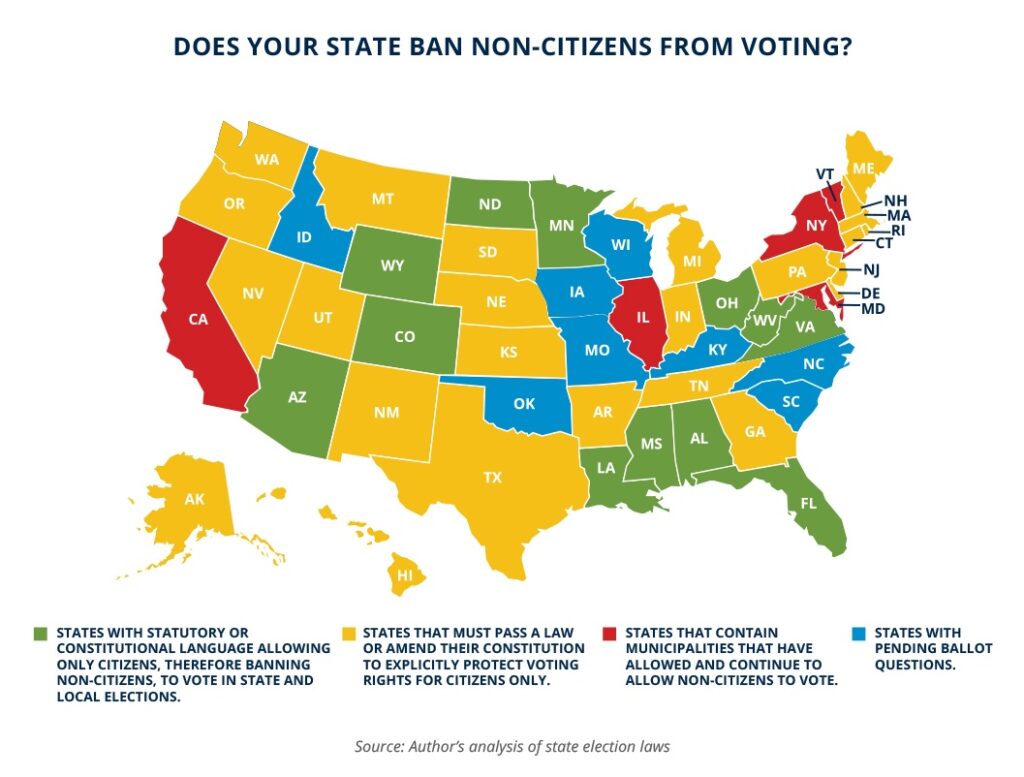
The question of whether non-citizens vote in American elections has generated one of the most acrimonious methodological disputes in contemporary political science, and understanding that dispute is essential to evaluating the real-world significance of registration errors like New Jersey's.
The controversy traces largely to a 2014 paper by Jesse Richman, Gulshan Chattha, and David Earnest, published in the prestigious journal Electoral Studies, titled "Do non-citizens vote in U.S. elections?" Using data from the Cooperative Congressional Election Study (CCES), a large survey of American adults conducted by Harvard and YouGov, Richman and his colleagues found that approximately 6.4 percent of non-citizens reported voting in the 2008 presidential election. If that percentage were applied to the estimated non-citizen adult population at the time — roughly 19 million — it would suggest that over a million non-citizens voted in 2008, a figure large enough to potentially have influenced close elections.
The paper produced an immediate and fierce response. Stephen Ansolabehere of Harvard, Brian Schaffner of Tufts, and Samantha Luks of YouGov published a rebuttal, also in Electoral Studies, arguing that Richman et al.'s findings were the product of survey measurement error rather than actual non-citizen voting. Their argument was methodological: the CCES, they pointed out, classifies respondents as citizens or non-citizens based on self-reported answers. In a large survey, a small but nonzero number of citizens will accidentally misclassify themselves as non-citizens — perhaps due to misreading the question, confusion about terminology, or data entry error. If even one percent of the CCES respondents who are actually citizens misidentify themselves as non-citizens, and those misidentified respondents voted at the same rate as other citizens, the resulting contamination of the "non-citizen" sample would produce exactly the pattern Richman et al. observed.
Ansolabehere et al. tested this hypothesis by looking at CCES respondents who identified as non-citizens in one survey wave but as citizens in a subsequent wave — a pattern consistent with measurement error. They found that these "switching" respondents accounted for a disproportionately large share of the apparent non-citizen voters in Richman's data. When these respondents were excluded, the non-citizen voting rate dropped to a level indistinguishable from zero.
Richman has contested this rebuttal, arguing that some of the "switchers" might represent actual non-citizens who later naturalized, or citizens who initially mis-answered the question. The debate has continued in the academic literature for a decade, with neither side achieving consensus. What the mainstream of election researchers — including scholars at the Brennan Center for Justice, the MIT Election Data and Science Lab, and the National Conference of State Legislatures — generally conclude is that non-citizen voting occurs but is rare: far rarer than a raw reading of Richman et al. would suggest, and certainly not occurring at rates that could swing statewide or national elections under normal circumstances.
This academic context is crucial for interpreting the New Jersey data. Of the 6,600 non-citizens registered, approximately 400 were reported to have cast ballots. That figure — 400 actual votes — needs to be understood in several ways simultaneously. First, it represents a clear legal violation: federal law under 18 U.S.C. § 611 makes it a crime for non-citizens to vote in federal elections, and all of these votes were cast in federal election cycles. Second, it represents a very small percentage of total votes cast — in a state with more than four million registered voters and typical turnout in the millions, 400 votes is statistically negligible in any race that was not extraordinarily close. Third, it likely overestimates intentional fraud: as researchers like Lorraine Minnite argue in her book The Myth of Voter Fraud, documented instances of non-citizen voting almost always involve people who were confused about their eligibility, registered without understanding they were ineligible, or received incorrect information from government officials — not people who deliberately sought to subvert elections.
Hans von Spakovsky of the Heritage Foundation, who maintains a database of documented voter fraud cases, takes a different view: that even small numbers of fraudulent votes can affect close elections, that the rarity of documented cases reflects the rarity of prosecutorial attention rather than the rarity of the offense, and that the existence of any non-citizen registration represents an unacceptable breach of election integrity. This perspective, which drives much of the political response to incidents like New Jersey's, tends to focus on the system-level failure — the fact that the safeguard did not work — rather than the electoral impact of the specific votes cast.
Neither perspective is entirely wrong, and the tension between them maps almost perfectly onto the partisan divide over election security.
The Legal Ecosystem: Federal Statutes, State Variance, and the Enforcement Gap
The legal prohibition on non-citizen voting in federal elections is unambiguous. 18 U.S.C. § 611, enacted as part of the Illegal Immigration Reform and Immigrant Responsibility Act of 1996, makes it a felony for any alien to vote in any federal election. The penalty is up to one year in prison (or, for aggravated cases, up to three years). The law also provides for deportation as a consequence.
But prosecution is exceedingly rare. Between 1996 and 2026, federal prosecutors have brought fewer than fifty cases under § 611. The reasons for this low prosecution rate are multiple and, depending on one's political perspective, either entirely appropriate or scandalously negligent.
First, the burden of proof is high. Prosecutors must demonstrate that the defendant knew they were not a citizen and knew that voting was illegal for non-citizens — the latter element requiring proof of knowledge of a fairly obscure federal statute. Many non-citizens who are registered and vote do so because a government official told them they were registered, or because the registration forms they encountered did not clearly communicate the citizenship requirement, or because they believed that possession of a legal permanent resident card entitled them to vote.
Second, the investigative infrastructure for identifying non-citizen voters is inadequate. Federal prosecutors must rely on state election records, which are not always cross-referenced with federal immigration databases in a timely or reliable way. The DHS SAVE (Systematic Alien Verification for Entitlements) program, which allows authorized government agencies to verify immigration status, is available to election officials but is not widely used for voter roll maintenance. A 2017 survey by the National Conference of State Legislatures found that only nine states were using SAVE checks as part of regular voter roll maintenance.
Third, there is a genuine humanitarian concern: prosecuting someone who voted in good faith because a government system registered them is a different moral and legal situation from prosecuting someone who deliberately sought to subvert an election.
State laws vary considerably on how non-citizen registration is handled. Most states make non-citizen registration a crime, but penalties range from misdemeanor to felony, and enforcement ranges from proactive to essentially nonexistent. Some states, notably California and Illinois, have explicit policies of not cross-referencing voter rolls with immigration databases, citing privacy concerns and the chilling effect such checks might have on Latino community civic participation more broadly.
The variance in state enforcement creates what legal scholars call "jurisdictional arbitrage" — situations in which the same underlying conduct receives very different treatment depending on where it occurs. A non-citizen who votes in Colorado, where investigations have led to prosecutions, faces different consequences than one who votes in California, where the same conduct might result in nothing more than a quiet removal from the voter rolls.
The SAVE Program: A Verification Solution Hiding in Plain Sight
The DHS SAVE (Systematic Alien Verification for Entitlements) program represents perhaps the most significant underutilized tool in American election administration. SAVE is a federal electronic verification system that allows authorized government agencies to confirm the immigration status of applicants for public benefits, licenses, and other services. It is already used for Medicaid eligibility verification, professional license applications, federal contractor background checks, and dozens of other programs. Its infrastructure is proven, its data is current, and its use for voter registration verification is legally permissible under existing law.
The question of why SAVE is not universally used for voter roll maintenance is the kind of question that sounds like it should have a simple bureaucratic answer but actually reveals deep political fissures.
Proponents of SAVE integration — primarily conservative election-integrity advocates and some Republican state officials — argue that it represents the most straightforward technical fix to the non-citizen registration problem. If every voter registration application triggered an automatic SAVE query, non-citizens would be identified before registration rather than after, eliminating the need for costly retrospective audits and removing the political controversy from voter roll maintenance. Several states, including Georgia, Kansas (briefly, under a disputed law), and Arizona, have attempted to require proof of citizenship or SAVE verification as part of registration.
Opponents — primarily voting rights advocates, Democratic officials, and civil liberties organizations — raise several counterarguments. First, SAVE is not infallible: it contains errors, is not always current, and has been known to flag naturalized citizens as non-citizens due to data synchronization delays between USCIS and DHS systems. A false positive rate of even one percent applied to millions of voter registrations could disenfranchise tens of thousands of legitimate citizens. Second, SAVE queries take time, and mandatory SAVE verification could slow the registration process, particularly during high-traffic periods before elections. Third, there is a documented pattern of immigration enforcement concerns chilling civic participation among Latino, Asian, and immigrant communities broadly, and the prospect of voter registration triggering an immigration database check could discourage eligible citizens from registering.
The Obama-era Department of Justice repeatedly pushed back against states that attempted to mandate citizenship verification at registration beyond what the NVRA requires. The Trump administration reversed course, and the Biden administration reversed again. The result is a policy landscape in which the availability of SAVE for voter roll maintenance is legally clear but its use remains a political choice made by individual states, producing exactly the kind of patchwork vulnerability that allows errors like New Jersey's to occur and persist.
The Biden-era EAC issued guidance in 2021 encouraging states to use SAVE for post-registration verification — that is, to cross-check existing voter rolls against immigration databases — but not as a prerequisite for registration. This represents a middle-ground position that satisfies neither side fully: too slow to catch errors before votes are cast, and too expansive for privacy advocates who worry about entangling voter rolls with immigration enforcement infrastructure.
Private Sector Involvement and the Accountability Vacuum
One of the most underappreciated dimensions of the New Jersey incident is the role of private software vendors in critical election infrastructure. The Motor Voter system at the center of the error was not built and maintained by the state of New Jersey itself — it was developed and managed under contract by a private technology company. Governor Sherrill's decision to terminate that contract was symbolically powerful, but it raises a question that goes well beyond any individual vendor relationship: why are private companies, operating with limited transparency and accountability, building the systems that manage democratic participation?
The involvement of private vendors in election technology is pervasive and deeply rooted. The Election Assistance Commission's (EAC) 2022 survey of election technology procurement found that approximately 92 percent of U.S. jurisdictions use commercial voting systems or commercial election management software, the vast majority developed and maintained by a small number of vendors. The voter registration database market is similarly concentrated: several major vendors — including Election Systems & Software (ES&S), Dominion Voting Systems, Hart InterCivic, and a handful of smaller companies — supply the registration systems used by the majority of U.S. states.
This concentration creates several problems. First, when a vendor has a bug, the bug may affect multiple states simultaneously — a single software update containing an error could replicate the New Jersey problem across a dozen jurisdictions at once. Second, vendor contracts typically include non-disclosure agreements that limit what state officials can reveal about system vulnerabilities, creating a situation in which the public's right to transparency about electoral infrastructure conflicts with vendors' contractual rights to protect proprietary information. Third, the technical expertise required to audit these systems often resides with the vendor rather than the state, creating a dependency relationship in which the state is not in a position to independently verify that the software behaves as intended.
The federal government has long recognized this problem without effectively solving it. The Help America Vote Act of 2002 (HAVA) established the EAC and created voluntary standards for voting system certification. But HAVA's standards do not extend to voter registration systems, which are considered a separate category of election technology and are not subject to federal certification requirements. This regulatory gap means that the software systems that determine who is on the voter rolls are held to a lower standard than the systems that count the votes themselves.
CISA's involvement in the New Jersey investigation reflects a broader and increasingly urgent federal interest in election security that goes beyond the voting machine question. CISA's election security program, launched in 2017 after the 2016 election interference concerns, has focused primarily on protecting election infrastructure from cyberattack. The New Jersey case represents a different kind of vulnerability — not a hack but a design failure — and CISA's intervention signals that the agency is expanding its mandate to encompass the full lifecycle of election technology, including registration systems.
International Comparisons: How Other Democracies Handle Voter Eligibility Verification
The challenges New Jersey faces with voter registration accuracy are not unique to the United States, but the specific vulnerability that produced the 6,600 non-citizen registrations reflects choices that American democracy has made differently from most peer democracies.
In most advanced democracies, voter rolls are maintained through a system of compulsory civil registration — a government-administered population database that is maintained continuously and from which voter eligibility is derived automatically. In Germany, France, Sweden, Denmark, and most of continental Europe, residents are legally required to register their address with the government, and this civil registry is used to generate and maintain voter rolls. Non-citizens, by definition, are registered under a different status in these systems and are not eligible for national election rolls. The problem of non-citizen registration through motor vehicle transactions does not arise because the motor vehicle registry is linked to the civil registry, which is linked to citizenship and immigration status, and eligibility flows from status rather than from self-attestation.
The United Kingdom uses an "annual canvass" system in which local authorities annually survey households to identify eligible voters. This approach, while more labor-intensive than continental civil registration, also relies on a cleaner separation between registration status and eligibility verification — local authorities can cross-check registration responses against National Insurance records and other government databases.
Canada's Elections Canada maintains a National Register of Electors using data from multiple federal and provincial government sources, including tax returns, health registrations, and citizenship records, with continuous updates. Canadian Citizens registering to vote for the first time must confirm their citizenship, but that confirmation is verified against the citizenship database maintained by Immigration, Refugees and Citizenship Canada (IRCC).
The United States chose a fundamentally different path — decentralized, opt-in registration managed at the state and local level, relying primarily on self-attestation of eligibility — for reasons deeply rooted in American federalism, historical suspicion of centralized government databases, and the legacy of registration being used as a tool of voter suppression. The result is a system that is more accessible than many comparative democracies in some respects (no compulsory registration requirement, multiple registration modalities) but more vulnerable to precisely the kind of administrative error that produced New Jersey's situation.
Some scholars, including political scientist Bernard Grofman of UC Irvine and election law scholar Richard Hasen of UCLA, have argued that the United States should move toward an automatic universal registration system built on federal records — essentially importing the European model into American federalism. This approach would require a level of federal-state data sharing and federal database infrastructure that does not currently exist, and would face significant constitutional and political obstacles. But the New Jersey case, and the broader pattern of AVR glitches, provides empirical evidence for their argument that self-attestation-based systems produce systematic errors at scale.
The Non-Citizen Voting Permission Paradox: Local Elections
An additional complexity rarely mentioned in coverage of the New Jersey incident is that "non-citizen voting" is not uniformly illegal in the United States. At the local level, a small but growing number of jurisdictions have explicitly authorized non-citizen residents to participate in certain elections.
Takoma Park, Maryland, pioneered this approach in 1991, extending local voting rights to all residents regardless of citizenship status. Several other Maryland municipalities followed suit, including Hyattsville, Mount Rainier, Barnesville, and others. San Francisco authorized non-citizen voting in school board elections in 2016, though this authorization was narrowly revoked by voters in November 2022 via Proposition N. New York City briefly authorized non-citizen voting in local elections through a 2021 City Council law before a state court struck it down in June 2022, ruling that it conflicted with the New York State Constitution.
Vermont's cities of Montpelier and Winooski have passed non-citizen local voting ordinances, as has Amherst, Massachusetts. As of mid-2026, approximately a dozen U.S. municipalities permit non-citizen voting in at least some local elections, typically municipal or school board elections.
This creates a genuine legal and administrative complexity for voter roll maintenance. A lawful permanent resident who is legitimately registered to vote in Takoma Park, Maryland, local elections is, by definition, a non-citizen on a voter roll. If that same individual is flagged by a SAVE check of voter rolls, how does the election official distinguish between a legitimate local voter and an improperly registered federal election voter? The answer, in principle, is that separate rolls should be maintained for local and federal elections — but in practice, many jurisdictions maintain a single master voter roll and denote eligibility for specific election types within that roll. The administrative sophistication required to maintain this distinction reliably is not uniformly present.
The existence of legal non-citizen voting in some jurisdictions also complicates the political narrative around incidents like New Jersey's. Headlines about "non-citizen voters" carry an implicit assumption that any non-citizen on a voter roll represents a failure of the system. But the reality is that the legal status of non-citizen participation in U.S. elections is genuinely contested at the local level, that reasonable people disagree about whether it should be permitted, and that the administrative infrastructure must accommodate a patchwork of rules that varies not just by state but by municipality.
The Remediation Problem: What It Actually Takes to Clean a Voter Roll
Governor Sherrill's commitment to removing the 6,600 non-citizens from New Jersey's voter rolls sounds straightforward but involves a genuinely complex legal and administrative process that illustrates why voter roll maintenance is chronically underfunded and underperformed across American states.
The National Voter Registration Act does not merely permit non-citizen removal from voter rolls — it requires it, while simultaneously placing strict procedural constraints on how removal must be accomplished. Under the NVRA, states cannot remove a voter from the rolls without first sending a written notice and waiting a specified period for a response. The notice must inform the registrant of the reason for the proposed removal and provide an opportunity to contest it. If the registrant responds within the notice period and asserts eligibility, the state must conduct an administrative hearing before removal. If the registrant does not respond, the removal can proceed — but only after the mandated waiting period, which can extend across multiple election cycles.
These procedural requirements were not invented to frustrate election officials. They were designed to prevent the use of voter roll purges as a voter suppression tool — a practice that has a long and well-documented history in American elections, particularly against Black, Latino, and low-income voters. The 2000 Florida voter roll purge, which removed thousands of eligible African American voters by incorrectly matching their names to those of convicted felons, is perhaps the most notorious example of how roll purges can be used — deliberately or through negligence — to disenfranchise legitimate voters.
The tension between the NVRA's removal procedures and the urgency of removing confirmed ineligible registrants is one of the central unresolved problems in election administration. For New Jersey's 6,600 non-citizens, the process is further complicated by the nature of the identifying information available. The state knows that these individuals registered through the MVC during the period the bug was active. It does not, through that fact alone, know the citizenship status of each individual — only that they answered "no" to the citizenship question, and that the software failed to register that answer. Some of the 6,600 may have since naturalized, making them currently eligible voters. Some may have been answering the citizenship question incorrectly, perhaps misunderstanding it. Some may indeed be non-citizens who have no intention of contesting the removal.
To navigate this complexity, New Jersey must cross-reference its MVC records with USCIS naturalization records, send individual notices to each of the 6,600, manage responses and appeals, and conduct individual determinations for contested cases — all while maintaining compliance with federal notice requirements and ensuring that no eligible voter is removed without due process. This is a multi-month, labor-intensive administrative process that requires legal expertise, inter-agency coordination, and ongoing quality control. It is exactly the kind of work that chronically underfunded state election administration infrastructure is poorly equipped to perform at speed.
Political Epistemology: How the Same Facts Support Opposite Narratives
The New Jersey incident has been described, depending on the source, as evidence of a massive voter fraud crisis that threatens American democracy, as a minor technical glitch being weaponized for partisan purposes, and as a cautionary tale about the risks of automation in government systems that demands bipartisan reform. All three framings engage with the same underlying facts and arrive at genuinely different conclusions — not necessarily because one side is lying, but because different interpretive frameworks weight the available evidence differently.
The conservative election-integrity framing focuses on two key data points: 6,600 non-citizens registered, and 400 confirmed votes. From this perspective, the incident demonstrates that the voting rolls are vulnerable to contamination, that the existing safeguards are inadequate, and that the consequence of this inadequacy is illegal votes being cast in American elections. The appropriate response, from this view, is stricter verification requirements, mandatory citizenship proof at registration, and aggressive prosecution of non-citizen voters. The underlying theory — associated with researchers like John Fund, Hans von Spakovsky, and conservative legal scholars — is that election fraud, while difficult to document, is more prevalent than official investigations suggest, and that systematic prevention is preferable to case-by-case prosecution.
The progressive election-reform framing focuses on different data points: the 400 votes represent a vanishingly small fraction of total votes cast, the registrations were caused by a government system error rather than deliberate fraud, the affected individuals are unlikely to have known they were ineligible, and the proposed remedies — citizenship verification requirements — have a documented history of disproportionately burdening minority and low-income voters. From this view, the appropriate response is fixing the software, improving auditing, and ensuring that error detection happens faster — not adding new barriers to registration that would exclude far more eligible voters than they prevent ineligible ones from registering. The underlying theory — associated with researchers like Lorraine Minnite, Justin Levitt of the Brennan Center, and voting rights scholars — is that election fraud is rare enough that the cure of strict verification is worse than the disease.
Both framings contain valid empirical elements and genuine values commitments. The difficulty is that they disagree not just on facts but on the appropriate metric of harm. The conservative framing treats any non-citizen vote as a serious harm worthy of significant preventive measures, even at the cost of access for eligible voters. The progressive framing treats voter disenfranchisement of eligible citizens as the primary harm to avoid, accepting some irreducible risk of ineligible voter participation as less costly than access barriers.
This values disagreement is not resolvable through more data. It is a political and philosophical disagreement about how to balance competing democratic goods — participation and integrity — that admits no neutral technical solution. The software vendor cannot write code that satisfies both sides simultaneously, because the disagreement is not fundamentally about software.
The 400 Who Voted: Legal Jeopardy, Prosecutorial Reality, and Human Consequence
The 400 individuals reported to have cast ballots while improperly registered occupy a legally and humanly complex position that mainstream coverage of the New Jersey incident has largely failed to examine in depth.
From a strictly legal standpoint, each of these individuals may have violated 18 U.S.C. § 611 — the federal prohibition on non-citizen voting in federal elections. Whether they have actually done so depends on facts specific to each case: their immigration status at the time of voting, their knowledge of the citizenship requirement, the nature of the elections in which they voted (federal elections are covered by the statute; state and local elections may or may not be covered by state law), and whether they can demonstrate good-faith reliance on government-provided registration materials.
The good-faith defense is particularly significant here. When a state government sent a voter registration card to these individuals — as would have happened as a result of their MVC registration — the card constituted an affirmative government representation that they were eligible to vote. When they received sample ballots, polling place information, and election administration communications, the government was, in effect, telling them to vote. Prosecuting someone for voting in reliance on explicit government communications telling them they are registered voters raises serious questions about due process and government estoppel — legal doctrines that prevent the government from enforcing a rule against someone whom it has affirmatively encouraged to violate it.
Federal prosecutors appear to have internalized this concern. As of mid-2026, no charges have been filed against any of the 400 individuals under 18 U.S.C. § 611 in connection with the New Jersey incident. This is consistent with the historical pattern: federal prosecutions for non-citizen voting are extremely rare, and in cases where the registration resulted from government error, they are essentially unheard of.
The human dimension of the situation also deserves attention. Many of the 6,600 non-citizens registered through New Jersey's MVC are legal permanent residents who have lived in the United States for years or decades, who pay taxes, who have families, who are deeply embedded in their communities. The fact that they answered "no" to a citizenship question on a driver's license form suggests that, far from seeking to commit electoral fraud, they were attempting to comply with a legal requirement they understood correctly. Being told, after the fact, that a government system error registered them anyway, and that the government is now seeking to remove them from voter rolls and potentially investigate them for a federal crime, is not an abstract administrative process for these individuals — it is a source of genuine fear, particularly in an immigration enforcement environment that has been intensely aggressive in the 2025-2026 period.
The Trust Deficit and Its Democratic Consequences
Beyond the specific mechanics of the New Jersey case lies a deeper problem that the incident both reflects and exacerbates: a catastrophic decline in public trust in election institutions.
Gallup polling consistently shows that confidence in the integrity of U.S. elections has declined sharply since 2016, with the 2020 and 2024 election cycles producing particularly dramatic drops in Republican trust. MIT Election Lab research by Charles Stewart III and colleagues finds that partisan differences in confidence in election administration have widened substantially and that these differences are not primarily driven by exposure to information about actual fraud, but by partisan media consumption and elite political cues.
This is the context in which the New Jersey incident lands. When 6,600 non-citizen registrations are announced, the audience receiving that information is not a neutral evaluator applying Bayesian updating to evidence about election security. It is a politically polarized public, large segments of which already believe that elections are systematically rigged, or that election-integrity concerns are systematically manufactured for partisan purposes. The incident is immediately absorbed into existing narratives and amplifies pre-existing concerns, regardless of its actual electoral significance.
The trust deficit creates a cruel policy paradox: the reforms most likely to restore trust in election security — stricter verification requirements — are also the reforms most likely, based on empirical evidence, to reduce access for legitimate voters and thereby generate new grounds for distrust among different segments of the electorate. There is no policy intervention that credibly rebuilds trust across the partisan divide simultaneously, because the deficit is not driven by information failure about election security but by a broader collapse of institutional trust that election administration cannot solve on its own.
This does not mean that improving election security is futile or that fixing the software glitch is unimportant. It means that the political consequences of incidents like New Jersey's cannot be addressed through technical remediation alone. They require what political scientists call "legitimation work" — sustained, transparent, bipartisan communication about how elections work, what errors occurred, how they were caught, what was done about them, and why the institution responsible for administering elections deserves continued trust despite its imperfections. This kind of legitimation work is exactly what contemporary American political culture makes extremely difficult.
Frontier Questions: Where the Research and Policy Actually Need to Go
The New Jersey incident points toward several genuinely open research and policy questions that deserve more systematic attention than they are currently receiving.
The false negative rate in citizenship verification: Much of the debate over SAVE integration focuses on the false positive problem — cases in which eligible citizens are flagged as non-citizens. But there is a corresponding false negative problem that is less well understood: how many non-citizens slip through citizenship verification because they possess documentation that passes automated checks? USCIS and DHS have invested heavily in document authentication, but the pace of sophisticated document fraud has not been systematically studied in the voter registration context.
The naturalization pipeline and registration timing: A non-trivial number of people in the United States are in the process of naturalization at any given time. These individuals may be non-citizens when they first obtain a driver's license and register to vote through the MVC, but citizens by the time they exercise that registration. Understanding the size and characteristics of this population — people who are "temporarily ineligible but on a path to eligibility" — would inform more nuanced approaches to registration verification that don't simply treat non-citizen status as binary and permanent.
The cognitive burden of citizenship questions: Research in behavioral economics and decision-making suggests that the framing and context of questions significantly affects how people answer them. No systematic research has examined how non-citizens experience and process the citizenship question during DMV transactions — whether they understand it, whether they feel pressured by the presence of government officials, whether they correctly grasp its implications for voter registration. Designing these interfaces based on actual behavioral research rather than legal requirements alone could significantly reduce inadvertent error.
AVR error rate benchmarking: No federal or state agency currently requires voter registration systems to report error rates, and there is no established benchmark for acceptable accuracy in AVR systems. The New Jersey case produced 6,600 errors out of an unknown total number of MVC transactions during the affected period. Without knowing the denominator, it is impossible to evaluate whether this represents an acceptable or unacceptable error rate, or to compare it to other states' systems. Mandatory error rate reporting would enable meaningful quality benchmarking for the first time.
The inter-database synchronization problem: The New Jersey error arose, in part, from a failure to correctly synchronize data across state databases. This is a ubiquitous problem in government information technology, and it is not unique to voter registration. Research on how other high-stakes government database integration projects — healthcare eligibility, benefits administration, tax enforcement — manage this synchronization problem could yield practical lessons for election administration.
Post-registration verification cadence: The debate over whether to require citizenship verification before or after registration assumes these are the only two options. There may be a more nuanced middle path: automated, ongoing post-registration cross-checks that flag potential ineligibility without triggering immediate removal, creating an administrative review queue that can be processed through proper due process procedures before any election in which the registrant might vote. Modeling the impact of different cadence options on both error detection rates and administrative workload would be a valuable contribution.
The Deeper Democratic Question: Automation, Accountability, and the Boundaries of Delegated Authority
At its most philosophical level, the New Jersey incident raises a question that extends far beyond voter registration: what functions of democratic self-governance can be safely delegated to automated systems, and what functions require human judgment?
The Motor Voter system was built on an assumption that voter registration is an administrative function — routine, high-volume, processable by algorithm. This assumption is largely correct. The overwhelming majority of driver's license applications come from eligible citizens who should be registered to vote, and automating that process serves democracy by removing unnecessary friction. The problem is that even a very small error rate in a very high-volume process produces significant absolute errors, and in election administration, the tolerance for error is asymmetric: errors that add ineligible voters are considered far more scandalous than comparably sized errors in other government benefit programs, because they touch the foundational legitimacy of democratic governance.
This asymmetry suggests that election registration systems should be held to a higher accuracy standard than the automation-optimized systems typically designed for efficiency. Building that higher standard into contracts with private vendors, into federal certification requirements, into mandatory auditing regimes, and into the administrative culture of election offices is a massive institutional undertaking that no jurisdiction has yet fully accomplished.
The deeper issue is accountability. When a private software vendor's code error registers 6,600 non-citizens to vote, who is responsible? The vendor, clearly — but vendors can be sued or terminated only if they have violated contract terms that are specific enough to define the required accuracy standard. The MVC, which failed to detect the error for a year — but the MVC's accountability to the public is mediated through gubernatorial appointments, legislative appropriations, and the general opacity of technical government operations. The previous administration's officials — but holding public officials accountable for software failures they may not have understood technically is a blunt instrument that doesn't obviously produce better systems. The state legislature, which may have underfunded election security — but legislative accountability for technical infrastructure failures is nearly impossible to maintain in practice.
The diffusion of accountability across vendors, agencies, administrations, and legislative bodies is not accidental. It is the predictable consequence of designing election administration in a way that prioritizes the delegation of technical complexity to private entities over the maintenance of clear public accountability chains. The New Jersey incident suggests that this design choice has real costs — not just in the specific errors it produces, but in the inability to assign and learn from those errors in ways that produce lasting improvement.
Conclusion: A Crisis That Is Also an Opportunity
The 6,600 non-citizen voter registrations in New Jersey are simultaneously less alarming and more important than the political discourse around them suggests. Less alarming, because the actual electoral impact was small, because the error was the product of a software glitch rather than deliberate fraud, and because the overwhelming majority of the affected individuals had done nothing wrong. More important, because the incident reveals structural vulnerabilities in American election infrastructure that go far beyond any single state or any single error — vulnerabilities in vendor accountability, in inter-agency data sharing, in federal oversight frameworks, in administrative auditing culture, and in the fundamental legal architecture of automatic voter registration.
The incident also reveals the profound difficulty of governing election systems in a period of extreme political polarization. Every fact about the New Jersey case is immediately weaponized by one side or the other, and the actual administrative task of improving the system gets lost in the noise of partisan attribution. This is a problem that technical fixes cannot solve. It requires political leadership willing to claim ownership of election administration failures, explain them honestly to the public, and pursue reforms that improve accuracy without reducing access — a political position that is difficult to maintain when every improvement can be reframed as either capitulation to voter suppression or insufficient response to a fraud crisis.
What the New Jersey case ultimately teaches is that democratic infrastructure is only as strong as the political culture that maintains it. A society that cannot speak honestly about election administration failures, cannot hold vendors and agencies accountable for technical errors, cannot distinguish between administrative malfunction and deliberate fraud, and cannot maintain bipartisan commitment to both access and integrity has a democracy problem that goes much deeper than any software glitch. The 6,600 mistaken registrations are a symptom. The disease is a failure of collective governance seriousness about the machinery of self-government — a machinery that, once it loses the confidence of large numbers of citizens, becomes very difficult to repair.
Sources referenced in this article include: Jesse Richman, Gulshan Chattha, and David Earnest, "Do non-citizens vote in U.S. elections?" Electoral Studies 36 (2014); Stephen Ansolabehere, Samantha Luks, and Brian Schaffner, "The perils of cherry picking low frequency events in large sample surveys," Electoral Studies 40 (2015); Lorraine Minnite, The Myth of Voter Fraud (2010); Justin Levitt, "The Truth About Voter Fraud," Brennan Center for Justice (2007); Heritage Foundation Voter Fraud Database (maintained by Hans von Spakovsky); EAC Statutory Overview and Survey Reports (2017-2023); NCSL Automatic Voter Registration Tracking; CISA Election Security Program documentation; 18 U.S.C. § 611; National Voter Registration Act of 1993 (Pub. L. 103-31); Help America Vote Act of 2002 (Pub. L. 107-252); DHS SAVE Program documentation; MIT Election Data and Science Lab research by Charles Stewart III.