Crime in the United States: Trends, Demographics, and the Road Ahead
American crime is in a state of paradox. By virtually every traditional metric — homicide, robbery, burglary, motor vehicle theft — the United States is experiencing its lowest rates of violent and property crime in more than half a century. Yet the country simultaneously grapples with an explosion in digital fraud, stubbornly high rates of gun violence relative to peer nations, persistent hate crime, and a public that frequently perceives crime as worsening even as official data show the opposite. Understanding where crime in America actually stands requires parsing hard numbers, demographic realities, geographic disparities, and the deep structural forces — poverty, inequality, social dislocation — that drive criminal behavior in the first place.
The Big Picture: Record-Breaking Declines in 2024 and 2025
The Federal Bureau of Investigation's crime reporting data for 2024 and the agency's preliminary figures for 2025 tell a striking story of sustained improvement across nearly every major category.
Violent Crime
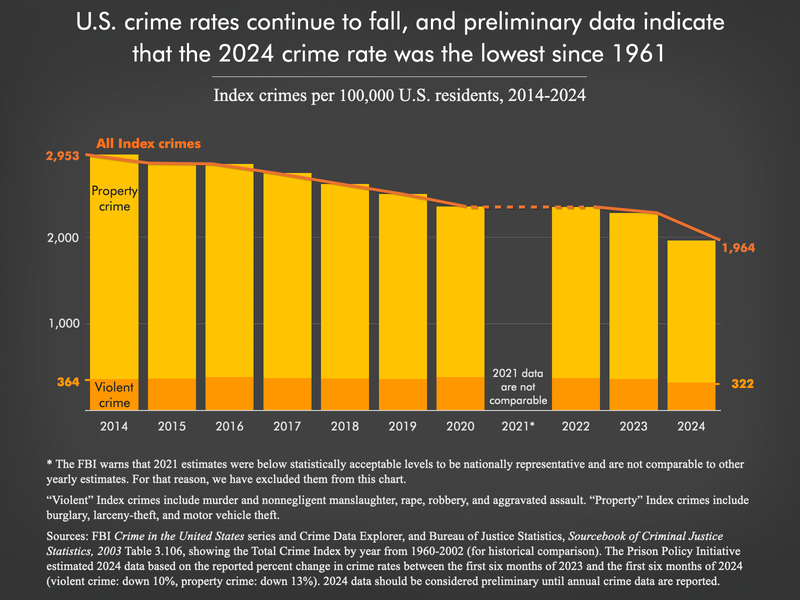
Violent crime in the United States fell an estimated 4.5% in 2024 compared to 2023, pushing the national rate to approximately 359 incidents per 100,000 inhabitants — the lowest figure documented in roughly 20 years, surpassing the previous low of 372.4 per 100,000 set in 2014. By 2025, the decline accelerated dramatically: the FBI's preliminary data show violent crime dropped an estimated 9.3% from 2024 to 2025, marking the largest year-over-year decline in violent crime rates since FBI estimations began in 1936.
The sub-categories of violent crime all declined in 2024:
| Crime Type | 2024 Change vs. 2023 |
|---|---|
| Murder & Non-Negligent Manslaughter | −14.9% |
| Rape | −5.2% |
| Robbery | −8.9% |
| Aggravated Assault | −3.0% |
In 2025, these trends intensified further:
| Crime Type | 2025 Change vs. 2024 |
|---|---|
| Murder & Non-Negligent Manslaughter | −18.1% |
| Rape | −7.6% |
| Robbery | −18.5% |
| Aggravated Assault | −7.2% |
Most notably, the 2025 murder rate of 4.1 per 100,000 inhabitants is tied with 1955 and 1956 for the lowest murder rate in American recorded history — a remarkable reversal from 2020, when homicides surged nearly 30% during the COVID-19 pandemic.
Property Crime
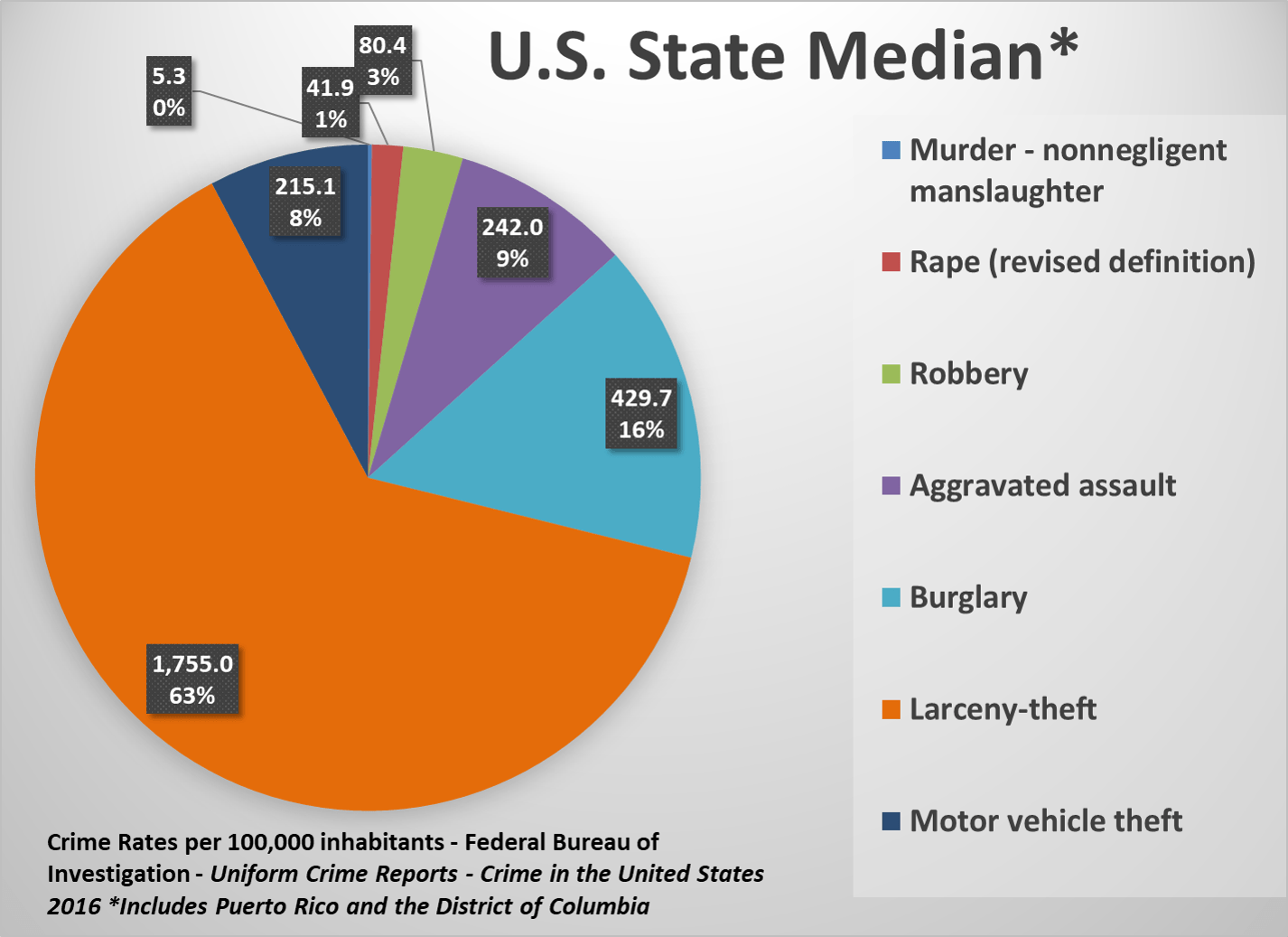
Property crime followed an equally dramatic trajectory. In 2024, property offenses declined an estimated 8.1% from 2023, with an estimated 5,986,400 property crimes committed nationwide — a rate of 1,760.1 per 100,000 inhabitants, the lowest since 1961.
``` Property Crime by Category — 2024
Burglary ████████░░░░░░░░░░ −8.6% Larceny-Theft ██████░░░░░░░░░░░░ −5.5% Motor Vehicle Theft ██████████░░░░░░░░ −18.6% ```
The precipitous drop in motor vehicle theft is particularly notable, reversing a sharp spike that ran from 2020 through 2023 — a surge driven in part by well-publicized vulnerabilities in certain Hyundai and Kia models.
Types of Crime: A Closer Look
Cybercrime: The Rising Tide
While traditional crime statistics paint an optimistic picture, digital crime tells the opposite story. The FBI's Internet Crime Complaint Center (IC3) reported that scammers and cybercriminals stole a record $16.6 billion from Americans in 2024, representing a 33% increase in losses from 2023. By 2025, cybercrime losses climbed further to an estimated $20.9 billion, continuing a years-long surge in both financial damage and reported incidents.
The biggest categories of cybercrime losses in 2024 include:
- Investment fraud: $6.57 billion in losses — the single largest category, driven heavily by cryptocurrency scams and "pig butchering" schemes in which fraudsters cultivate long-term online relationships before persuading victims to invest in fraudulent platforms.
- Business Email Compromise (BEC): $2.77 billion, targeting corporate finance departments and wire transfer systems.
- Tech support scams, elder fraud, and ransomware attacks on critical infrastructure round out the top categories.
Older Americans (60+) are disproportionately victimized by cybercrime and account for the largest total dollar losses of any age group, though younger adults file more total complaints. The true scale of cybercrime is almost certainly larger: reporting rates are low, and many victims — particularly businesses — do not disclose breaches publicly.
White-Collar Crime: Vast Costs, Diminishing Prosecution
White-collar crime — fraud, embezzlement, money laundering, insider trading, and related offenses — costs the United States an estimated $300 billion to $800 billion annually, according to the FBI. Yet federal prosecution of these offenses has declined sharply. U.S. Attorney offices filed 4,332 white-collar prosecutions in fiscal year 2024, and FY 2025 was projected at just 3,862 — the lowest level since federal records began in 1986, and less than half the 10,269 filed in FY 1994.
Less than 10% of white-collar crimes are ever reported to law enforcement, according to National Public Survey data, making these figures likely a substantial undercount of actual activity. Investment fraud accounted for the largest dollar losses among reported cases, followed by business email compromise.
Drug Crime
Drug abuse violations remained a leading arrest category in 2024, with approximately 822,488 drug-related arrests reported to the FBI. Drug offense rates held roughly even comparing the first half of 2025 to the same period in 2024, suggesting the years of dramatic declines in drug arrests following policy shifts in many states have largely stabilized. The fentanyl crisis continues to dominate the drug landscape: fentanyl and other synthetic opioids remain responsible for the vast majority of the roughly 100,000 overdose deaths recorded annually, blurring the line between drug crime and public health catastrophe.
Gun Violence
Gun violence occupies its own category in the American crime landscape — both because of the country's exceptional civilian firearm ownership rates and because firearms amplify the lethality of conflicts that might otherwise result in non-fatal outcomes.
In 2024, an estimated 44,447 people died from gun-related injuries, according to CDC data — a figure that includes homicides, suicides, and accidents. Shooting homicides specifically declined for a fourth consecutive year, dropping from nearly 17,000 in 2024 to approximately 14,651 in 2025 — a 14% decline that tracks closely with the broader homicide decrease documented by the FBI.
However, firearm suicides have not declined and have in fact increased slightly. An average of 2,338 Americans died by firearm suicide every month between January and July 2025, a slight increase from the same period in 2024. Suicides account for roughly 54% of all gun deaths in the United States.
Mass shootings — defined by the Gun Violence Archive as incidents involving four or more victims shot, not including the shooter — numbered 587 in 2024, resulting in 712 deaths and 2,389 injuries. Using the FBI's narrower definition of "active shooter incidents" (an individual actively engaged in killing or attempting to kill people in a populated area), there were 24 active shooter incidents in 2024, resulting in 23 deaths (excluding shooters) — a meaningful decline from 61 such incidents in 2021.
Hate Crimes
The FBI's 2024 hate crime data revealed 11,679 hate incidents reported — the second-highest total on record since the FBI began tracking such offenses in 1991, though it represented a 10% decrease from 2023's record-setting figure of 12,498. (The FBI's preliminary 2025 data show a further decline of approximately 7%, to 10,606 incidents.)
``` 2024 Hate Crime Bias Categories
Race/Ethnicity/Ancestry ████████████████████ 53% Religion ██████████ 25% Sexual Orientation ███████ 18% Other ██ 4% ```
Within these categories:
- Anti-Black hate crimes accounted for the largest share of race-based incidents (3,004 incidents), though this represented a 9% drop from 2023.
- Anti-Jewish incidents (1,938) led religion-based hate crimes — a figure that remained elevated relative to pre-2020 norms and reflected global tensions following the October 7, 2023 Hamas attacks and the subsequent conflict in Gaza.
- Anti-LGBTQ+ incidents numbered 2,413, with anti-gay (male) bias accounting for the largest subcategory; gender identity-motivated incidents totaled 463.
- Anti-Muslim incidents (228) and anti-Sikh incidents (142) were also significant within religious categories.
Hate crime researchers consistently note that official FBI figures capture only a fraction of actual incidents, as many victims do not report to police and not all law enforcement agencies participate in voluntary hate crime reporting.
Demographics of Crime
Understanding crime requires looking honestly at who commits it and who experiences it — data that are often politically charged but essential to designing effective policy responses.
Age
The relationship between age and crime is among the most robust findings in criminology. Most murder offenders in the United States are between the ages of 17 and 39, with the number of offenders declining steadily after age 40. Homicide victimization is similarly concentrated: the highest rate of death by homicide is found among males between the ages of 15 and 24. Juvenile arrests have declined significantly since the early 1990s' peak.
Gender
Male offenders dominate virtually every crime category. According to Bureau of Justice Statistics data:
- 76% of violent incidents involved male offenders — 1.5 times their share of the general population.
- Female offenders were identified in approximately 19% of violent incidents — less than half their population proportion.
- In 2024, there were 13,469 male murder offenders compared to 1,902 female murder offenders nationally.
The gender gap in criminal offending is a universal finding across countries and time periods; criminologists attribute it to differences in risk-taking behavior, social control mechanisms, peer group dynamics, and differential exposure to environments that normalize violence.
Race and Ethnicity
Crime statistics by race require careful contextualization. Racial disparities in arrest and victimization data do not exist in a vacuum — they are inseparable from the history of residential segregation, discriminatory policing, concentrated poverty in urban neighborhoods, and structural inequalities that affect opportunity, community cohesion, and exposure to violence.
With that context, the Bureau of Justice Statistics' 2024 Criminal Victimization report found:
- African Americans experience the highest rates of violent victimization at 22.9 per 1,000 individuals, substantially higher than other demographic groups.
- Black Americans accounted for approximately 25% of perceived offenders in violent incidents while representing roughly 12% of the 12-and-older population.
- In 2024, law enforcement reported approximately 6,454,889 total arrests, with Black Americans representing approximately 2.2 times their population share in arrest data.
These disparities reflect both actual differences in crime participation — largely attributable to the concentration of disadvantage in certain communities — and well-documented disparities in policing intensity, which means that crime in Black and low-income neighborhoods is more likely to generate arrests than equivalent behavior elsewhere. In areas of concentrated poverty with histories of disinvestment, both victimization and offending rates are elevated across racial groups, consistent with the broader research literature linking socioeconomic deprivation to crime.
Geography: Where Crime Concentrates
State-Level Patterns
Crime rates vary dramatically across the 50 states. In 2024:
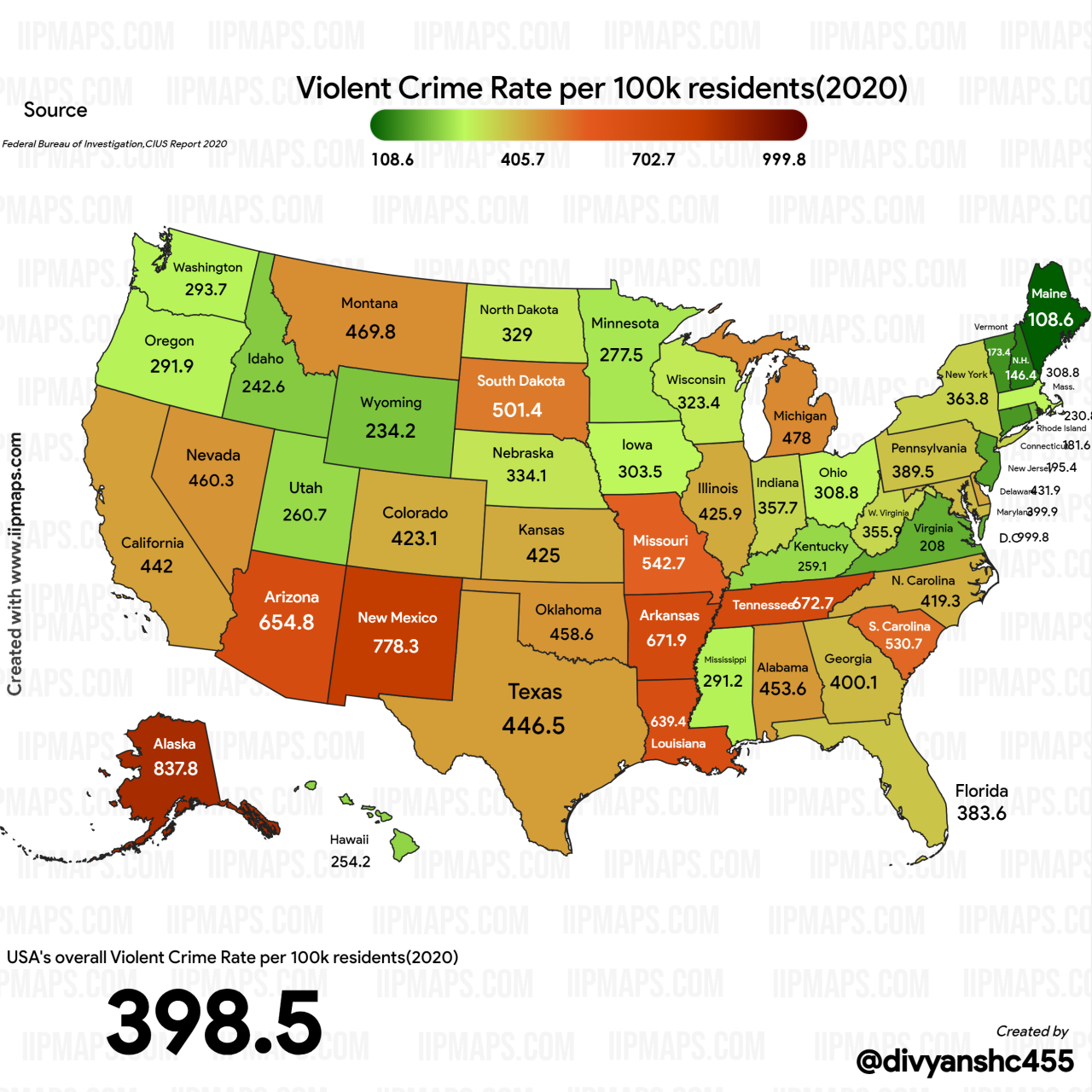
- Alaska recorded the nation's highest violent crime rate: 724.1 per 100,000 residents — nearly twice the national average. Remote geography, high rates of substance abuse, limited mental health services, and a large rural population with limited law enforcement access contribute to Alaska's persistent crime challenges.
- New Mexico ranked second for violent crime at 717.1 per 100,000.
- Maine had the lowest violent crime rate in the nation.
- New Hampshire, Maine, and Rhode Island were consistently among the top-performing states for both violent and property crime.
- Hawaii recorded the nation's largest single-year crime surge in 2024, with violent crime up 16.4% and property crime up 16.6%, driven partly by tourism-related property crime.
``` Violent Crime Rate per 100,000 Residents — 2024
Alaska ████████████████████████████████ 724.1 New Mexico ███████████████████████████████ 717.1 National Avg ████████████████ 359.0 Maine ████ ~110.0 ```
Urban, Suburban, and Rural Differences
The conventional image of crime as an exclusively urban phenomenon is increasingly outdated. While major cities still account for a disproportionate share of violent crime in absolute numbers, rural areas face unique challenges:
- Rural residents are less likely to report crimes to police, particularly domestic violence and property crime, meaning official statistics undercount rural victimization.
- Rural opioid crises and methamphetamine use have elevated property crime and domestic violence rates in many small communities.
- Response times in rural areas are substantially longer, affecting both deterrence and investigation quality.
New Orleans had the highest murder rate of any major American city in 2024, with approximately 46 homicides per 100,000 people. St. Louis, Missouri also ranked among the highest for murder rates. At the opposite end of the spectrum, Irvine, California and Virginia Beach, Virginia consistently rank among the safest large cities, with violent crime rates below 100 per 100,000.
Motivations and Root Causes
Economic Deprivation and Inequality
Decades of criminological research establish a clear relationship between economic conditions and crime rates. A 2024 study in the Journal of Research in Crime and Delinquency testing relative deprivation theory found that income inequality is more predictive of violent crime than absolute poverty levels — meaning that large, visible gaps between rich and poor generate crime even in relatively affluent communities.
Research consistently shows:
- Counties with higher economic inequality have more violent crime, though income inequality shows weaker associations with property crime.
- The quality of available employment matters: areas with only low-wage, unstable jobs show higher crime rates than areas with good-paying, stable employment, even controlling for other factors.
- The loss of manufacturing jobs, reduced generational economic mobility, and growing visible wealth disparities all contribute to elevated crime.
- The anonymity of urban environments reduces the social deterrence that exists in smaller communities — people are less constrained by community reputation in dense cities.
Economists studying crime increasingly find that labor market attachment is among the most powerful crime-reduction interventions available: when disadvantaged young men gain meaningful employment at living wages, crime participation declines substantially.
Substance Abuse
The relationship between substance use and crime is well-established but complex. Alcohol is implicated in a significant share of violent offenses, including domestic violence and assault. Methamphetamine and crack cocaine are associated with property crime as users seek funds to sustain addiction. The fentanyl crisis has generated secondary crime effects: property crime linked to drug dependency, violence associated with illegal drug markets, and a generation of children raised in families destabilized by addiction.
Social Dislocation and Community Factors
Research highlights the role of social cohesion — the strength of community ties, trust in institutions, and the presence of informal social controls — as a buffer against crime. Neighborhoods with high residential instability, concentrated poverty, and weak social institutions (churches, civic organizations, community centers) consistently show higher crime rates regardless of their racial composition. Conversely, communities with strong social networks, stable housing, and active civic participation show crime resilience even under economic stress.
Mental Health
Untreated severe mental illness plays a role in a subset of violent incidents, particularly those involving unknown victims (public-place attacks). However, researchers emphasize that mental illness alone is not a strong predictor of violence — the vast majority of people with mental illness are never violent. The interaction of mental illness with substance abuse, housing instability, and social isolation elevates risk substantially more than any single factor.
The Justice System's Response
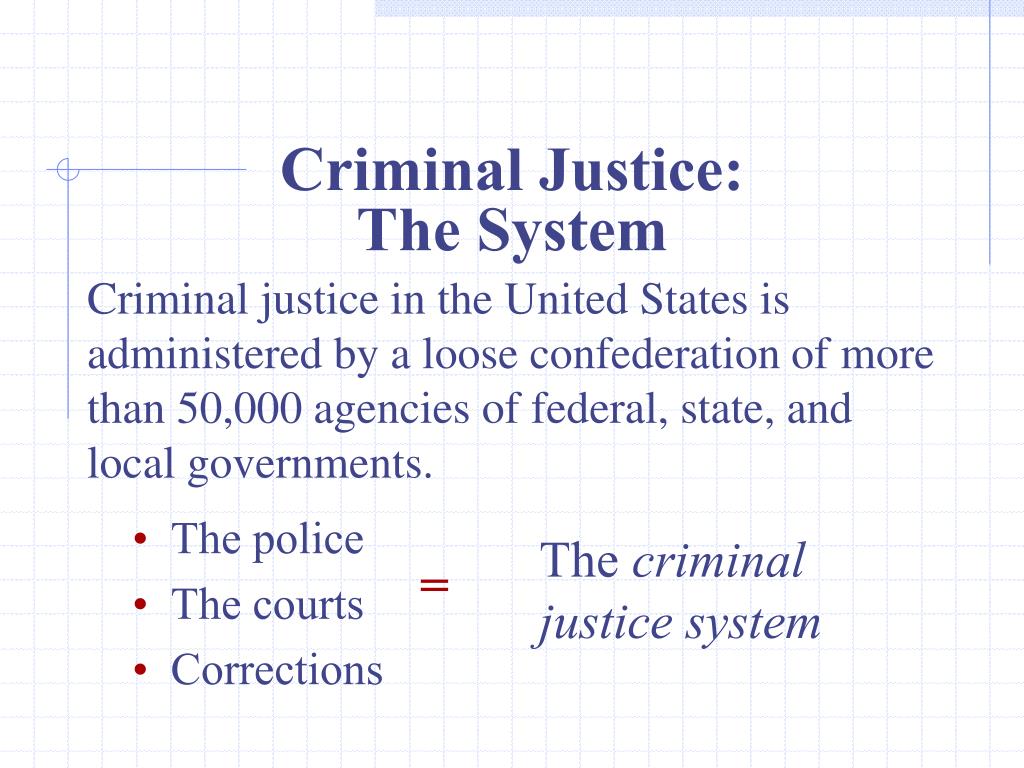
Incarceration
The United States remains the world's leading incarcerator by rate: approximately 1.9 million people were held in U.S. prisons and jails in 2025, according to Prison Policy Initiative data — a rate of roughly 570 per 100,000 residents, compared to 100 or fewer in most Western European nations. Despite substantial declines since the peak of mass incarceration in the late 2000s, the U.S. prison population remains extraordinarily high by international standards.
The racial composition of the incarcerated population reflects and amplifies the disparities seen in arrest data: Black Americans are incarcerated at approximately five times the rate of white Americans.
Recidivism
Recidivism — reoffending after release — remains a fundamental challenge for the justice system. Studies find that while overall recidivism rates are high for many categories of offense, people convicted of violent offenses show some of the lowest recidivism rates for similar crimes after release. A study examining re-incarceration rates for those paroled after homicide and sex-related convictions found that more than 99% did not return to prison within three years with a new sentence for a similar offense. Property and drug offenders show higher recidivism patterns.
Reform Efforts
As crime rates have declined, bipartisan conversations about reforming an expensive and often counterproductive carceral system have gained traction. In 2025, policy organizations across the political spectrum are advancing proposals that include:
- Reducing sentence lengths for non-violent offenses
- Expanding drug treatment and mental health diversion programs
- Reforming conditions of parole and probation supervision to reduce technical violations that return people to prison
- Investing in reentry programs addressing housing, employment, and behavioral health
The Justice Action Network's 2025 federal policy agenda notes broad bipartisan support for reforms that "preserve accountability while making the criminal justice system more fair."
Public Perception vs. Reality
One of the most persistent features of the American crime landscape is the gap between public perception and statistical reality. Gallup polling consistently finds that a majority of Americans believe crime is increasing nationally even in years when FBI and Bureau of Justice Statistics data show significant declines. In 2024, despite crime falling to multi-decade lows, surveys found high proportions of respondents expressing concern about personal safety.
This perception gap has multiple drivers:
- Media coverage that disproportionately covers violent incidents relative to their actual frequency.
- Social media amplifying individual crime stories across networks, creating impressions of ubiquity.
- Political messaging that emphasizes crime fears regardless of trends.
- Local variation: even in a year of national decline, some cities and neighborhoods experienced increases, and residents in those areas have accurate local perceptions even when national trends are moving the other way.
The perception-reality gap matters for policy: crime fear affects public health, mobility, urban investment, and housing markets — and it shapes demand for punitive policies whose effectiveness in further reducing crime is often modest.
Key Trends to Watch
Several dynamics will shape the American crime landscape in the coming years:
- AI-enabled fraud: Generative AI tools are making voice cloning, deepfake video, and hyper-personalized phishing attacks more accessible and convincing. The cybercrime loss figures of $16.6 billion (2024) and $20.9 billion (2025) are likely to continue rising unless countermeasures catch up.
- Fentanyl market evolution: Law enforcement actions against Chinese fentanyl precursor suppliers have disrupted some supply chains, but trafficking organizations adapt rapidly. The trajectory of synthetic opioid availability will heavily influence property crime and drug-related violence.
- Gun policy and firearm markets: The record firearm sales volumes of 2020–2022 expanded the civilian arsenal substantially; the long-term effect on violence is still being studied. State-level red flag laws and background check expansions show early evidence of modest effectiveness.
- Urban economic recovery and housing: The post-pandemic recovery of urban labor markets and housing stability in formerly distressed neighborhoods will influence crime trajectories significantly. Cities that make meaningful progress on housing and homelessness tend to see correlated improvements in public safety.
- Federal prosecution shifts: The steep decline in white-collar prosecutions raises questions about deterrence for financial crime. With FY 2025 projected filings at historic lows, the practical enforcement of laws against fraud, corruption, and financial crime may weaken further.
Conclusion
The United States stands at a genuine, data-confirmed inflection point in its long struggle with crime. Homicide rates are at historical lows, property crime has fallen to levels not seen since the early 1960s, and the overall trajectory of violent crime has been dramatically downward since the pandemic-era spike. These are meaningful achievements — the product of complex interactions between demographic change, economic recovery, community investment, targeted policing strategies, and policy reforms.
Yet the picture is incomplete. Cybercrime is a metastasizing threat that dwarfs traditional property crime in dollar terms. Hate crimes remain near record highs. Gun deaths — even as homicides decline — continue at a rate that separates the United States from every comparable wealthy nation. The racial and socioeconomic disparities embedded in both offending and victimization data point to structural inequalities that crime statistics measure but cannot resolve. And a carceral system of extraordinary scale and cost has not demonstrably produced the low-crime outcomes that far smaller systems in peer nations have achieved.
The challenge for policymakers, community leaders, and citizens is to hold the complexity of this picture honestly — celebrating genuine progress while refusing to look away from what remains. The data support neither panic nor complacency, but rather the kind of sustained, evidence-driven commitment to the economic opportunity, community investment, and systemic fairness that the research consistently shows underlies lasting public safety.
Sources:
- FBI Releases 2024 Reported Crimes in the Nation Statistics
- FBI Releases 2025 Reported Crimes in the Nation Statistics
- US crime rates fell nationwide in 2024, FBI report says — Stateline
- Nationwide 2024 Crime Data — Center for American Progress
- Criminal Victimization, 2024 — Bureau of Justice Statistics
- Crime in the U.S.: Key questions answered — Pew Research Center
- Violent Crime Rate in US 2025 — The Global Statistics
- UCR Summary of Reported Crimes in the Nation, 2024
- FBI reports hate crimes hit 2nd largest record in 2024 — Axios
- Murder and Extremism in the United States in 2024 — ADL
- Gun Violence By The Numbers in 2025 — The Trace
- What the data says about gun deaths in the US — Pew Research Center
- Crime Trends in U.S. Cities: Year-End 2025 Update — Council on Criminal Justice
- The path to public safety requires economic opportunity — Brookings
- Economic Inequality, Relative Deprivation, and Crime — Taylor & Francis
- Mass Incarceration: The Whole Pie 2025 — Prison Policy Initiative
- White-Collar Crime — FBI
- Federal Prosecution of White-Collar Crimes — TRAC Reports
- Which states have the highest and lowest crime rates? — USAFacts
- Hate Crimes in America — OpenCrime
- Crimes in the United States 2025 — The Global Statistics