Claude.ai
Claude.ai is the primary consumer and enterprise web interface for Claude, an AI assistant developed by Anthropic, PBC, an American artificial intelligence safety company headquartered in San Francisco, California. The domain claude.ai serves as the public-facing product surface for Anthropic's family of large language models. While "claude.ai" is a product domain rather than a standalone legal entity, it is commonly used as shorthand for Anthropic's AI assistant platform and its associated services.
What They Do and What Problem They Solve
Anthropic's core mission is the responsible development and maintenance of advanced AI for the long-term benefit of humanity. Claude.ai addresses several overlapping problems:
Information access and reasoning: Like competing AI assistants, Claude helps users synthesize information, draft documents, analyze data, and reason through complex problems faster than unaided human effort would allow.
Safety and reliability: Anthropic positions Claude as a solution to a problem it believes is inadequately addressed by competitors — the tendency of large language models to behave in ways that are harmful, deceptive, or misaligned with user intent. Claude is designed with extensive safety research baked into its training rather than applied as a post-hoc filter.
Enterprise trust: Businesses that cannot risk unpredictable or harmful AI outputs need an assistant they can deploy with confidence. Claude targets this gap by emphasizing honesty, reduced hallucination rates relative to prior model generations, and resistance to manipulation.
The underlying technical framework informing Claude's behavior is Constitutional AI (CAI), a training methodology Anthropic developed and published, in which a model is guided by a set of principles rather than solely by human feedback on individual outputs.
Products and Services
Claude.ai (Web Interface)
The flagship consumer product, accessible at claude.ai, provides a chat-based interface for interacting with Claude models. Features include long-context conversations, file and document uploads, image understanding, and artifact generation (code, documents, and structured outputs rendered in a side panel).
Claude API
Anthropic offers API access to its model family for developers and enterprises building applications. The API exposes multiple model tiers differentiated by capability and cost:
- Claude Haiku — fastest, lowest cost, suited for high-volume tasks
- Claude Sonnet — balanced capability and speed
- Claude Opus — highest capability, suited for complex reasoning tasks
Claude for Work / Teams / Enterprise
Anthropic offers tiered business plans providing higher usage limits, administrative controls, data privacy guarantees (conversations not used for training), and SSO integration. Enterprise agreements include custom context windows, dedicated support, and compliance tooling.
Claude in Third-Party Products
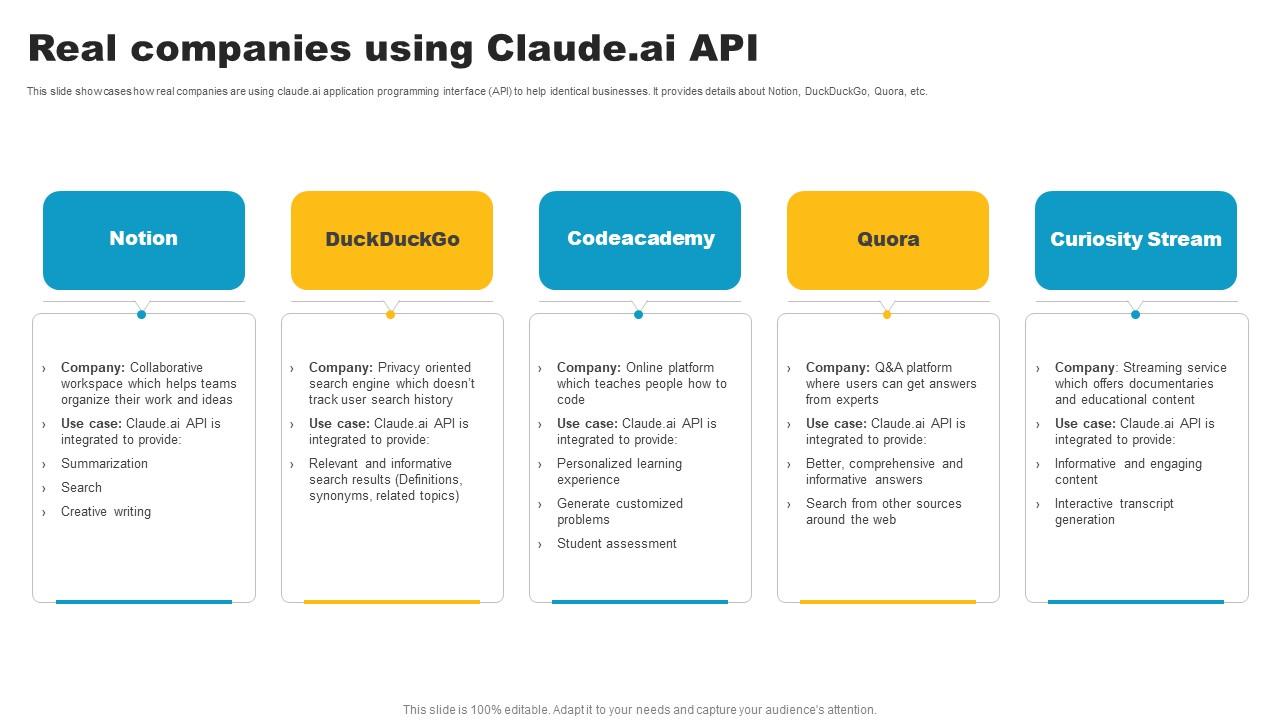
Through its API, Claude is embedded in products across Salesforce, Slack, Amazon Web Services (via Amazon Bedrock), Google Cloud (via Vertex AI), and numerous independent software vendors.
Pricing and Business Model
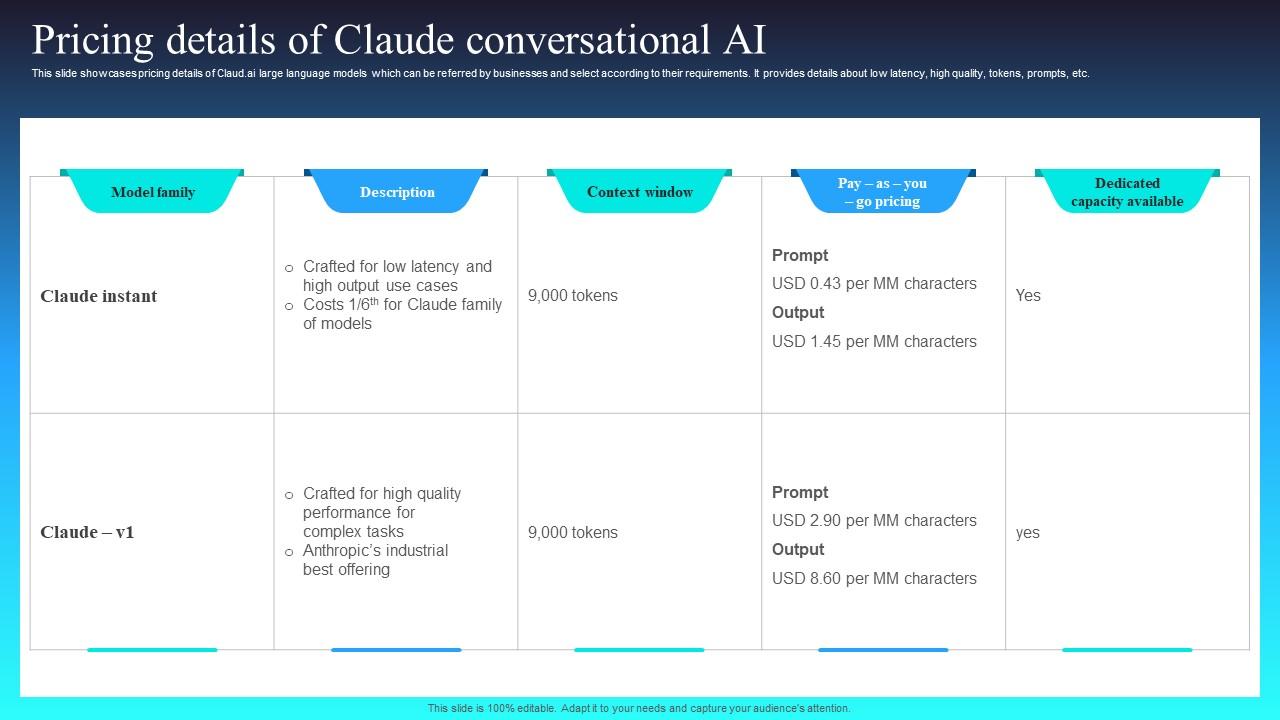
Anthropic operates a freemium SaaS model combined with API consumption pricing:
| Tier | Price | Notes |
|---|---|---|
| Free | $0 | Limited usage, access to standard Claude models |
| Claude Pro | ~$20/month | Higher limits, priority access, advanced models |
| Claude Team | ~$30/user/month | Centralized billing, admin controls |
| Enterprise | Custom | Volume pricing, compliance, dedicated support |
| API | Per-token | Priced per million input/output tokens, varies by model |
API pricing follows the industry-standard input/output token model. As of the knowledge cutoff, Anthropic's API pricing was competitive with OpenAI's comparable tiers, with Haiku-class models priced to compete on cost-sensitive workloads.
Anthropic's revenue model depends on both direct B2C subscriptions and B2B API revenue, with enterprise and cloud-partnership revenue constituting a growing share of total revenue — a pattern common across frontier AI labs.
Marketing and Positioning
Anthropic positions Claude explicitly around safety, honesty, and harmlessness — a differentiated stance in a market where competitors lead with raw capability benchmarks. Key positioning themes include:
- "Claude is trained to be helpful, harmless, and honest" — a formulation that has been central to Anthropic's public communications since the company's founding.
- Research credibility: Anthropic publishes safety research and model cards, appealing to enterprise buyers and policymakers who require transparency.
- Constitutional AI: The CAI methodology is marketed as a principled alternative to RLHF-only approaches, giving Anthropic a technical narrative distinct from OpenAI's.
- Long context: Claude has historically competed on context window size, enabling use cases such as analyzing entire codebases or legal documents in a single session.
Anthropic's marketing tends toward professional and enterprise channels — research publications, developer conferences, cloud marketplace listings, and thought leadership — rather than mass-market consumer advertising. This reflects its positioning as a serious, safety-conscious partner rather than a novelty product.
History and Founding
Anthropic was founded in 2021 by Dario Amodei and Daniela Amodei, along with several colleagues who departed OpenAI, where Dario had served as VP of Research. The departure was reported to reflect philosophical differences about the pace of commercialization and the prioritization of safety research.
Key milestones:
- 2021: Anthropic founded; initial research and safety work begins.
- 2022: Anthropic raises early funding rounds; internal Claude development underway.
- March 2023: Claude 1 released to limited API access.
- July 2023: Claude 2 released, featuring a 100,000-token context window — then among the largest available commercially.
- November 2023: Anthropic secures a major investment from Google (~$300M, following an earlier ~$400M commitment), and separately from Amazon (~$1.25B initial tranche of a committed $4B). These partnerships include cloud distribution agreements.
- 2024: Claude 3 model family (Haiku, Sonnet, Opus) released, with Opus achieving competitive or superior scores on several standard benchmarks relative to GPT-4.
- 2024–2025: Claude 3.5 Sonnet and subsequent iterations released; claude.ai expands features including Projects (persistent memory and document organization), computer use capabilities (in beta), and expanded enterprise tooling.
- 2025: Claude 4 model family released, including Opus 4 and Sonnet 4 variants, extending the capability frontier with stronger reasoning and extended thinking features.
Anthropic is structured as a Public Benefit Corporation (PBC), a legal structure that formally encodes a public mission alongside commercial interests.
Leadership and Team
Dario Amodei — CEO: Former VP of Research at OpenAI; PhD in computational neuroscience from Princeton. Serves as the public face of Anthropic's technical and policy positions.
Daniela Amodei — President: Former VP of Operations at OpenAI; leads business, operations, and go-to-market functions.
Other notable co-founders and early employees drawn from OpenAI include researchers with backgrounds in reinforcement learning, interpretability, and large-scale training infrastructure. Anthropic has grown substantially since founding, with headcount expanding into the hundreds and then thousands as funding rounds closed.
The company maintains a comparatively flat research culture and publishes work on mechanistic interpretability, scalable oversight, and model evaluation — areas considered foundational to long-term AI safety.
Competitive Landscape
Anthropic competes in one of the most resource-intensive and rapidly evolving technology markets in history:
Direct competitors (frontier model providers):
- OpenAI (GPT-4, GPT-4o, o1, o3): First mover in consumer AI assistants; dominant market share in both B2C (ChatGPT) and B2B (API) segments; backed by Microsoft.
- Google DeepMind (Gemini): Integrated across Google Workspace, Search, and Cloud; benefits from Google's distribution and infrastructure.
- Meta AI (Llama): Open-weight model strategy; not directly monetized via API but displaces revenue in developer and enterprise segments by enabling self-hosted deployments.
- Mistral AI: European competitor emphasizing efficiency and open models.
- xAI (Grok): Elon Musk's AI venture, integrated with X (formerly Twitter).
Structural dynamics: The frontier AI market exhibits high capital intensity (training runs costing tens to hundreds of millions of dollars), rapid capability iteration, and a tendency toward consolidation around a small number of players with sufficient compute and talent access. Anthropic's cloud partnerships with Amazon and Google provide compute subsidies and distribution that partially offset these barriers.
Differentiation on safety is contested: all major labs now publish safety research and model cards, raising the baseline and compressing Anthropic's differentiation. Benchmark performance, pricing, context length, and integration ecosystem are increasingly decisive competitive factors.
Target Customers
Consumers: Knowledge workers, students, writers, and programmers seeking a capable AI assistant for everyday tasks. Competes with ChatGPT's free and Pro tiers.
Developers: Engineers building AI-powered features who need reliable API access, predictable behavior, and strong documentation. Competes primarily with OpenAI's API and Google's Vertex AI.
Enterprises: Legal, financial, healthcare, and technology firms requiring high-volume AI processing with data privacy guarantees, compliance documentation, and vendor accountability. This segment is Anthropic's highest-value market and the focus of its partnership and sales efforts.
Government and regulated industries: Organizations that require auditable AI behavior, explainability, and alignment with responsible AI policies. Anthropic's safety research heritage and PBC structure provide credibility in procurement processes that include ethical AI requirements.
Cloud-native businesses: Companies already on AWS or Google Cloud who access Claude through Bedrock or Vertex AI, benefiting from consolidated billing and existing vendor relationships.
This article reflects information available as of mid-2025. The AI industry evolves rapidly; specific model capabilities, pricing, and competitive standings are subject to change.