BRICS: The Emerging Bloc Reshaping the Global Order
At the opening of the 18th BRICS Leaders' Summit in New Delhi on September 12, 2026, Prime Minister Narendra Modi stood before heads of state representing nearly half of humanity. The assembled leaders — from Brazil, Russia, China, South Africa, Egypt, Ethiopia, Iran, Saudi Arabia, the United Arab Emirates, and Indonesia — gathered at Bharat Mandapam under the theme "Building for Resilience, Innovation, Cooperation and Sustainability." What began seventeen years earlier as a Goldman Sachs analyst's shorthand for promising emerging markets had become one of the most consequential diplomatic formations of the twenty-first century: a bloc large enough to rival the G7 in economic weight, diverse enough to strain its own coherence, and ambitious enough to attempt a fundamental rewiring of the global financial system.
BRICS is neither a formal alliance nor a treaty organization in the traditional sense. It has no binding charter, no standing military, and no supranational authority. Yet its convening power has proven formidable. Its annual summits attract more heads of government than almost any other multilateral forum. Its institutional creations — the New Development Bank and the Contingent Reserve Arrangement — have begun disbursing billions in loans. And its joint declarations, however carefully hedged, signal a coordinated challenge to the post-1945 Western-led international order. Understanding BRICS means understanding where global power is moving, and why the journey is far more complicated than either its champions or its critics suggest.
Origins: From Wall Street Concept to Geopolitical Project
The word "BRIC" was first written not in a foreign ministry but in a Goldman Sachs research note. In 2001, economist Jim O'Neill published a paper titled Building Better Global Economic BRICs, arguing that Brazil, Russia, India, and China were growing so rapidly that, if their trajectories held, they would collectively outpace the G6 economies by 2050. The label was primarily an investment thesis — a way of telling fund managers where to put their money — and for several years it remained little more than marketing vocabulary.
But the concept had political resonance that O'Neill perhaps did not intend. The BRIC countries recognized that their grouping implied not just economic potential but also a shared grievance: that the international institutions built after World War II — the International Monetary Fund, the World Bank, the UN Security Council's permanent-member structure, and the dollar-centered financial system — reflected a world order designed by and for Western powers. Voting shares in the IMF and World Bank remained skewed toward wealthy countries long after the balance of economic power had shifted. The G7, which claimed to represent the world's leading economies, excluded nations with larger populations and faster growth than several of its own members.
BRIC leaders began informal consultations on the sidelines of the 2006 UN General Assembly. The first formal BRIC Foreign Ministers' Meeting took place in 2006 in New York. The real launch, however, came in June 2009, when the four countries convened their first heads-of-state summit in Yekaterinburg, Russia. The timing was charged: the global financial crisis had just devastated Western economies. Lehman Brothers had collapsed less than a year earlier. The United States and Europe were reeling from a catastrophe whose origins lay at the heart of the Western financial system. The BRIC summit in Yekaterinburg, with its implicit message that alternative power centers were rising, carried enormous symbolic weight.
In 2010, the group extended an invitation to South Africa, transforming BRIC into BRICS and expanding the bloc's geographic footprint to the African continent. South Africa's admission was driven less by its economic size — it was far smaller than the others — than by its symbolic importance as a gateway to African diplomatic networks and the continent's vast natural resources. The acronym changed, but the fundamental logic did not: BRICS would serve as a caucus for major emerging economies seeking greater voice in global governance.
Membership: An Expanding Circle
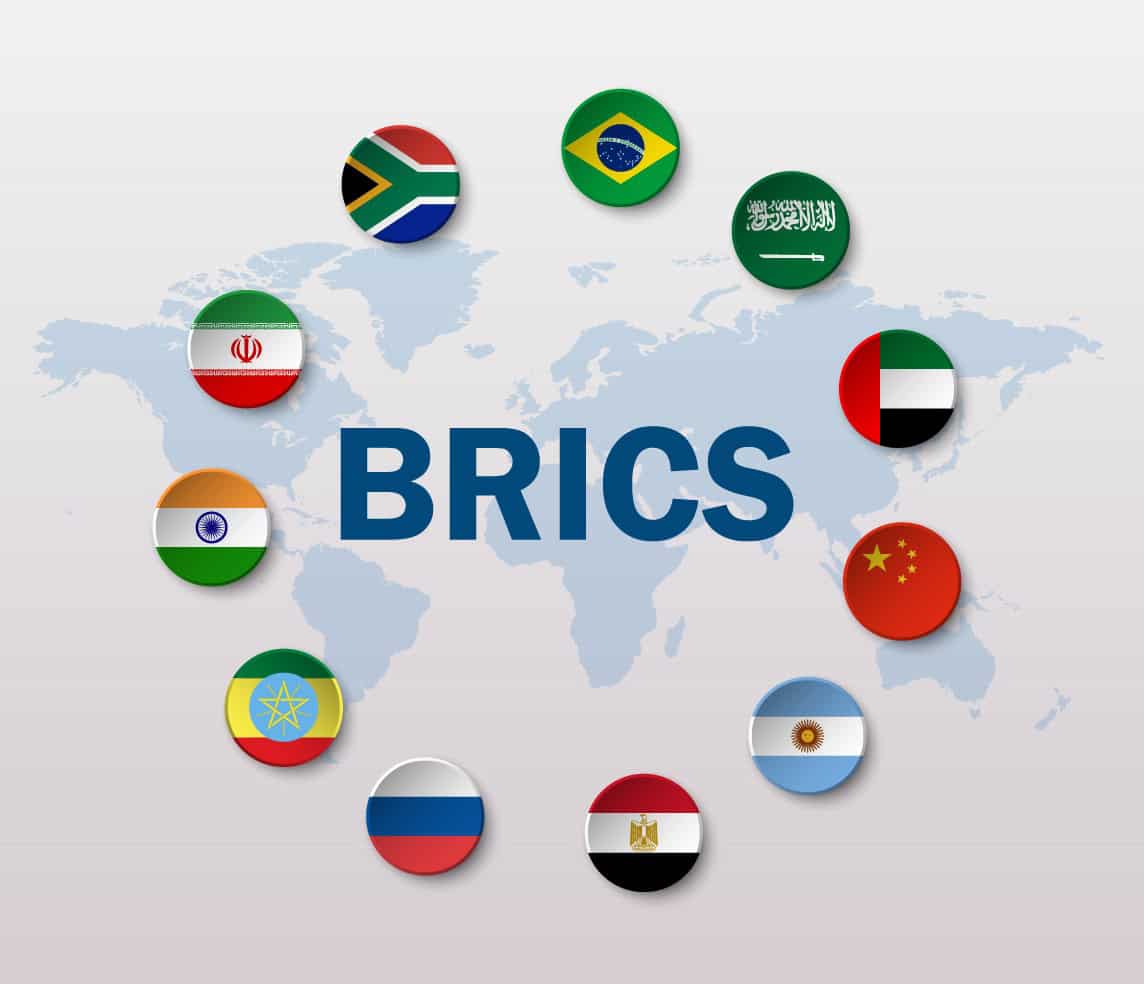
For its first decade, BRICS consisted of five members. The 2023 Johannesburg Summit marked a watershed moment, when the bloc announced its largest-ever expansion. Five countries received invitations to join as full members: Egypt, Ethiopia, Iran, Saudi Arabia, and the United Arab Emirates. All five formally acceded on January 1, 2024, bringing total full membership to ten nations. Indonesia then formally joined in January 2025, raising the count to eleven.
The Eleven Full Members
Brazil is South America's largest economy and the bloc's host for the 2025 summit in Rio de Janeiro. Under President Lula da Silva, Brazil has emphasized multilateralism, climate finance, and cooperation among the Global South, while maintaining cautious skepticism of proposals — particularly from Russia and China — that would weaponize BRICS against the West.
Russia was a founding BRIC member and has used the bloc as a platform to demonstrate that Western sanctions following the 2022 invasion of Ukraine have not isolated Moscow from the global community. Russia holds the largest nuclear arsenal of any BRICS member and is a major energy exporter. Its interest in BRICS is explicitly geopolitical: it views the group as a vehicle to accelerate the decline of dollar hegemony and Western institutional dominance.
India is the world's most populous country and its fastest-growing major economy. India's role in BRICS is paradoxical: it is simultaneously one of the group's most active members and its most cautious. New Delhi views BRICS as a platform for development cooperation and South-South engagement, but is deeply wary of letting China dominate the bloc's agenda. The India-China border dispute — which produced deadly clashes as recently as 2020 — casts a long shadow over every BRICS summit, including the 2026 New Delhi meeting where Modi and Xi held a closely watched bilateral on September 12.
China is the economic colossus of BRICS, accounting for approximately 48.5% of the bloc's combined GDP. Beijing has pushed hardest for expansion, de-dollarization, and the creation of parallel financial institutions. China sees BRICS as a vehicle for building influence across the Global South and reducing the leverage that Western financial systems give Washington and Brussels over Chinese and allied foreign policy.
South Africa remains the only sub-Saharan African member, though it has championed greater African representation within the bloc. The country's economy is relatively small by BRICS standards, but its symbolic and diplomatic role on the continent gives it outsized importance.
Egypt is the Arab world's most populous country and a major transit state controlling the Suez Canal. Its accession to BRICS reflected its effort to diversify diplomatic alignments and reduce dependence on Western aid and investment.
Ethiopia — Africa's second most populous country and one of the continent's fastest-growing economies — joined alongside Egypt, strengthening BRICS's African presence. Ethiopia's membership was controversial given its ongoing civil conflict, but China and Russia pushed strongly for its inclusion.
Iran joined BRICS under sustained Western sanctions over its nuclear program. Tehran sees BRICS membership as a lifeline: a way to access alternative financial channels, bypass dollar-based sanctions, and signal to domestic audiences that isolation is not permanent.
Saudi Arabia has maintained a more ambiguous posture toward BRICS than most new members. Riyadh accepted the invitation but has moved cautiously, sensitive to its deep strategic relationship with the United States, including the petrodollar arrangement that has anchored Saudi-American ties for half a century. Saudi Arabia has not fully ratified its membership as of the September 2026 summit, reflecting ongoing domestic deliberation over the geopolitical implications.
The United Arab Emirates is a smaller but more globally integrated economy than many of its BRICS partners, with deep ties to Western financial markets. Like Saudi Arabia, the UAE joins as much to preserve optionality as to commit to a specific anti-Western posture.
Indonesia formally joined in January 2025, becoming the eleventh full member. As the world's fourth most populous country and Southeast Asia's largest economy, Indonesia's accession significantly enlarged the bloc's demographic and economic footprint.
The Partner Country Framework
Created at the Kazan Summit in October 2024, the partner country category provides a lower-commitment pathway into the BRICS orbit. As of 2026, ten nations hold partner status: Belarus, Bolivia, Cuba, Kazakhstan, Malaysia, Nigeria, Thailand, Uganda, Uzbekistan, and Vietnam. Partner countries are invited to participate in select meetings and working-level discussions but do not hold the same standing as full members. The framework was designed to manage the queue of applicants without forcing premature membership decisions that might destabilize internal BRICS consensus.
Dozens more countries have expressed interest or filed formal applications, including Algeria, Azerbaijan, Bahrain, Bangladesh, Pakistan, Serbia, Sri Lanka, Turkey, and Venezuela. Turkey, a NATO member, occupies perhaps the most striking position among aspirants: its simultaneous membership in the Western alliance and active courtship of BRICS membership exemplifies the hedging strategies that many middle powers are adopting as geopolitical alignments become more fluid.
Economic Weight: The Numbers Behind the Narrative
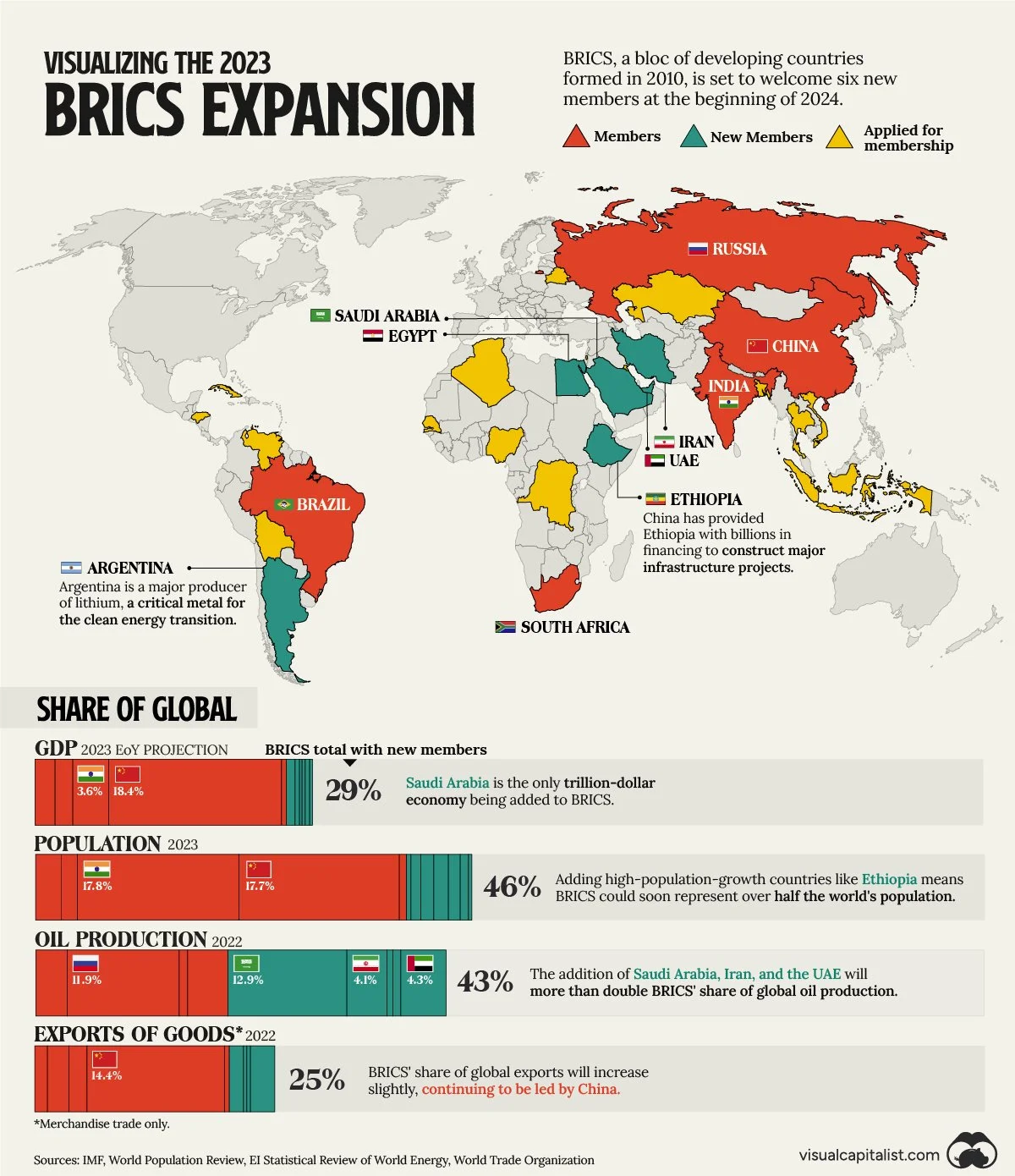
The raw economic statistics of expanded BRICS are striking. As of 2026, the bloc's eleven full members collectively account for approximately 41% of global GDP measured at purchasing power parity, compared with roughly 28% for the G7. The combined BRICS population stands at approximately 3.9 billion people, representing 49.5% of the global total. BRICS nations hold a substantial share of the world's critical resources, including oil, natural gas, rare earth minerals, and agricultural commodities.
Growth rates further reinforce the bloc's economic momentum. BRICS nations are forecast to achieve average GDP growth of approximately 3.7–3.8% in 2025–2026, compared with roughly 1% for G7 economies, whose mature markets face sluggish domestic demand and aging demographics. In nominal dollar terms, BRICS still lags behind the G7, but the gap is narrowing with each passing decade.
These headline figures require important qualifications. China alone accounts for nearly half of all BRICS GDP, making the bloc's apparent weight heavily dependent on a single member. India contributes roughly 20.7% of the total, while Brazil, Russia, and South Africa together make up most of the remainder. The newer members — Egypt, Ethiopia, Indonesia, and others — add population and geopolitical reach but limited economic mass in the near term. And per-capita income within BRICS remains far below G7 averages, reflecting persistent development gaps even among the wealthier members.
Still, the directional trend is clear. The IMF's long-run projections consistently show the center of economic gravity shifting toward Asia and the Global South — precisely the regions where BRICS membership is concentrated.
Institutional Architecture: Banks, Reserves, and Payment Systems
BRICS has worked to translate its economic weight into tangible institutions, with varying degrees of success.
The New Development Bank
Founded at the 2014 Fortaleza Summit, the New Development Bank (NDB) is BRICS's most prominent institutional creation. Headquartered in Shanghai, with an authorized capital of $100 billion and paid-in capital of approximately $52.7 billion, the NDB was designed as a multilateral development bank focused on infrastructure and sustainable development in emerging economies. Unlike the World Bank, the NDB explicitly rejects conditionality — it does not attach policy reform requirements to its loans, deferring instead to each borrower country's own regulatory framework.
The NDB has gradually expanded its membership beyond the original BRICS five, admitting Bangladesh, Egypt, the UAE, Uruguay, and other countries as shareholders. By 2025, it had approved loans totaling tens of billions of dollars across infrastructure, energy, transportation, and water projects.
Critics, however, point to a persistent paradox: despite its stated mission of reducing dollar dependence, the NDB continues to raise most of its capital by issuing dollar-denominated bonds on international capital markets and lends primarily in dollars. Local currency financing remains a stated aspiration more than a current reality, constrained by currency volatility, limited local bond markets, and the practical dominance of the dollar in international transactions. Russia's participation has also complicated the NDB's Western member relationships following the Ukraine war.
The Contingent Reserve Arrangement
Also established at Fortaleza in 2014, the Contingent Reserve Arrangement (CRA) is a $100 billion pool of currency reserves designed to help BRICS members withstand short-term balance-of-payments crises — a rough parallel to the IMF's role. China contributes the largest share ($41 billion), followed by Brazil, Russia, and India ($18 billion each) and South Africa ($5 billion).
The CRA has rarely been activated and remains largely a precautionary instrument. Its architecture also includes an important constraint: 70% of any member's drawing rights are automatically linked to an IMF program, limiting its effectiveness as a true alternative to traditional Western-anchored institutions.
BRICS Pay
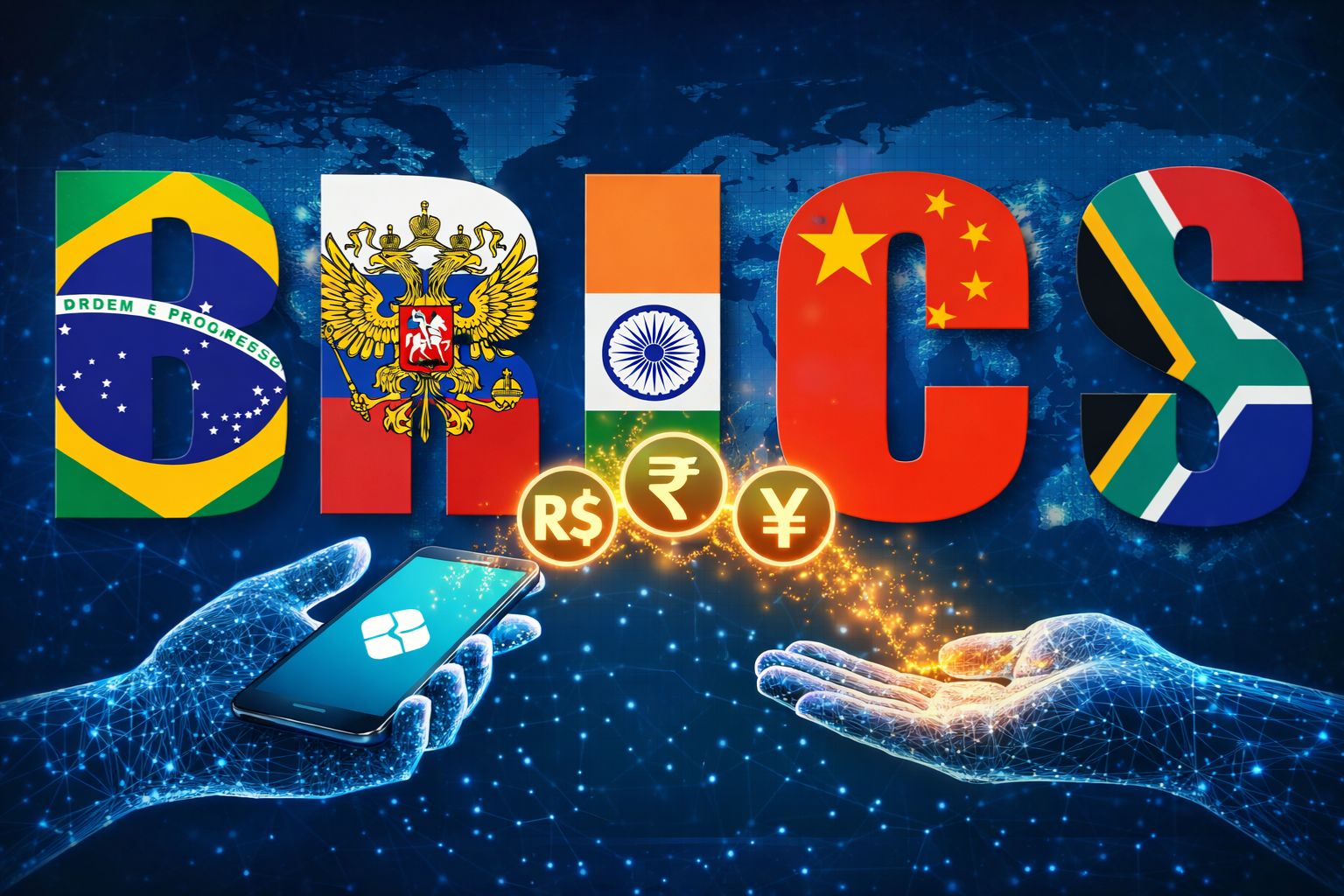
Perhaps the most ambitious financial project announced in the run-up to the 2026 New Delhi summit is BRICS Pay, a blockchain-based cross-border payment platform designed as an alternative to the SWIFT interbank messaging system. BRICS Pay integrates national payment systems including China's CIPS, India's UPI, Brazil's Pix, and Russia's SPFS, enabling local-currency settlements among member countries without routing transactions through dollar-based correspondent banking infrastructure.
BRICS Pay was announced as going live at the September 12–13, 2026 summit in New Delhi. If fully operational, it would represent a significant infrastructural step toward reducing members' exposure to dollar-denominated transaction systems — and to the financial sanctions that those systems enable. Skeptics note that interoperability between distinct national payment architectures is technically demanding, and that truly bypassing SWIFT requires not just technology but willingness among global banks and counterparties to route transactions through the alternative system.
Strategic Agenda: What BRICS Actually Wants
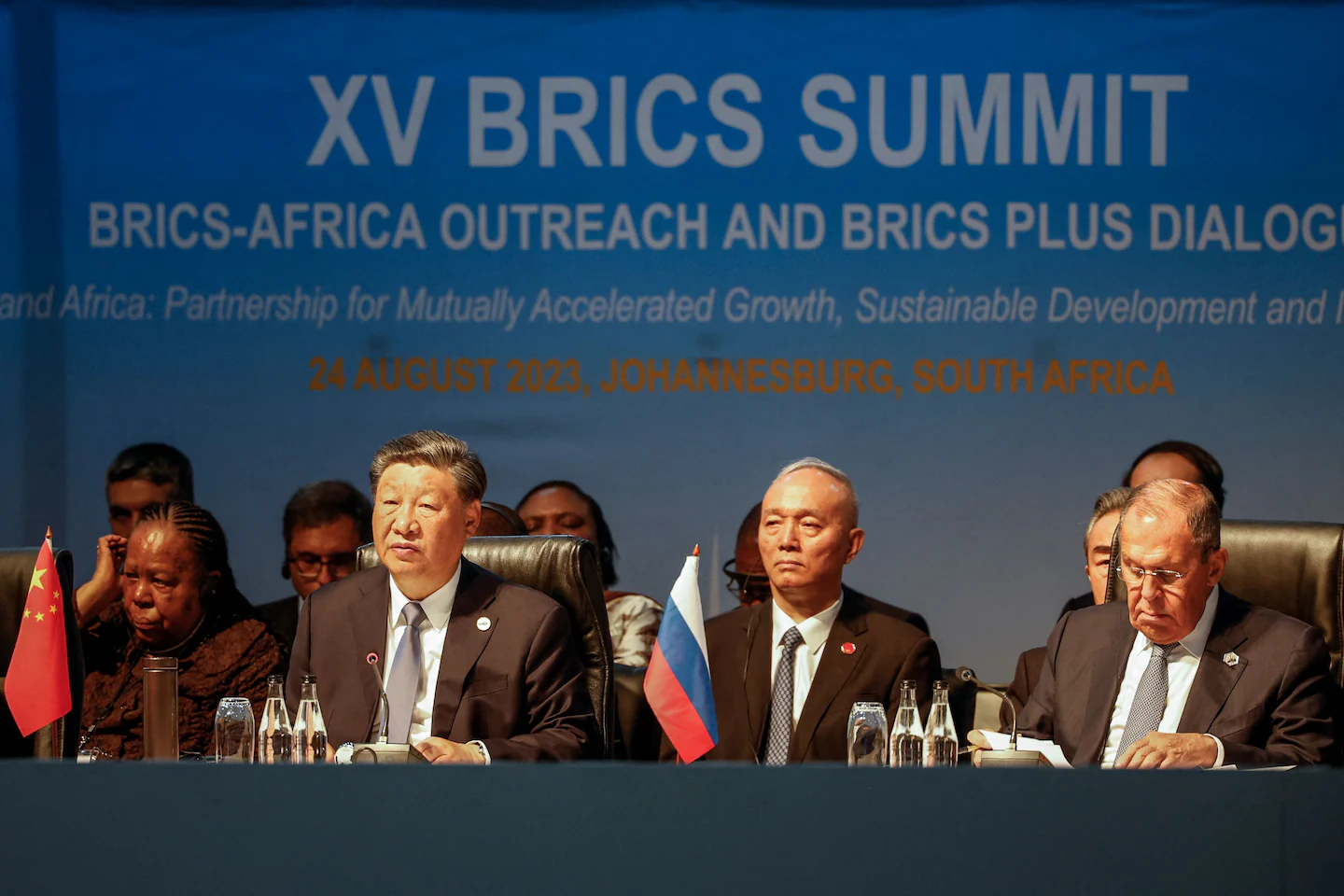
BRICS does not speak with a single voice on most substantive issues, but several consistent themes run through its joint declarations, working-group outputs, and member statements.
Reforming Global Governance
The founding impulse of BRICS — that existing multilateral institutions are structurally biased toward Western powers — remains the group's unifying thread. BRICS communiqués consistently call for reform of the IMF's voting structure, expansion of the UN Security Council's permanent membership (a position that benefits Brazil, India, and South Africa, which each seek a permanent seat), and restructuring of the World Trade Organization's dispute-resolution mechanisms.
India has been particularly vocal on Security Council reform during its 2026 BRICS chairship. For Beijing, which already holds a permanent UNSC seat, the reform agenda is more instrumental than intrinsic — a way to build solidarity with states that feel excluded from the current system.
De-Dollarization
BRICS nations — particularly Russia, China, and Iran — have made reducing dependence on the US dollar a central strategic priority. The rationale is partly economic (dollar dominance amplifies exchange-rate volatility and financial contagion from US monetary policy) and partly geopolitical (dollar-clearing infrastructure gives Washington the ability to impose devastating financial sanctions on any country that conducts transactions in dollars).
Progress toward de-dollarization has been real but uneven. Russian Finance Minister Anton Siluanov has confirmed that Russia and China settled 99.1% of bilateral trade payments in rubles and yuan by 2025. Russia and India settle a growing share of energy trade in rupees. Brazil and China conduct roughly a quarter of their bilateral trade in local currencies. Intra-bloc local-currency settlement reportedly surpassed 67% in early 2026.
A proposed BRICS common currency — sometimes called "mBridge" or informally referred to in the media as the "BRICS dollar" — has gained less traction than its advocates hoped. India, under its 2026 chairship, has explicitly distanced itself from a single BRICS currency, preferring instead to focus on payment system interoperability and central bank digital currency (CBDC) linkages. Without India's support, a common BRICS currency remains a long-term aspiration rather than a near-term policy initiative.
South-South Cooperation and Development Finance
BRICS frames much of its agenda in the language of the Global South — a loose concept referring to developing and emerging economies in Africa, Asia, Latin America, and the Middle East. The bloc's 2025 summit in Rio de Janeiro, hosted by Brazil under President Lula da Silva under the theme "Strengthening Global South Cooperation for a More Inclusive and Sustainable Governance," positioned the group as a champion of equitable development finance, climate justice, and health equity for poorer nations.
The 2026 New Delhi summit's agenda has emphasized trade and investment, digital payments, supply chain resilience, energy access, technology cooperation, and climate finance — a broad canvas that reflects both the diversity of members' interests and India's particular emphasis on practical, people-centric deliverables.
AI Governance and Digital Cooperation
Artificial intelligence governance has emerged as a newer agenda item, reflecting both the rapid technological changes reshaping global economies and the bloc's desire to stake out an independent position on emerging tech regulation. Brazil introduced AI governance as a 2025 summit pillar; India has advanced it further in its 2026 chairship, pushing for an approach that emphasizes sovereign development of AI capacity in emerging economies rather than dependence on US or EU technology platforms and regulatory frameworks.
Internal Tensions: The Fault Lines Beneath the Surface
BRICS's ambitious agenda is perpetually complicated by the deep divergences among its members.
The China-India Rivalry
The bloc's most consequential internal tension runs between its two largest members. China and India are simultaneously BRICS partners and strategic rivals, competing for regional influence in South Asia and the Indo-Pacific, engaged in a long-running territorial dispute along their Himalayan border, and pursuing fundamentally different foreign policy postures. India maintains strategic autonomy as a core principle — it participates in BRICS while also deepening security ties with the United States through the Quad framework alongside Japan and Australia.
At the 2026 New Delhi summit, Modi and Xi held a high-profile bilateral meeting that was widely interpreted as part of an ongoing diplomatic reset following a period of acute Sino-Indian tensions. Chatham House analysts noted that the "India-China reset" would likely continue through the summit, but cautioned that structural competitive pressures between the two would persist regardless of ceremonial cordiality.
Divergent Strategic Visions
Russia and China view BRICS primarily as a geopolitical instrument — a vehicle for building a multipolar world that erodes US-led hegemony. India and Brazil, by contrast, are more likely to describe BRICS as an economic cooperation forum focused on development, trade, and multilateral reform, rather than a confrontational counterweight to the West. This divide has practical consequences: India and Brazil have resisted joint declarations that adopt explicitly anti-Western language, and both have pushed back against proposals — particularly from Moscow — that would commit BRICS to coordinated responses to Western sanctions.
Expansion vs. Coherence
China and Russia have consistently advocated for rapid and broad expansion, reasoning that a larger BRICS is more representative and commands greater legitimacy. India and Brazil have been more cautious, concerned that expanding membership will make the already-difficult task of reaching consensus even harder, and that it will dilute their own influence within the bloc. The debate over how quickly to grant full membership versus partner status to additional countries reflects this fundamental tension.
Energy Market Interests
BRICS includes both major energy exporters (Russia, Saudi Arabia, UAE, Brazil, Iran) and major energy importers (China, India). These divergent positions create structural friction whenever energy pricing, sanctions, or climate policy is discussed. Russia and the Gulf states prefer higher energy prices; China and India prefer lower ones. This is not a theoretical tension — it shapes real deliberations on commodity market governance and climate finance commitments.
The 2026 New Delhi Summit: A Pivotal Moment
The 18th BRICS Summit, held on September 12–13, 2026, at Bharat Mandapam in New Delhi, represents India's formal debut as BRICS chair and host. India has used its chairship to advance several distinct priorities:
Digital payment interoperability — India's UPI system is one of the world's most successful real-time payment platforms, and New Delhi has been pushing for BRICS-wide linkages that would allow UPI-style instant payments across member borders. The planned launch of BRICS Pay at the summit represents the culmination of this effort.
Local currency trade — India has pushed for bilateral trade agreements among BRICS members that denominate transactions in national currencies rather than dollars, reducing currency risk and exchange costs for members whose currencies are not freely convertible.
AI and technology governance — India has positioned itself as a voice for emerging economies in global AI regulation debates, advocating for frameworks that allow developing countries to build domestic AI capacity rather than depend on imported Western or Chinese technology.
Climate finance reform — India has continued to press developed countries to meet climate finance commitments to developing nations, framing climate action as inseparable from development justice.
The summit has also been notable for the bilateral meetings it has enabled. Beyond the Modi-Xi conversation, Modi held meetings with Putin and Iranian President Pezeshkian on September 11, ahead of the main leaders' sessions. Foreign Policy reported that India and China were visibly competing to set the summit's dominant narrative, each seeking to emerge as the bloc's most authoritative voice — a dynamic that captured the fundamental ambiguity of a bloc where the two largest members are also rivals.
BRICS and the Western Response
Western governments have watched BRICS's evolution with a mixture of skepticism and growing concern. The prevailing view in Washington and Brussels has long been that BRICS is too internally divided to mount a coherent challenge to Western-led institutions, and that its anti-dollar rhetoric outpaces practical progress. Those assessments retain some validity — internal BRICS disagreements have repeatedly prevented the bloc from issuing joint statements on Ukraine, Gaza, and other geopolitically charged topics.
But the dismissive view has also become harder to sustain. BRICS now represents nearly half the world's population and a larger share of purchasing-power-adjusted global output than the G7. Its expansion has drawn in Gulf petrostates, major African economies, and Southeast Asia's largest country. BRICS Pay, if successful, could provide an alternative payment architecture that reduces the leverage of dollar-based financial infrastructure. And the bloc's annual summits function as a counter-scheduling device — a competing calendar of diplomatic events that gives non-Western leaders an alternative convening forum to G7, NATO, and Bretton Woods gatherings.
The United States under both Republican and Democratic administrations has applied pressure on countries considering BRICS membership or partner status, warning of secondary sanctions risks and signaling that alignment with Russia and China carries diplomatic costs. Those warnings have moderated enthusiasm in some capitals, but have not reversed the broad trend toward hedging and diversification that BRICS represents.
Criticisms and Limitations
BRICS faces a set of structural criticisms that its own members often acknowledge privately.
Consensus without action. BRICS operates by consensus, meaning any member can block any joint initiative. This has produced a long record of aspirational communiqués followed by limited implementation. The common currency proposal, ambitious NDB targets, and various trade facilitation initiatives have frequently announced and then stalled.
Dollar dependence. The bloc's own institutions — the NDB in particular — continue to rely heavily on dollar financing. True de-dollarization requires not just political will but deep, liquid alternative financial markets, credible central bank policies across all member currencies, and willingness among global counterparties to accept non-dollar settlement. These structural prerequisites remain largely unmet.
Per-capita poverty. Despite the bloc's impressive aggregate GDP, per-capita income across most BRICS members remains far below G7 levels. BRICS contains some of the world's poorest countries by average income, and the bloc's collective resources have not translated into meaningful poverty reduction mechanisms comparable to Western development institutions.
Geopolitical incoherence. BRICS includes countries with deeply incompatible geopolitical interests: India and China are border rivals, Saudi Arabia and Iran have competing regional ambitions, Russia is subject to sweeping Western sanctions that complicate any joint BRICS financial initiative with Western links. Managing this diversity has required carefully crafted language that often papers over rather than resolves fundamental disagreements.
Conclusion
BRICS enters its third decade as a genuinely consequential but fundamentally unresolved force in world politics. It represents the most coherent attempt to date by major non-Western powers to reshape the rules and institutions of global governance — not through military confrontation but through the patient construction of alternative economic infrastructure, diplomatic caucusing, and a narrative of multipolarity that resonates with billions of people who feel underrepresented in the current world order.
Whether it succeeds in that ambition depends less on grand declarations than on unglamorous operational progress: whether BRICS Pay achieves real transaction volumes, whether the NDB develops genuine local-currency lending capacity, whether India and China find a stable working relationship within the bloc, and whether the expanding membership develops enough shared interest to sustain collective action. The New Delhi summit of September 2026 — hosted by the world's most populous democracy, attended by leaders from four continents, and coinciding with the planned launch of a new cross-border payment system — offers both a measure of how far BRICS has come and a reminder of how much work remains ahead.
Sources:
- BRICS Summit 2026: 11 Members, 10 Partners Explained
- About Us – BRICS India 2026
- Which Countries Want to Join BRICS? Updated List (2026) | EBC Financial Group
- BRICS Expansion in 2026: Which Countries Want to Join as Summit Approaches
- BRICS Summit 2026 Explained: Members, Agenda and the Key Issues to Watch | Forbes India
- 2025 BRICS Summit: Takeaways and Projections | Stimson Center
- 18th BRICS Summit 2026, Date, Venue, Theme & Host Country
- What Is the BRICS Group and Why Is It Expanding? | Council on Foreign Relations
- BRICS Expansion, the G20, and the Future of World Order | Carnegie Endowment for International Peace
- BRICS | Members, History, Name Origin & Facts | Britannica
- Are the BRICS and Their New Development Bank Offering Alternatives to the World Bank, the IMF? | Naked Capitalism
- Can BRICS De-dollarize the Global Financial System? | Cambridge
- BRICS GDP Outperforms Global Average, Accounts for 40% of World Economy
- BRICS vs G7: Comparing 2026 GDP Growth Forecasts | Visual Capitalist
- BRICS leaders meet in India as wars and US tensions test the bloc | NPR
- India, China Compete for Dominance Over BRICS Leaders' Summit | Foreign Policy
- The India–China reset will continue at the BRICS summit | Chatham House
- BRICS Pay Goes Live: Architecture of a Dollar-Free Settlement System
- Member states of BRICS | Wikipedia
- New Development Bank | BRICS Brazil
- BRICS Indonesia Joins as Full Member | DD News
- BRICS Expansion 2026: Egypt, UAE, Saudi, Iran Reshaping Global Power | The Middle East Insider