AMD Ryzen AI Max: The Chip That Wants to Rewrite Mobile Computing
In January 2025 at CES in Las Vegas, AMD CEO Lisa Su took the stage and unveiled a processor the company had been building toward for years — one that would challenge not just Intel's dominance in the Windows laptop market, but implicitly take aim at Apple's celebrated M-series silicon. The AMD Ryzen AI Max, based on the internal "Strix Halo" architecture, is AMD's most ambitious mobile chip to date: a monolithic system-on-chip (SoC) that integrates a high-core-count CPU, a GPU powerful enough to rival discrete mid-range cards, and a leading-edge neural processing unit (NPU) for on-device AI workloads — all sharing a single unified memory pool of up to 128 gigabytes. It is, in short, AMD's answer to the question Apple has been posing since 2020: what happens when you stop treating the laptop as a collection of components and start treating it as a unified system?
The answer, it turns out, is complicated, fascinating, and deeply revealing about where the entire computing industry is heading.
What Is the Ryzen AI Max, Exactly?
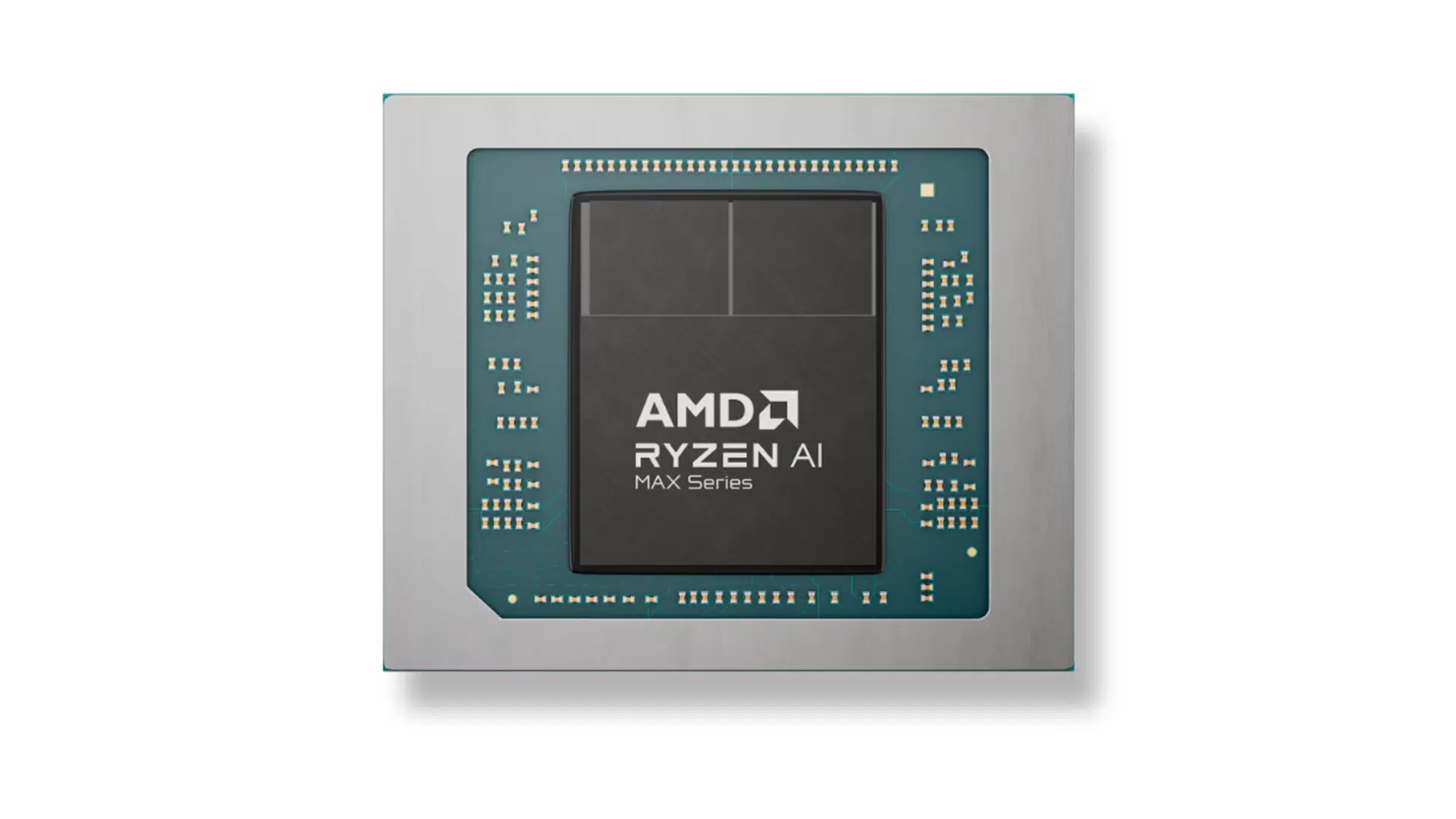
The Ryzen AI Max is not a single chip but a family of three processors, all built on the same "Strix Halo" silicon die and announced simultaneously at CES 2025:
- Ryzen AI Max 385 — the entry model, with 12 Zen 5 CPU cores and 16 RDNA 3.5 compute units (CUs), up to 64 GB of LPDDR5X memory
- Ryzen AI Max+ 395 — the flagship, with 16 Zen 5 CPU cores and 40 RDNA 3.5 CUs, up to 128 GB of LPDDR5X memory
- Ryzen AI Max+ 395 with HBM3e — a specialized workstation variant featuring 96 GB of High Bandwidth Memory 3e instead of LPDDR5X
The "Max" branding signals AMD's intent clearly: this is a maximum-performance mobile platform, a category above standard laptop processors and aimed squarely at professionals, content creators, developers, and AI researchers who need workstation-class capability in a portable form factor.
The Strix Halo Die: Engineering Ambition in Silicon
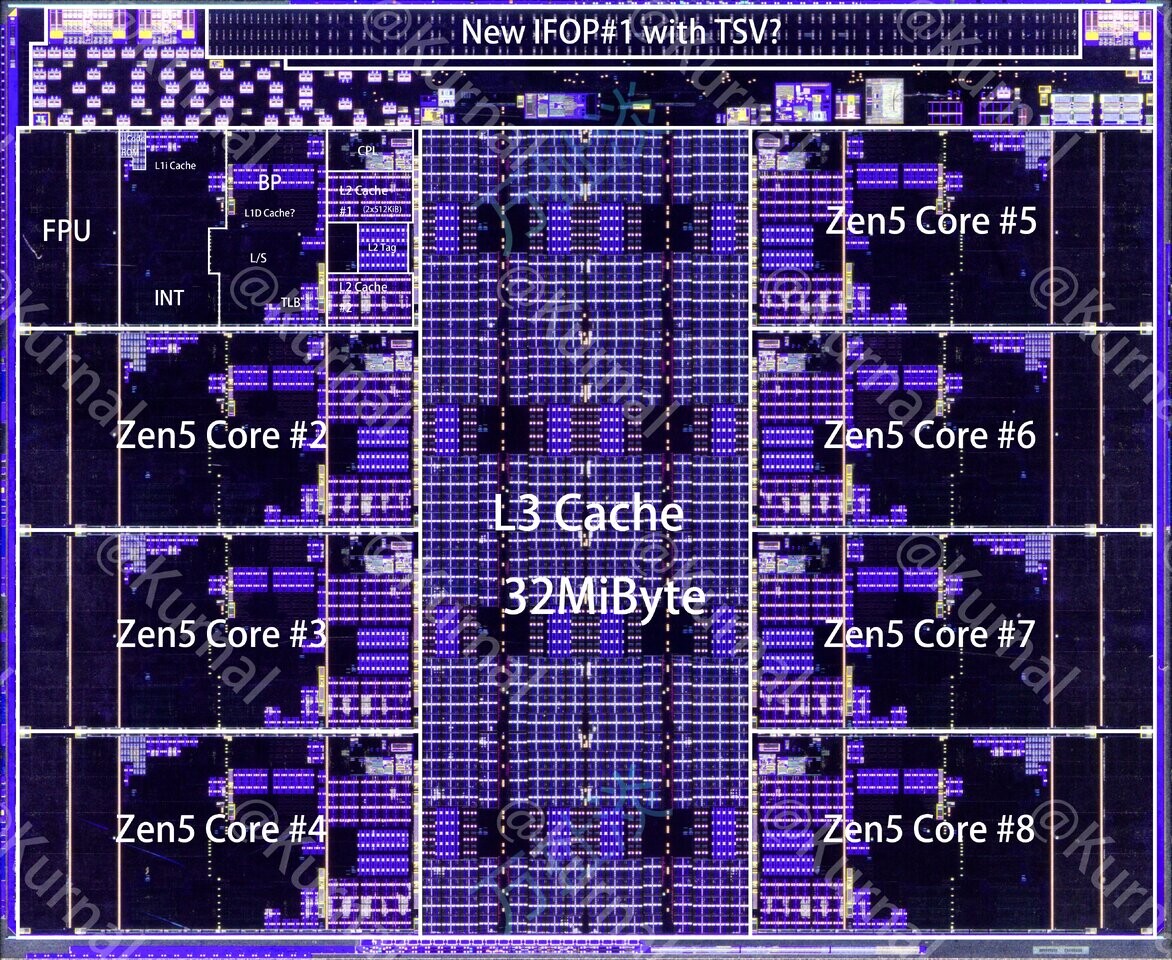
The Strix Halo die is where the engineering ambition of the Ryzen AI Max becomes tangible. At 222mm², it is a physically large piece of silicon for a laptop chip — nearly double the 122mm² of Intel's Lunar Lake die and more than double the approximately 103mm² of Apple's M4 chip. AMD fabricates it using TSMC's 4nm N4P process node, packing in approximately 32.5 billion transistors.
For context: Apple manufactures its M4 on TSMC's more advanced 3nm N3E process, which offers better transistor density and efficiency per unit area. That process node gap is not trivial — it means Apple can achieve more compute per watt and per square millimeter. AMD's chosen trade-off is raw scale: by tolerating a larger die and higher power envelope, it achieves GPU compute levels that simply cannot be matched by chips constrained to Apple's power budget.
The architecture integrates four distinct compute elements on one die:
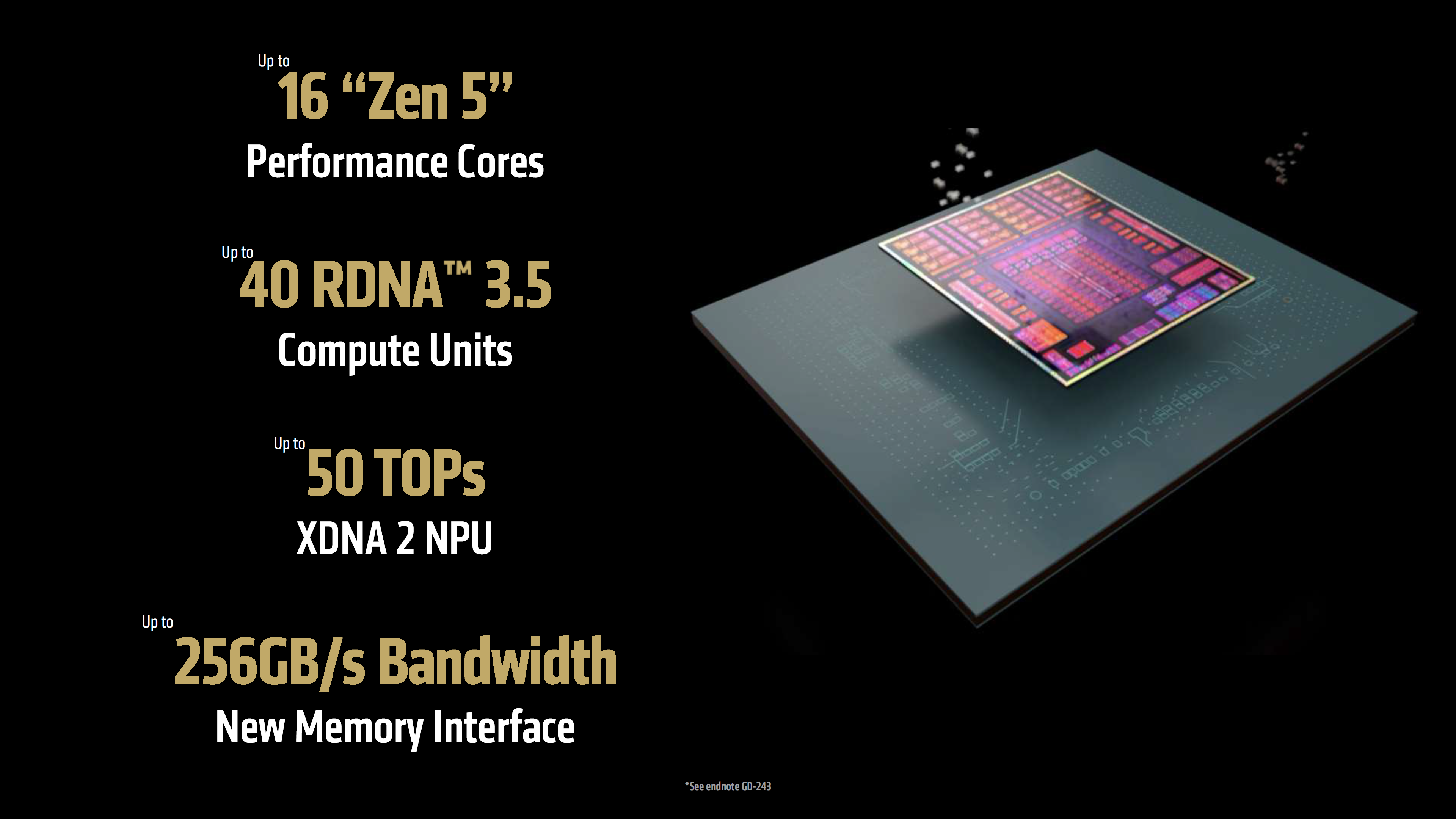
- CPU cluster — 16 Zen 5 cores in the Max+ 395, running at boost clocks up to 5.1 GHz
- GPU — 40 RDNA 3.5 Compute Units in the flagship, each containing 64 shaders, for 2,560 total shaders and approximately 18 teraflops of FP32 compute throughput
- NPU (XDNA2) — AMD's second-generation neural processing unit, rated at 50 TOPS (tera-operations per second)
- Unified memory controller — interfacing with LPDDR5X at 7,500 MT/s across a 256-bit bus, yielding approximately 256 GB/s of memory bandwidth in standard configuration
The GPU inside the Max+ 395 carries the Radeon 890M branding — or equivalently, RX 7900M-class performance — representing something genuinely new in the laptop landscape: integrated graphics that can perform at discrete mid-range GPU levels. The 40-CU configuration matches what AMD ships as a discrete mobile GPU, which is why reviewers at publications like Tom's Hardware characterized it as "discrete GPU performance without the discrete GPU."
The Memory Architecture: AMD's Bet on the Unified Pool
Perhaps the most consequential architectural decision AMD made with Strix Halo is adopting a unified memory architecture — one in which CPU, GPU, and NPU all draw from the same physical memory pool rather than from separate, dedicated banks. This is the same fundamental approach Apple pioneered with the M1 in 2020 and has refined through every subsequent generation.
In the standard Ryzen AI Max+ 395, that pool reaches 128 GB of LPDDR5X — enough to comfortably hold the weights of a 70-billion-parameter large language model without quantization. On a system with a traditional discrete GPU, even the most generously VRAM-equipped consumer cards (NVIDIA's RTX 4090 laptop with 16 GB, for example) cannot load such models into GPU memory at full precision. The Ryzen AI Max shatters that ceiling.
The LPDDR5X configuration delivers approximately 256 GB/s of bandwidth. This is more than sufficient for most workloads and considerably faster than typical DDR5 in a desktop system. However, it is a meaningful gap behind Apple's M4 Max, which achieves 546 GB/s through wider memory buses and tighter packaging. That gap matters especially in memory-bandwidth-sensitive tasks like large-matrix AI inference, video processing pipelines, and sustained 4K game rendering.
AMD addresses the bandwidth limitation with the HBM3e variant of the Ryzen AI Max+ 395. High Bandwidth Memory 3e, stacked directly adjacent to the processor, delivers approximately 800 GB/s — exceeding Apple's M4 Max by a considerable margin and approaching the bandwidth of professional AI accelerators like NVIDIA's A100. The trade-off is capacity: the HBM3e model tops out at 96 GB rather than 128 GB, and the technology carries a substantial cost premium. The HBM3e variant is aimed explicitly at data scientists, ML engineers, and AI researchers who need maximum throughput for inference and fine-tuning workloads, not consumers buying gaming laptops.
CPU Performance: Zen 5 Holds Its Own
The 16 Zen 5 cores inside the Ryzen AI Max+ 395 represent AMD's latest CPU microarchitecture, following the Zen 4 cores of the previous Ryzen 7000 series. Zen 5 brings meaningful improvements in instructions-per-cycle (IPC) efficiency, improved branch prediction, wider execution pipelines, and expanded AVX-512 throughput — changes AMD claims deliver roughly 16% IPC uplift over Zen 4 in typical workloads.
In Cinebench R24 multi-threaded testing, the Ryzen AI Max+ 395 scores approximately 1,440 points. In PassMark's CPU benchmark suite, the chip posts a multi-threaded score of 49,131. Single-threaded Cinebench R24 performance sits around 131 points.
These numbers place the Ryzen AI Max+ 395 firmly above Intel's best standard laptop offering — the Core Ultra 9 285H scores approximately 1,100 points in Cinebench R24 Multi and 38,956 in PassMark Multi — while trailing Apple's M4 Max, which achieves approximately 2,000 Cinebench R24 Multi points and 53,516 in PassMark.
The single-threaded gap is more pronounced. Apple's M4 Max scores 4,581 in PassMark single-thread testing, versus the Ryzen AI Max+ 395's 3,890 and Intel's Core Ultra 9 285H at 3,678. Apple's lead in per-core performance is the result of several factors: the ARM ISA's efficiency advantages, TSMC's 3nm process node delivering more performance per watt, and years of ARM microarchitecture refinement in Apple's custom silicon team. For tasks that are fundamentally serial — rendering a single complex operation, compiling an individual translation unit, executing a JavaScript engine's hot loop — Apple still leads.
For heavily parallelized workloads — scientific computing, 3D rendering, video encoding, compilation across many threads — the 16 Zen 5 cores give AMD a more competitive footing against Apple and a clear lead over Intel's standard mobile lineup.
GPU Performance: The Headline Achievement
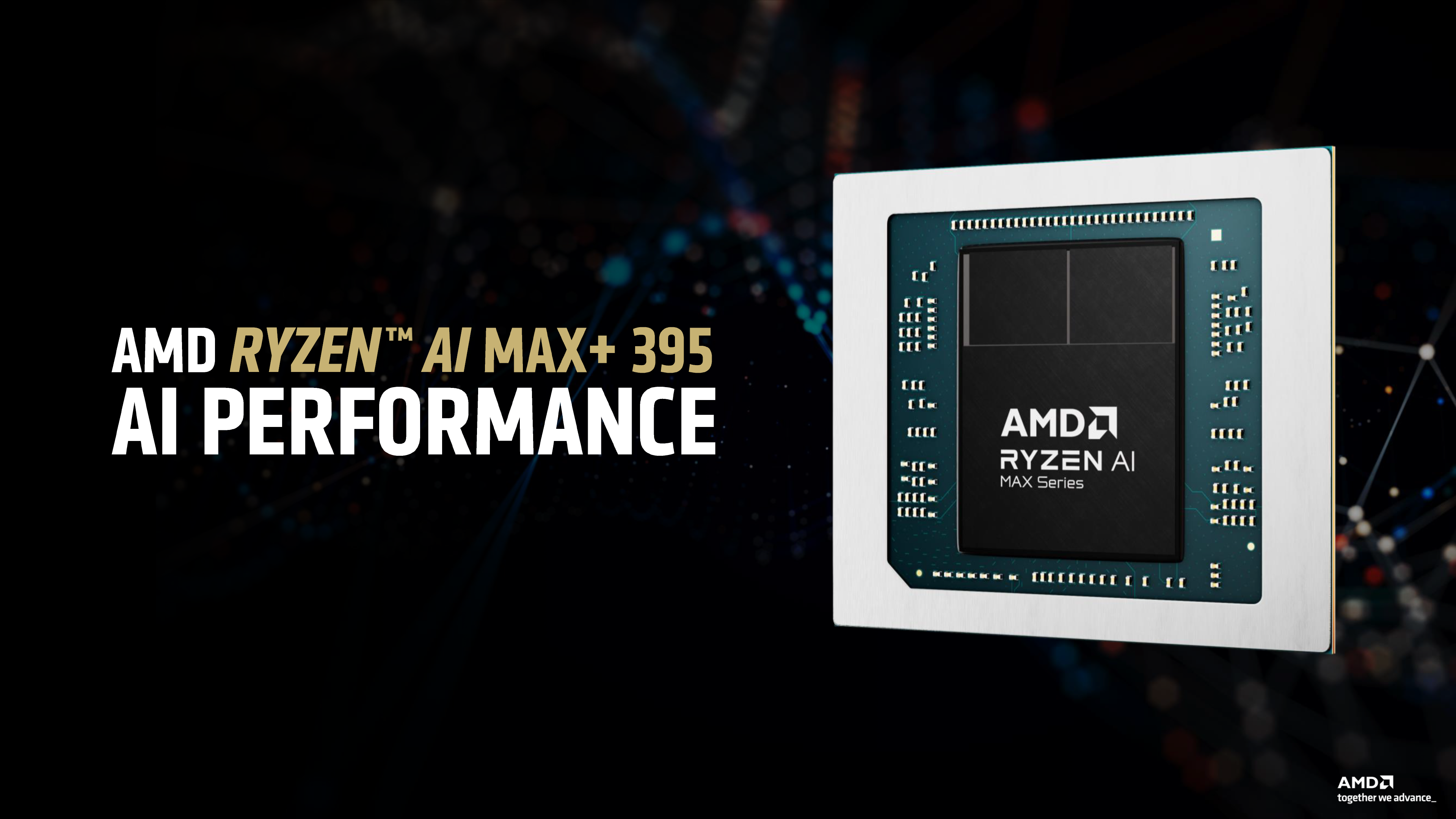
The Ryzen AI Max+ 395's GPU performance is the feature that has generated the most industry attention, and for good reason. The 40 RDNA 3.5 Compute Units deliver approximately 18 teraflops of FP32 throughput — a number that, until the Strix Halo's arrival, existed only in discrete GPU territory.
Real-world gaming benchmarks bear out the theoretical figures. In tests on laptops like the HP OmniBook Ultra Flip 14 and ASUS ROG Flow Z13 — among the first devices to ship with the Ryzen AI Max+ 395 — reviewers recorded:
- Cyberpunk 2077 at 1080p, Ultra settings: approximately 45 fps
- Shadow of the Tomb Raider at 1080p: approximately 78 fps
- Total War: Warhammer III at High settings, 1080p: approximately 60 fps
Those Cyberpunk numbers, critically, are in the same ballpark as an NVIDIA RTX 4060 Laptop GPU — a discrete card that comes in laptops typically priced similarly and requiring separate VRAM, a dedicated cooling solution, and associated board real estate. The ability to match that performance from an integrated solution with no discrete GPU is what AMD means when it talks about a new category of laptop.
By contrast, Intel's best integrated graphics — the Arc 140V found in the Core Ultra 200V series — achieves noticeably lower throughput. The Arc 140V's 8 Xe2 cores (128 Execution Units) are efficient and capable for light gaming but cannot approach the Ryzen AI Max at demanding titles. The Arc 140V is positioned for Copilot+ productivity laptops and thin-and-light designs, not gaming workloads.
Apple's M4 Max GPU — with up to 32 cores — is more competitive. Theoretical throughput for the 32-core M4 Max GPU approaches 14+ teraflops, closer to but still below AMD's 18 TFLOPs figure. In practice, the gap between the two in macOS gaming benchmarks narrows considerably, partly because Apple's highly optimized Metal graphics API and tight hardware-software coupling extract efficiency that raw teraflop comparisons don't fully capture. Yet the platform disadvantage is real: most major game releases target Windows and DirectX, and macOS support is a secondary consideration for many publishers. The Ryzen AI Max benefits from a far broader library of natively optimized Windows games.
AI and the NPU: The 50 TOPS Race
Every major silicon vendor is now competing on AI inference performance, and the Ryzen AI Max is no exception. AMD's XDNA2 NPU — the second generation of its Neural Processing Unit architecture — delivers 50 TOPS of dedicated AI compute. This exceeds Intel's NPU4 in the Lunar Lake architecture (48 TOPS) and Apple's 16-core Neural Engine in the M4 (38 TOPS).
However, TOPS figures are notoriously difficult to compare across vendors because they use different data types, model configurations, and precision levels. Microsoft's Copilot+ PC program, which requires 40+ TOPS of combined NPU performance, was designed in part around Intel and Qualcomm's TOPS claims, but AMD's Ryzen AI Max also qualifies under those criteria.
The more revealing measure is what the integrated system can accomplish together. Because the Ryzen AI Max's GPU, CPU, and NPU all share the same 128 GB memory pool, AI workloads can distribute across all three compute elements fluidly. In LLaMA 3 70B inference benchmarks using the llama.cpp framework, the Ryzen AI Max+ 395 achieves approximately 20–25 tokens per second — meaningfully faster than systems limited to a 24 GB discrete GPU (which must use quantized models, often dropping to 7–10 tokens per second, and cannot load the full model at native precision at all).
This is where the unified memory architecture pays the most dramatic dividends. A 70B-parameter model at FP16 precision requires approximately 140 GB of memory — beyond even the Ryzen AI Max's 128 GB ceiling for the LPDDR5X variant. But at 4-bit quantization (Q4_K_M, the standard for efficient llama.cpp deployment), memory requirements drop to roughly 40 GB, well within the chip's capacity. With a discrete GPU limited to 24 GB VRAM, even the quantized 70B model must be split across CPU and GPU memory with significant performance penalties.
For Apple's M4 Max, the memory capacity picture is similar — up to 128 GB unified — but the software ecosystem for local LLM inference on macOS using Apple's MLX framework has matured considerably, and many researchers find the Apple platform more seamlessly integrates with modern ML Python toolchains. AMD's ROCm support on Windows, while improving, remains less mature than Apple's Core ML and MLX stack.
Comparing the Competitors: Intel's Strategy
Intel's mobile processor strategy in 2024–2025 has bifurcated sharply. On one hand, the company offers Core Ultra H-series chips (Arrow Lake architecture, including the Core Ultra 9 285H) targeting high-performance traditional laptops — often paired with discrete NVIDIA or AMD GPUs. On the other, the Core Ultra 200V series (Lunar Lake architecture) targets thin-and-light efficiency machines and Microsoft's Copilot+ PC initiative.
Intel Core Ultra 200H Series (Arrow Lake)
The Core Ultra 9 285H combines 6 performance cores (Lion Cove), 8 efficiency cores, and 2 low-power efficiency cores — 16 cores and 22 threads total. Its integrated Arc GPU offers limited gaming capability (8 Xe-cores), and in practice, most Core Ultra H-series laptops pair with discrete NVIDIA RTX 40 or 50-series GPUs for serious graphics work.
In CPU-only benchmarks, the Core Ultra 9 285H's single-threaded performance is competitive with AMD's Zen 5 — posting approximately 140 points in Cinebench R24 Single versus AMD's 131 — but its multi-threaded score (~1,100 Cinebench R24 Multi) falls notably short of AMD's 1,440. The chip's TDP ranges similarly to AMD's, with manufacturer-configurable power limits between 45W and 115W.
The key difference in positioning: Intel's H-series assumes a discrete GPU will be present in most premium configurations. The Ryzen AI Max assumes it will not — and that assumption changes the thermal, form-factor, and battery calculus of the entire laptop design.
Intel Core Ultra 200V Series (Lunar Lake)
Lunar Lake is Intel's most architecturally interesting recent release. By moving to on-package LPDDR5X memory (similar to Apple's approach) and introducing Lion Cove performance cores alongside Skymont efficiency cores, Intel achieved a dramatic improvement in battery life for thin-and-light laptops. The Core Ultra 7 258V, for example, offers 14–20 hours of office productivity battery life — class-leading for x86 silicon.
But Lunar Lake is not a performance competitor to the Ryzen AI Max. Its 4P + 4E core configuration and limited Arc 140V GPU (8 Xe2 cores) yield approximately 800 Cinebench R24 Multi points — roughly half of what AMD's Ryzen AI Max+ 395 delivers. Lunar Lake is Intel's answer to the MacBook Air: optimized for efficiency and AI PC feature compliance, not raw throughput.
Intel's NPU4 in Lunar Lake hits 48 TOPS — competitive with AMD — and the full-system TOPS figure (CPU + GPU + NPU combined) reaches Intel's claimed 120 TOPS for Copilot+ certification purposes. But AMD's Strix Halo similarly qualifies and delivers far higher GPU compute alongside comparable NPU performance.
Comparing the Competitors: Apple Silicon
The comparison between AMD's Ryzen AI Max and Apple's M-series chips is the most interesting and the most philosophically loaded, because both companies have converged on the same architectural philosophy — unified memory SoC design — from very different directions.
Apple M4 and M4 Max
Apple's M4 chip, announced in May 2024, is manufactured on TSMC's 3nm N3E process and integrates 28 billion transistors in approximately 103mm². The consumer-facing M4 packs a 10-core CPU (4 performance + 6 efficiency) and 10-core GPU alongside a 16-core Neural Engine rated at 38 TOPS. The professional M4 Max scales dramatically: up to 14-core CPU (10P + 4E), up to 32-core GPU, and unified memory reaching 128 GB with 546 GB/s of bandwidth.
The M4 Max's memory bandwidth advantage is significant. At 546 GB/s versus AMD's 256 GB/s (LPDDR5X), the M4 Max moves data between memory and compute units roughly twice as fast in standard configuration. Only the Ryzen AI Max+ 395 HBM3e variant (~800 GB/s) surpasses it.
Where Apple genuinely leads — and where no competitor has closed the gap — is efficiency. The MacBook Pro with M4 Max delivers 14–16 hours of real-world productivity battery life, with sustained compute workloads consuming roughly 30–40W. Apple's ARM architecture, 3nm process, and years of microarchitecture refinement produce remarkable performance-per-watt. The Ryzen AI Max+ 395 operates at 45–120W depending on workload — necessary to deliver its GPU performance, but expensive in terms of battery life. Under gaming loads, HP OmniBook laptops with the Ryzen AI Max+ 395 drain in approximately 2–3 hours. The MacBook Pro's battery under sustained GPU load lasts considerably longer.
The software ecosystem distinction is also meaningful. Apple's Core ML framework, Final Cut Pro, Logic Pro, and developer toolchain have years of M-series optimization. The MLX machine learning framework, released by Apple's ML Research team and optimized for Apple Silicon's unified memory architecture, provides exceptional local AI inference performance with a Python-first API. AMD's ROCm (Radeon Open Compute) platform supports PyTorch and TensorFlow on Linux but remains less mature on Windows, which is where the majority of Ryzen AI Max users will work.
For macOS users, the comparison is not a real competition: the Ryzen AI Max runs Windows. For users who need Windows — which covers the majority of enterprise and gaming users — the Ryzen AI Max offers GPU and AI capabilities that M4 Max simply cannot match in the Windows ecosystem.
A Summary Comparison Table
| Metric | Ryzen AI Max+ 395 | Intel Core Ultra 9 285H | Apple M4 Max |
|---|---|---|---|
| Process | TSMC 4nm N4P | Intel 18A (pre-prod) / TSMC 3nm | TSMC 3nm N3E |
| CPU Cores | 16 Zen 5 | 16 (6P+8E+2LP) | 14 (10P+4E) |
| GPU Compute | 40 CUs / ~18 TFLOPs | 8 Xe-cores / ~4 TFLOPs | 32 cores / ~14 TFLOPs |
| NPU | 50 TOPS (XDNA2) | 48 TOPS | 38 TOPS (Neural Engine) |
| Max Memory | 128 GB (LPDDR5X) / 96 GB (HBM3e) | 96 GB (LPDDR5X) | 128 GB |
| Memory Bandwidth | 256 GB/s (LPDDR5X) / 800 GB/s (HBM3e) | ~96 GB/s | 546 GB/s |
| CB R24 Multi | ~1,440 | ~1,100 | ~2,000 |
| CB R24 Single | ~131 | ~140 | ~165 (est.) |
| PassMark Multi | 49,131 | 38,956 | 53,516 |
| TDP Range | 45–120W | 45–115W | ~30–60W (est.) |
| OS | Windows | Windows / Linux | macOS |
Real-World Use Cases: Who Should Buy This?
Content Creators
For video editors, 3D artists, and motion designers working in Windows, the Ryzen AI Max+ 395 represents a compelling option. The combination of 40 GPU CUs and 128 GB unified memory enables proxy-free 4K and even 8K editing workflows in DaVinci Resolve and Adobe Premiere. GPU-accelerated renders in Blender benefit from the RDNA 3.5 architecture's OpenCL and HIP support, though AMD's GPU rendering performance in Blender still lags NVIDIA's CUDA ecosystem in absolute terms.
The 128 GB memory capacity is particularly valuable for professionals working with very large video projects or complex 3D scenes that exhaust 32 or 64 GB systems.
AI Researchers and Developers
This is arguably the Ryzen AI Max's strongest use case. The ability to run 70B-parameter LLMs locally — without quantization artifacts that degrade model quality, without cloud API costs, and without data leaving the local machine — is genuinely transformative for researchers working in regulated industries, proprietary data environments, or simply seeking cost efficiency.
The 20–25 tokens-per-second figure for LLaMA 3 70B at Q4 quantization means real-time conversational interaction with frontier-class models is feasible on a laptop. That was not practical before Strix Halo. For professionals who also need to run code, build models, and visualize data in Windows, this combination is unique in the market.
Gamers
The Ryzen AI Max+ 395 offers something genuinely new: a gaming laptop without a discrete GPU that can play modern AAA games at 1080p with high to ultra settings. For users who want a thin, light laptop that can handle occasional serious gaming without the bulk and fan noise of a discrete GPU thermal solution, the Ryzen AI Max is the first integrated option to make this viable.
However, expectations should be calibrated. RTX 4070 or 4080 laptop performance remains out of reach for the integrated GPU. Demanding titles at 1440p or high-refresh rates will show the limits. The target is competent gaming performance in a form factor that doesn't announce itself as a gaming laptop — and on that specific brief, the Ryzen AI Max delivers.
Pricing and Available Laptops
As of mid-2025, laptops featuring the Ryzen AI Max family are available from several major manufacturers at a range of price points:
- HP OmniBook Ultra Flip 14 — a premium 2-in-1 starting around $1,799 with 16 GB configurations, rising to over $2,500 for Max+ 395 with 128 GB
- ASUS ROG Flow Z13 — a gaming-oriented detachable tablet starting around $1,699
- Lenovo ThinkBook 14 2-in-1 AMD — a business-oriented model starting around $1,499
- Dell Inspiron 14 Plus AMD — entry-level configurations from approximately $1,299
Full configurations of the Ryzen AI Max+ 395 with 128 GB memory approach or exceed $3,000, placing them in direct competition with Apple's MacBook Pro lineup. The MacBook Pro 14 with M4 Pro starts at $1,999; the M4 Max configuration begins at $2,499 and scales higher with memory upgrades.
Intel Core Ultra 9 285H laptops — which typically include a discrete GPU — range from $1,200 to well over $2,500 depending on GPU tier and configuration.
Limitations and Honest Tradeoffs
The Ryzen AI Max is not a perfect chip, and AMD's honest challenge is navigating several real limitations.
Memory bandwidth in the LPDDR5X configuration. The 256 GB/s figure is sufficient for most tasks but creates a bottleneck in heavily bandwidth-dependent workloads — large-matrix multiplications, sustained 4K gaming at maximum settings, memory-intensive ML operations — where Apple's 546 GB/s advantage becomes visible. The HBM3e variant resolves this but at significant cost and with reduced memory capacity.
Software ecosystem maturity. AMD's ROCm platform on Windows is improving but has not reached the robustness of NVIDIA's CUDA ecosystem or Apple's mature MLX/Core ML stack. Developers integrating GPU-accelerated ML workflows on Windows may encounter rougher edges, missing operators, or performance quirks in PyTorch/ROCm versus CUDA. AMD has pledged continued investment here, and the situation is meaningfully better than it was two years ago, but parity with CUDA remains a work in progress.
Power and battery life. Delivering discrete-GPU-class performance from an integrated chip requires power, and the Ryzen AI Max+ 395's 45–120W operating range reflects that reality. At sustained peak load, battery life drops to 2–3 hours — not catastrophically short for a high-performance laptop, but considerably below Apple's macOS efficiency or Intel Lunar Lake's remarkable 14–20 hour ultrabook performance.
Driver stability. Early reviews noted occasional GPU driver instability in specific games and applications, a characteristic shared with many new platform launches. AMD has shipped subsequent driver updates addressing several reported issues.
Looking Ahead
The Ryzen AI Max represents AMD's first serious foray into the unified SoC philosophy that Apple proved out with M1. Whether AMD can iterate on this architecture as rapidly as Apple has — which has shipped M1, M2, M3, and M4 in four years — will determine whether Strix Halo is a breakthrough or a one-generation wonder.
AMD's roadmap points to a successor using Zen 6 CPU cores and RDNA 4 graphics, which will likely address both the memory bandwidth gap (through architectural improvements or broader HBM3e deployment) and the process node disadvantage (as TSMC's 3nm and eventually 2nm nodes become more accessible to foundry customers). For 2025, AMD is also shipping the mainstream Ryzen AI 300 series (Strix Point), using a similar Zen 5 + RDNA 3.5 foundation but in a smaller, lower-power die targeted at thin-and-light productivity laptops — extending the architecture's reach down the market.
Intel's competitive response is similarly in motion. The Panther Lake architecture, expected in late 2025 and into 2026, will bring Intel's first 18A process node chips to consumers alongside next-generation GPU and NPU capabilities. Intel has publicly committed to reclaiming efficiency leadership and expanding AI compute performance.
The broader story here transcends any single chip: the mobile computing industry is converging on the insight that unified memory architectures, tightly integrated compute, and on-device AI inference capability are the defining features of the next generation of portable machines. AMD's Ryzen AI Max is the first serious proof point that this philosophy is not Apple's alone to own.
Conclusion
The AMD Ryzen AI Max+ 395 is the most capable x86 mobile processor available as of mid-2025, and its Strix Halo architecture marks a genuine architectural inflection point for AMD. By delivering GPU performance equivalent to a discrete mid-range card, a leading 50-TOPS NPU, and a unified memory pool large enough to run 70B-parameter AI models locally — all in a laptop SoC — AMD has redefined what is possible in a Windows portable.
Against Intel's Core Ultra 200H series, the Ryzen AI Max wins decisively on GPU capability and AI workload capacity, trading some single-threaded CPU efficiency. Against Apple's M4 Max, the comparison is more nuanced: Apple leads in per-core CPU performance, memory bandwidth (in standard LPDDR5X configurations), power efficiency, battery life, and software ecosystem maturity. AMD leads in raw GPU throughput, NPU TOPS figures, and crucially, Windows compatibility — the factor that for most enterprise and gaming users is simply non-negotiable.
What the Ryzen AI Max ultimately represents is not just a new processor but a new category: a Windows laptop SoC that makes discrete GPUs optional rather than mandatory for professional-class GPU workloads. For the right user — a developer running local LLMs, a 3D artist on Windows, a gamer who refuses the bulk of a gaming laptop — it is the most interesting silicon choice available in the PC market today.