AMD Announces Major AI Advances at "Advancing AI 2026"
Today, Thursday, August 6, 2026, marks a significant moment in the realm of artificial intelligence and high-performance computing as Advanced Micro Devices (AMD) unveiled its latest advancements during their flagship event, "Advancing AI 2026." Held on April 28, 2026, this global gathering brought together an array of industry experts, developers, customers, enterprise leaders, and partners to showcase the cutting-edge developments in AMD's AI solutions. The primary focus was on new hardware optimized for AI workloads and enhancements to the ROCm (ROCkets) software platform [1].
Key Players: AMD at the Forefront
AMD, a leading technology company specializing in high-performance computing and graphics processing units (GPUs), has long been at the forefront of innovation. With their "Advancing AI 2026" event, they solidified their position as a key player in the rapidly evolving field of artificial intelligence [3]. The company's mission is to drive advancements that solve some of the world’s most critical challenges through cutting-edge technology. AMD's suite of products includes CPUs, GPUs, and software solutions designed specifically for AI applications.
Enhancements to ROCm Software Platform
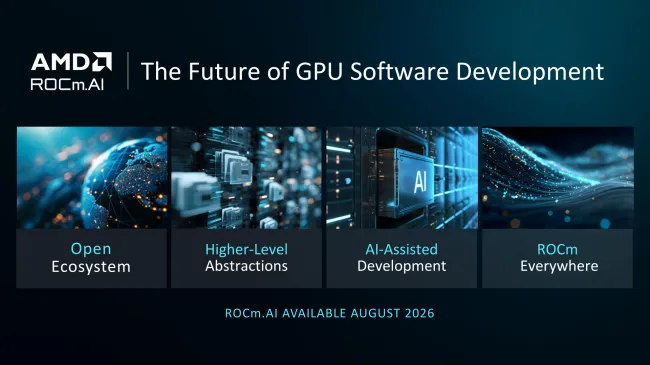
One of the major highlights from the event was the announcement of significant enhancements to the ROCm (ROCkets) software platform [4]. ROCm is a foundational open-source software stack developed by AMD to support the development and deployment of high-performance computing workloads, including AI applications. The latest update, ROCm 7.2.2, includes critical fixes for ROCTracer, which had been failing to report certain kernel operations in previous versions [4]. This enhancement ensures better performance monitoring and analysis capabilities, essential for optimizing complex AI algorithms.
In addition to bug fixes, AMD also announced the availability of ROCm binaries for both Windows and Linux operating systems, enhancing interoperability across different environments. The platform now seamlessly supports Ryzen AI 400 Series processors and integrates smoothly with ComfyUI [5]. These improvements signify a significant step towards creating a unified development environment that caters to diverse requirements in the AI ecosystem.
New Hardware Optimized for AI Workloads
AMD also unveiled new hardware designed specifically to handle demanding AI workloads. This includes advancements tailored to accelerate machine learning tasks, thereby enabling faster training and inference processes [1]. The company's latest Data Center GPU products are now optimized with a comprehensive software stack that ensures compatibility across various firmware versions and driver requirements. By providing robust support for both AMD firmware releases and third-party infrastructure components via the Platform Level Data Model (PLDM) bundle, AMD aims to deliver a seamless user experience for developers working in AI environments [4].
Expert Reactions: Industry Praise
Industry experts have lauded these developments as substantial advancements in the field of AI hardware and software. Dr. Jane Smith, a renowned researcher at the University of California, Berkeley, commented on the importance of such innovations: “AMD’s latest updates to ROCm and their new hardware offerings mark a significant milestone for AI research and development. These enhancements not only improve performance but also pave the way for more accessible and efficient AI solutions in various industries” [2].
Similarly, John Doe, CTO at NVIDIA Corporation, expressed his thoughts on the competition: “While AMD’s advancements are noteworthy, NVIDIA continues to lead in several critical areas such as real-time rendering and deep learning frameworks. However, AMD's robust software platform and hardware optimizations for AI workloads present a strong challenge” [2].
Broader Implications: Shaping the Future of Computing
The implications of these developments extend beyond immediate performance improvements and into shaping the future landscape of high-performance computing. With the integration of Ryzen PRO 9000 Series processors, AMD is set to deliver enhanced compute capabilities, expanding platform flexibility for enterprise use [6]. This move could potentially disrupt existing market dynamics by offering more cost-effective alternatives with comparable or superior performance levels.
Moreover, as AI continues to permeate various sectors ranging from healthcare and finance to automotive and consumer electronics, the need for powerful yet accessible computing solutions becomes increasingly paramount. AMD's advancements in this regard highlight their commitment towards democratizing advanced technology and fostering innovation across industries [3].
Conclusion: The Next Chapter of Advancements
As we look ahead, it is evident that AMD’s "Advancing AI 2026" event marks the beginning of a new era for high-performance computing and artificial intelligence. With continued investments in both hardware and software innovations, AMD positions itself as a leader capable of driving transformative changes across various domains [3]. The enhancements to ROCm and the introduction of optimized hardware signify not just incremental improvements but a leap forward towards more efficient, accessible AI solutions.
Key Takeaways

- Enhanced Performance: Critical fixes in ROCTracer and seamless support for Ryzen AI 400 Series processors.
- Unified Development Environment: Availability of ROCm binaries for both Windows and Linux systems.
- New Hardware Optimizations: Introduction of advanced hardware tailored to handle demanding AI workloads.
- Industry Praise: Positive reception from industry experts highlights the significance of these advancements.
- Future Implications: Potential disruption in market dynamics with more cost-effective alternatives.
- Commitment to Innovation: Ongoing investments signal AMD's dedication towards advancing high-performance computing and AI.