2026: Michigan, Minnesota and Wisconsin Primaries
The first week and a half of August 2026 delivered a political reckoning across the upper Midwest. On August 4 in Michigan and August 11 in Minnesota and Wisconsin, voters cast ballots in consequential primaries that will shape the arc of the November midterms — and, many analysts argue, the future identity of both major political parties. What emerged from the ballot boxes was not a simple ideological verdict, but a multidimensional picture of an electorate restless with the status quo, skeptical of institutional politics, and hungry for candidates who speak to economic anxieties in direct, personal terms. Progressives notched stunning upsets; establishment moderates were toppled or put on notice; Trump-endorsed Republicans posted mixed results; and a new generation of candidates broke into front-runner status. Taken together, the three states served as a proving ground — and for some, a harsh mirror — for the forces that will contest power in November.
Michigan: August 4 Primary
Michigan voted one week ahead of its neighbors, and its results landed like a political thunderclap. Two marquee races — the Democratic Senate primary and the gubernatorial contests in both parties — produced winners that confounded the established order and energized activists on the left.
Michigan U.S. Senate: Abdul El-Sayed Stuns the Establishment
The most talked-about result of primary night in Michigan was the victory of Abdul El-Sayed in the Democratic Senate primary — an outcome that Al Jazeera described as an "extraordinary win" that "stunned the pro-Israel establishment." El-Sayed, a Rhodes Scholar and former Detroit Health Commissioner, defeated incumbent-adjacent Rep. Haley Stevens, a centrist congresswoman who enjoyed the backing of the Democratic Party apparatus, prominent labor unions, and a financial machine that dwarfed El-Sayed's grassroots operation by an 8-to-1 margin. The Democratic primary for Michigan's U.S. Senate race became the most expensive Democratic Senate primary ever recorded, with total spending reaching over $80.8 million — with Stevens backed by $62 million in outside money.
El-Sayed ran on a platform rooted in economic populism: Medicare for All, Supreme Court reform, taxing billionaires, public ownership of AI systems, and a pledge to accept no corporate PAC money. His campaign, fueled almost entirely by small-dollar donations, mobilized a coalition of progressives, Arab-American and Muslim voters in Dearborn and suburban Wayne County, and younger Democrats fed up with what they saw as a party too close to corporate donors. With 95% of votes counted, El-Sayed led Stevens 735,625 to 716,222 — a narrow but definitive margin that sent shockwaves through the Democratic establishment and its donor class.
Strengths: El-Sayed's grassroots infrastructure proved it can compete with machine spending. His base was energized, diverse, and organized. His identity as a Muslim-American physician resonated powerfully in Michigan's large Arab-American communities. He also benefited from anti-establishment momentum building since earlier progressive victories in other state primaries this cycle.
Weaknesses: His fundraising disadvantage going into November remains severe. Mike Rogers, the expected Republican nominee, is a well-funded former congressman with national security credentials who will run hard in the general. Critics within the party warn that El-Sayed's progressive platform — particularly Medicare for All — may be a liability in a competitive general election where independent voters tend to be more risk-averse. Bridge Michigan called his win a "progressive shockwave," but some Democratic insiders fret that the shock may yet rebound.
Michigan Governor: Benson vs. James Set for November
Michigan's gubernatorial primaries produced two expected but symbolically rich matchups for November. On the Democratic side, Jocelyn Benson, the two-term Secretary of State, defeated Genesee County Sheriff Chris Swanson in a landslide — capturing more than 83% of the vote, with final tallies showing 1,493,709 votes. Benson, a Wellesley and Harvard Law graduate who previously served as dean of Wayne State University Law School, entered the race as the prohibitive favorite and never relinquished that standing.
Benson's tenure as Secretary of State gave her a platform and a record — she oversaw Michigan's elections with relative stability, expanded voting access, and reduced wait times at motor vehicle offices. Her campaign is built on competence, affordability, and the institutional credibility of a candidate who has survived election denial campaigns aimed directly at her office. She plans to prioritize education (targeting a top-10 national ranking for public schools), affordability reforms, and maintaining the governance stability Michiganders came to expect under outgoing Gov. Gretchen Whitmer.
On the Republican side, John James — a decorated combat veteran, Army Black Hawk helicopter pilot, businessman, and congressman for Michigan's 10th District — won the GOP nomination with 50.05% of the vote and approximately 928,983 votes, defeating self-funded businessman Perry Johnson, who claimed to have spent $30 million of his own money on the race. Trump endorsed James, and that endorsement, combined with James's own statewide name recognition from two previous Senate campaigns, proved sufficient to secure the nomination — though the relatively modest winning margin against a newcomer businessman revealed that James's support was not monolithic.
John James — Strengths and Weaknesses: James brings an exceptional biography to the race: a Black Republican veteran from Detroit is a formidable contrast to Democratic cultural messaging. He can appeal to suburban voters uncomfortable with Trump's style while still benefiting from the president's base turnout. His weakness is that Michigan has trended away from Republican gubernatorial candidates in recent cycles, and his embrace of the Trump brand could alienate the moderate suburban voters who proved decisive in 2022.
Jocelyn Benson — Strengths and Weaknesses: Benson's name recognition, institutional backing, and large financial war chest (having reserved $10 million in advertising for September and October) make her a formidable general election candidate. However, she faces the challenge of generating grassroots enthusiasm in a party whose base is increasingly energized by figures further to her left. Her candidacy also carries the weight of governing in a state with significant economic anxieties.
Minnesota: August 11 Primary
Minnesota held its primary election on August 11, and the results crystallized a Democratic Party in the midst of a generational and ideological argument about its future. Two of the state's highest-profile contests — for governor and for the U.S. Senate seat being vacated by Sen. Tina Smith — both featured pitched battles between the progressive and moderate wings of the DFL (Democratic-Farmer-Labor Party), with progressives winning the Senate race outright and the governor's race going to the establishment choice by a wide margin.
Minnesota Governor: Klobuchar and Demuth Make History
The Democratic gubernatorial primary was never truly in question. Sen. Amy Klobuchar, a three-term U.S. senator and 2020 presidential candidate, announced her run for governor after the death of Gov. Tim Walz's political ambitions at the national level, and promptly dominated the DFL primary field. Klobuchar won the nomination with approximately 89.6% of the vote — 625,985 votes counted at 11 p.m. on election night — becoming the first woman to win the DFL nomination for Minnesota governor. Her opponent, state Rep. Qualls supporter and former health executive-aligned candidate, was never competitive.
Klobuchar enters the general election as a heavy favorite, bringing her national fundraising apparatus, centrist pragmatism, and decades of Minnesota name recognition to bear. She has long cultivated an image as someone who can win in purple and red parts of a state that has not elected a Republican governor since 1978. Her candidacy is premised not on ideological transformation but on governing competence — a deliberate contrast to both the Trump era and the more leftward drift of her party's base.
On the Republican side, the primary was far more turbulent. State House Speaker Lisa Demuth defeated both MyPillow CEO Mike Lindell and former healthcare executive Kendall Qualls to claim the GOP nomination. With 93% of votes counted, Demuth secured 43.6%, Lindell came in second at 32.3%, and Qualls placed third at 21.4%.
The Lindell Factor: Lindell, a Trump ally who claimed the 2020 election was stolen and spent millions amplifying those claims, entered the race as a national spectacle. He had Donald Trump's personal backing. Yet he lost decisively — even failing to concede on election night, claiming as usual that the results were fraudulent. His defeat was widely read as evidence that Trump's endorsement, while still meaningful in some contexts, is no longer sufficient to paper over a weak candidate in a contested primary in a competitive state. The Time headline summarized it bluntly: "Mike Lindell Won't Concede to Lisa Demuth in Minnesota's Governor Primary, Where Both Donald Trump's and the GOP's Picks Lost."
Demuth's Strengths and Path Forward: Lisa Demuth, the sitting House Speaker, is a credible, institutionally experienced candidate who can appeal to Minnesota Republicans without the national baggage that Lindell carries. Her victory represents the pragmatic wing of the Minnesota GOP reasserting itself. She will face Klobuchar in November — an extremely difficult task given Klobuchar's profile, but not impossible in a midterm environment where presidential party fatigue can be a wild card. Demuth chose Ryan Wilson as her running mate.
Qualls's Significance: Kendall Qualls, a former healthcare executive and the first Black candidate to win a major-party endorsement for governor in Minnesota, ran a serious campaign on conservative economic principles and social conservatism. His 21.4% showing, while placing him third, was notable. After the primary he called for Republican unity: "If we're going to win, we got to win as a united Republican Party."
Minnesota U.S. Senate: Flanagan vs. Tafoya — An Unlikely November Showdown
The contest for Tina Smith's open Senate seat became the night's most ideologically charged Democratic primary. Lt. Gov. Peggy Flanagan, a progressive endorsed by Sens. Bernie Sanders and Elizabeth Warren, defeated centrist Rep. Angie Craig with 58.8% of the vote to secure the DFL nomination. Flanagan's victory was celebrated by the progressive left as a confirmation that the anti-establishment energy visible in Michigan was not an aberration — it was a regional wave.
Flanagan, who is Ojibwe and would become the first Native American woman elected to the U.S. Senate, ran on a platform of taxing the wealthy, expanding healthcare access, and standing firmly against Trump's immigration enforcement agenda. Her victory over Craig — a careful, pragmatic House member who represented competitive suburban terrain — signaled that DFL primary voters this cycle are demanding a bolder posture, not a safer one.
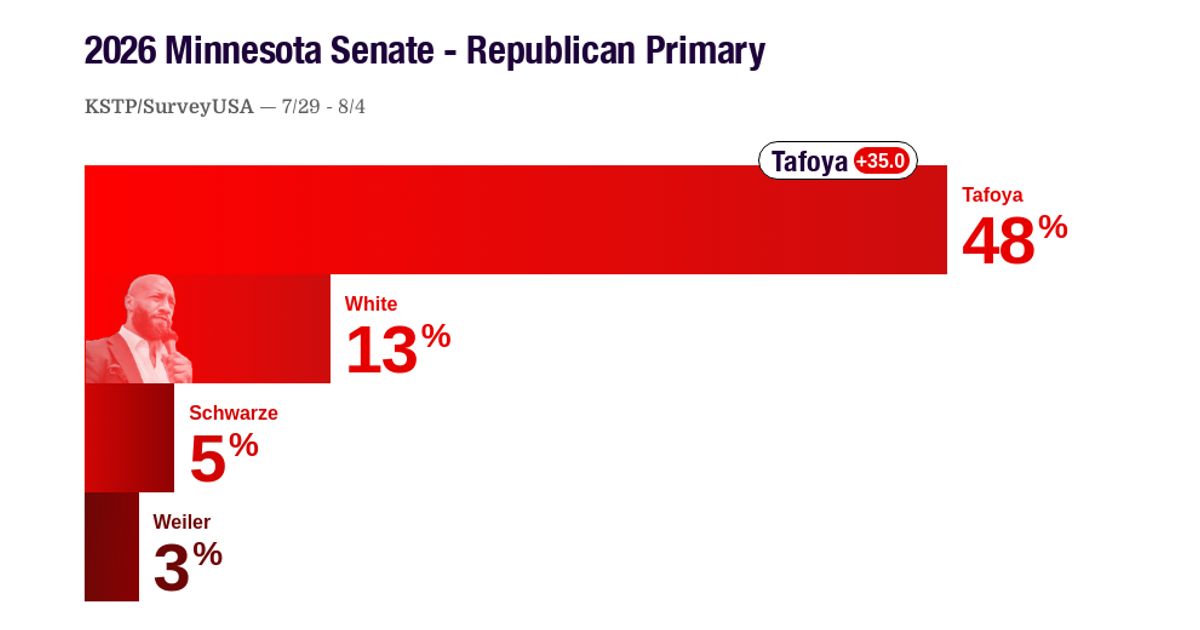
Republican winner Michele Tafoya presents one of the most distinctive nominees of the 2026 cycle anywhere in the country. A former NBC Sports sideline reporter best known for her 17 years on Sunday Night Football and Monday Night Football, Tafoya had pivoted to conservative commentary in recent years, appearing frequently on Fox News and hosting a political podcast before announcing her Senate run. She defeated Adam Schwarze, a Marine veteran and Navy SEAL, and former NBA player and MAGA-aligned candidate Royce White, tallying more than 52% of the vote — despite losing the formal Minnesota Republican Party endorsement to another candidate before the primary.
Tafoya's campaign platform centers on law enforcement support, opposing transgender women competing in women's sports, cutting taxes for the middle class, and bringing "courage and common sense" back to government. Her name recognition from decades of national television coverage — and a significant fundraising advantage over her primary rivals — carried her to the nomination.
Flanagan's strengths include a compelling personal story, genuine enthusiasm among the progressive base, and the structural advantage that Democrats hold in Minnesota Senate elections. Her vulnerabilities center on the November battlefield: Minnesota is competitive, and a Flanagan-Tafoya matchup is ideologically extreme on both ends, which could energize partisan turnout on both sides while making persuadable suburban voters the deciding factor.
Tafoya's strengths include celebrity name recognition and the ability to raise funds from a national conservative donor network. Her weaknesses are her thin governing record, the novelty of her political identity, and the challenge of winning statewide in Minnesota — where no Republican has won a U.S. Senate seat since 1978.
Wisconsin: August 11 Primary
Wisconsin's primary — held the same day as Minnesota's — delivered a photo-finish Democratic governor's race and handed Trump's man an uncontested path to the gubernatorial nomination, while also confirming a mixed picture of progressive power in the state.
Wisconsin Governor: Crowley Edges Hong in Historic Democratic Primary
The most tightly contested race of primary night across all three states was the Wisconsin Democratic gubernatorial primary, where Milwaukee County Executive David Crowley narrowly defeated democratic socialist state Rep. Francesca Hong in a race that was not called until well past midnight. With 86% of votes counted, Crowley led with 281,881 votes (40.0%) to Hong's 279,267 (39.6%) — a margin of roughly 2,600 votes. By final count, Crowley prevailed.
The race had consumed the political left's attention for months. Hong, a 37-year-old DSA (Democratic Socialists of America) member, former dishwasher and executive chef who ran her own restaurant in Madison before becoming a state assemblywoman, had led polls in the crowded field throughout much of the primary season. Backed by national progressive infrastructure and an army of volunteers, she carried the banner of the democratic socialist movement into a statewide race in a perennial presidential battleground — something the movement had not done before at the gubernatorial level. Outgoing Gov. Tony Evers declined to endorse but made clear his preference for the more moderate Crowley.
Francesca Hong — Profile and Analysis: Hong's campaign was built on a radical-honesty platform that excited the left and alarmed the center. She had previously called to "defund and abolish the police," stated her "perfect world would be a world without prisons," and had written in 2021 that she would like to "abolish the Senate." At the race's only debate, she walked back her police defunding stance — but the repositioning was awkward and gave Crowley's camp ammunition to portray her as politically unsteady. Her working-class biography was genuine and arresting: Fortune profiled her as "the 37-year-old single mother and former line cook rattling Democratic moderates in Wisconsin." But the biography couldn't fully override concerns among pragmatic Democrats that her statewide viability in November against a Trump-backed Republican was unproven. She came breathtakingly close.
David Crowley — Profile and Analysis: Crowley, born in Milwaukee in 1986, became Milwaukee County's seventh executive in May 2020 — its first Black executive and its youngest. He served in the Wisconsin State Assembly before winning the executive seat. As county executive, his record includes fighting the opioid crisis, expanding affordable housing, and reducing carbon emissions. His "reboot campaign" for governor, as Wisconsin Public Radio described it, was explicitly framed around electability: his argument was that a progressive reformer with executive experience and institutional support from the Evers coalition could win the general election in a way Hong could not. He is positioned to become Wisconsin's first Black governor. His weakness: an extremely thin margin of victory in the primary that suggests his coalition within the Democratic Party is divided. He will need Hong's supporters, and some may not follow.
Tom Tiffany — GOP Nominee: Republican Rep. Tom Tiffany, a Trump-endorsed U.S. congressman from northwestern Wisconsin, cruised to the GOP nomination against minimal opposition, defeating political outsider Andy Manske in a landslide. Tiffany is a reliable conservative aligned with Trump's populist-nationalist agenda, and his path to the nomination was never in doubt. His path to the general election — against a relatively moderate Crowley — is more competitive. Wisconsin is a genuine battleground, having narrowly decided the 2020 and 2024 presidential elections.
Wisconsin Congressional Races
Wisconsin's congressional primaries produced several results worth noting. Rep. Mark Pocan, a veteran progressive from Madison's 2nd Congressional District, easily defeated primary challenger Douglas Alexander. With no Republican on the November ballot, his primary win effectively guarantees his return to Washington. In Wisconsin's 1st Congressional District — the seat held by Republican Rep. Bryan Steil — Mitchell Berman won the Democratic primary and will face Steil in what is expected to be a difficult November race for Democrats. In the 7th Congressional District, Michael Alfonso won the Republican nomination, pledging to work with Trump on extending the tax cuts and holding the line against Democratic spending.
Voter Sentiment: What the Primaries Revealed

Taken together, the August 4 and August 11 primaries across Michigan, Minnesota, and Wisconsin told a coherent story about the current state of the American electorate — or at least its most engaged primary-voting segment.
Progressive Energy Is Real — and Has Limits
The primary season produced genuine progressive victories that cannot be dismissed as fringe results. Abdul El-Sayed's Senate primary win in Michigan — against an 8-to-1 spending deficit — is perhaps the most striking demonstration that grassroots organizing, digital fundraising, and community-level mobilization can overcome traditional political money. Peggy Flanagan's Senate primary win in Minnesota similarly confirms that DFL primary voters are moving left. And Francesca Hong's near-miss in Wisconsin shows that democratic socialists can compete — even statewide — in ways that would have been unimaginable a decade ago.
Yet the limits are visible too. Hong ultimately lost. Crowley's more cautious politics, backed by the Evers coalition, survived — barely, but it survived. In Minnesota, the governor's race was not competitive; Amy Klobuchar sailed through with nearly 90% of the DFL vote, suggesting that at the gubernatorial level, where general-election viability looms larger in voters' minds, the appetite for ideological experimentation is more constrained.
Trump's Endorsement Is Potent but Not Omnipotent
On the Republican side, the primary results offered a nuanced portrait of Trump's continued influence. His endorsement of John James in Michigan proved decisive in a contested field. His backing of Tom Tiffany in Wisconsin produced an easy win — though Tiffany had establishment credibility and faced weak opposition. But in Minnesota, his endorsement of Mike Lindell crashed badly, with Lindell finishing a distant second to Lisa Demuth at 32.3% to her 43.6%. The Time headline made the political stakes explicit: Trump's pick lost because Lindell, whatever Trump's backing, is not a credible candidate in a competitive statewide election. NPR's analysis noted that Trump's "endorsement power was mixed" across the August primaries, "with his approval at a second-term low."
Anti-Establishment Anger Is the Unifying Thread
Perhaps the single most consistent signal across both parties and all three states is voter frustration with institutional politics. El-Sayed explicitly campaigned against the party establishment that spent $62 million to stop him. Hong mobilized around a rejection of the mainstream Democratic Party's post-2020 moderation. Lindell's core appeal, however ultimately unsuccessful, was to voters who see conventional Republican politics as a failed project. Lisa Demuth won in Minnesota by offering establishment competence — but only after the party-endorsed candidate was swept aside in favor of a candidate with stronger grassroots infrastructure.
NPR's four takeaways from the August 12 primaries across six states framed this succinctly: voters in Democratic primaries signaled "a desire for generational change" and "a harder line against President Trump's immigration crackdown," while on the Republican side, the August nights "tested how far Trump's endorsement still carries."
Economic Anxiety as the Connective Tissue
Across party lines, the candidates who gained traction — El-Sayed with his Medicare-for-All and tax-the-wealthy populism, Hong with her working-class personal narrative, Crowley with his county-level record on affordable housing and opioid response, Benson with her affordability platform — shared a common orientation toward economic pain as the dominant political reality. Michigan, Minnesota, and Wisconsin are manufacturing and agricultural states where the cost of living, healthcare, housing, and industrial competitiveness are lived realities for millions of voters, not abstract policy arguments. Candidates who could speak to those realities in personal, concrete terms outperformed those who could not.
November Matchups at a Glance
| State | Race | Democrat | Republican |
|---|---|---|---|
| Michigan | Governor | Jocelyn Benson | John James |
| Michigan | U.S. Senate | Abdul El-Sayed | Mike Rogers |
| Minnesota | Governor | Amy Klobuchar | Lisa Demuth |
| Minnesota | U.S. Senate | Peggy Flanagan | Michele Tafoya |
| Wisconsin | Governor | David Crowley | Tom Tiffany |
Conclusion
The August 2026 primaries in Michigan, Minnesota, and Wisconsin produced results that neither fully confirm nor refute the dominant political narratives of the Trump era. What they do confirm is that both major parties are in the midst of contested identity processes — and that the voters most willing to show up in August primaries are the ones demanding transformation, not consolidation. Progressive insurgents won some fights and nearly won others. Trump's orbit produced some winners and some embarrassing losses. And across all three states, the candidates who captured something authentic — a real biography, a clear economic argument, an honest reckoning with what voters are angry about — outperformed the candidates who relied on institutional support, big money, or borrowed celebrity alone. November will test whether those primary-night energies can be sustained, broadened, and converted into governing majorities in the perennial battleground of the upper Midwest.
Sources:
- Michigan governor's race enters general election after Benson, James primary wins - ClickOnDetroit
- Michigan Senate primary election results 2026: Abdul El-Sayed defeats Haley Stevens - The Washington Post
- How Abdul El-Sayed's 'extraordinary' win stunned pro-Israel establishment - Al Jazeera
- Abdul El-Sayed wins Michigan Senate primary in progressive 'shockwave' - Bridge Michigan
- John James wins Republican primary for Michigan governor over Perry Johnson - Bridge Michigan
- Trump-backed John James wins Michigan's GOP primary for governor - NBC News
- Jocelyn Benson wins Michigan Democratic governor primary - Detroit News
- Amy Klobuchar wins DFL primary for Minnesota governor - Star Tribune
- Minnesota governor primary results: Amy Klobuchar, Lisa Demuth advance - NewsNation
- Mike Lindell Won't Concede to Lisa Demuth in Minnesota's Governor Primary - Time
- Progressive Lt. Gov. Peggy Flanagan wins Minnesota Democratic Senate primary - NBC News
- Flanagan wins DFL duel in Senate race, Tafoya claims GOP nod for open seat - MPR News
- Ex-NFL reporter Michele Tafoya wins GOP Senate primary in Minn. - ESPN
- David Crowley wins Democratic primary for Wisconsin governor over Francesca Hong - PBS NewsHour
- In Wisconsin, David Crowley defeats Francesca Hong in Democratic primary for governor - NPR
- Crowley wins Wisconsin's 2026 Democratic primary for governor in a photo finish - PBS Wisconsin
- Can DSA's Francesca Hong Win in Cheese Country? - The American Prospect
- Francesca Hong recalibrates her democratic socialist message as Wisconsin's primary nears - NBC News
- Four takeaways from Tuesday's primaries in six states - NPR
- In Minnesota and Wisconsin, competitive primaries will again test power of progressive candidates - NPR
- Democrats clash again in Minnesota and Wisconsin primaries as big midterm races take shape - CNBC
- Mainstream Democrats pin hopes on David Crowley's reboot campaign for governor - WPR
- Minnesota Primary Election Results — August 12, 2026 - Faegre Drinker
- Wisconsin congressional primaries set stage for November - WPR